


Javier Rueda champions bars in a book: "They are a sign of life"
The author from Malaga publishes 'Utopías de barra de bar', an essay in which he defends the importance of these spaces for the community, especially in the rural world.
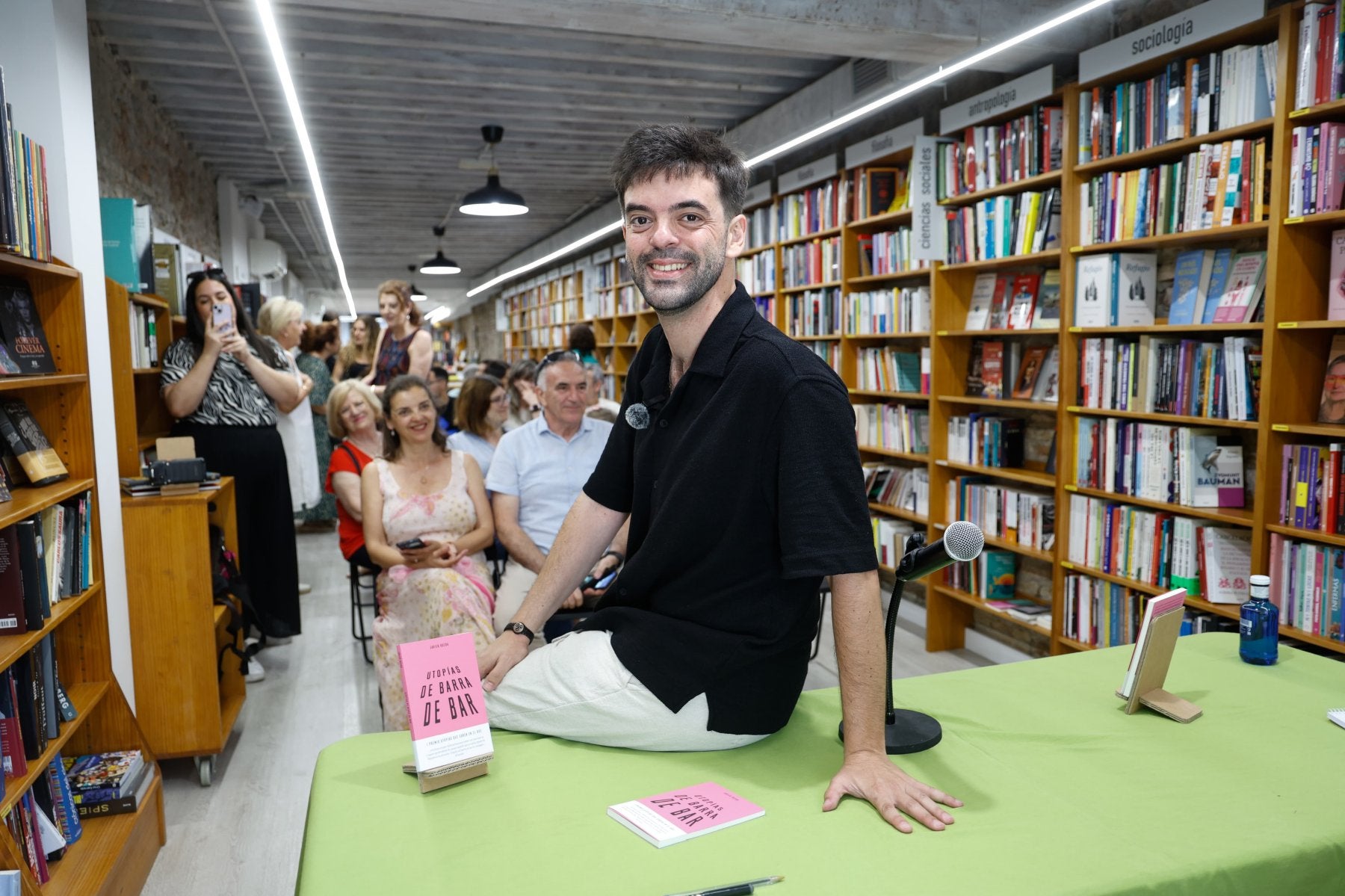

Something as simple and, at times, as ordinary as a bar counter. Javier Rueda, a sociologist and political scientist, goes beyond. "So many bars that we have in Spain and nobody had researched them before," he begins his presentation of his book: 'Bar Counter Utopias', with which he has just won the 'First Utopias Essay Prize that fit in the BOE', organized by Lengua de Trapo and the Círculo de Bellas Artes.
A warm murmur runs through the Luces bookstore in Málaga. It seems that almost everyone knows the writer well and holds him dear. Most hold the pink book, as big as the palm of a hand, but with the weight of a thesis and several years of research. With a critical and human approach, the author explores the symbolic and functional value of these establishments, moving away from a superficial view.
For Rueda, a bar, especially in small towns, is a place of meeting and leisure, but it is also a trench in the fight against homogenization and a chance to feel uncomfortable and debate. In his view, they are places where people of different social classes and ideologies meet, talk, drink, argue, and most importantly, exchange ideas. "Democracy is not an abstract concept and these spaces help to develop it." What does a bar give us that no other place does? What is really lost when the last bar in a town closes? "The bar is a sign of life," explains the writer. "And if you ask me if I drank a lot during the research, indeed," he jokes.
For older people who live alone, these places are their social refuge. Javier Rueda tells a story from one of the bars he visited: "A man who went daily to his trusted tavern, one day did not show up. Everyone immediately noticed, went to his house and, indeed, he had passed away." If it weren't for this routine, perhaps they wouldn't have realized so quickly.
Link between customers
Rueda does not idealize. He recognizes that he likes the bars he finds less and less. He believes they open and close and do not allow creating a bond between customers. They don't let them take root. "I like the bars in small towns, those where you meet people who think like you and people who don't, but you are forced to see them," he confesses. More franchise venues are opening and the lifelong ones are closing. In the former, they do not know your name, nor what you usually order. The latter are imperfect places but maintain the essence of the human and the social.
The man from Málaga recalls his adventures in the interior of the country and remembers a conversation he had with people at a bar in Cuenca while having some beers. They talked about rural depopulation. "From a young age, we tell children to leave here, to look for a future elsewhere. First, we have to believe in the opportunities in the towns, but they also have to believe us. We are partly to blame for this depopulation, but by no means entirely," debated some people, of course, at the bar counter.

Latest news





Upcoming events
12
Nov
El Desembarco, la traición de Viriato at La Caja Blanca
12
Nov
HOMER El Mero Mero at Sala Trinchera Málaga
13
Nov
Marbella Startup Lab – Innovate & Collaborate
13
Nov
Candlelight: Coldplay & Imagine Dragons at Sala Fundación Unicaja María Cristina
13
Nov
Candlelight: Tribute to Ludovico Einaudi at Anantara Villa Padierna
Similar News

Málaga Airport Makes History with More Than Three Million Passengers in One Month
Málaga

Port of Málaga looks beyond its docks to support future growth
Málaga

Guide to the Virgen del Carmen Processions in Málaga and the Province
Málaga
