Javier de Juan, the infinite cartoonist
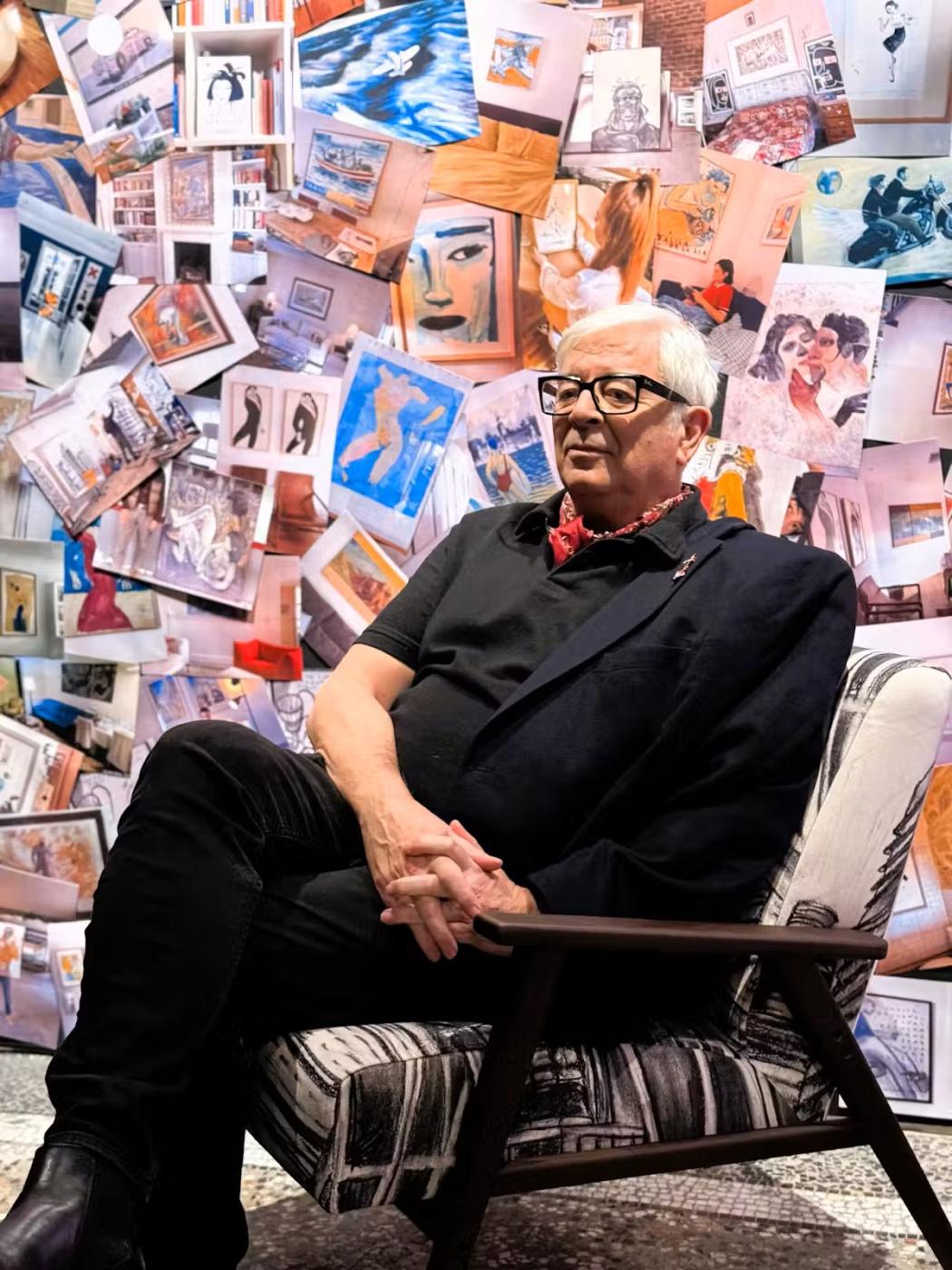

Seeing the mastery with which Javier de Juan draws on any type of surface is hypnotic. He is an artist with a masterful ‘hand’, selected by nature to be able to transform a sheet of paper into anything his imagination desires.
A white-haired man sitting in a chair with the wall behind him covered in drawings.

Javier de Juan at the exhibition. Museum of Decorative Arts
It is therefore not surprising that he is the subject of an exhibition at the National Museum of Decorative Arts in Madrid, which is open until October.
Talking to fellow professionals, we all came to the conclusion that skilled drawing is achieved through continuous effort. Javier de Juan has been sitting down every day for more than 50 years and it shows.
Born in Jaén and adopted by Madrid, he is capable of constructing visual stories populated by human beings who interact with each other while being observed and, in turn, observing the universe around them. He is a figurative artist who, through a wide variety of techniques, represents the people of his time.
In his early days, he was one of the leading figures who transferred what was happening in the exuberant Madrid of the Movida Madrileña to painting, drawing and engraving. He has subsequently developed his own imagery, notable for its representation of the human body, the precision of the drawing, the colour, the narrative force and the technical innovation.
Art theorist and novelist John Berger commented that ‘in teaching drawing, it is commonplace to say that the fundamental thing is the specific process of looking. A line, an area of colour, is not really important because it records what one has seen, but because of what it will lead one to continue seeing’. Juan looks, and from that gaze comes his ability to recreate urban spaces from memory in great detail.
A multidisciplinary artist
The artist and professor Marián Cao quotes the French philosopher Jean-Luc Nancy when she writes that ‘drawing is defined by the movement of the line - whether with a pencil or the body itself through space - which produces a rhythm and generates that pleasure without object, that endless purpose, which defines all aesthetic experience’.
Looking at Javier de Juan's works, we can perceive that ‘pleasure without object and that endless purpose’, qualities that have led him to develop purely artistic projects as well as commissioned graphic creations and illustrations. His figure resembles that of the French creators of the late 19th century.

Poster showing a woman dancing the cancan while shadowy men watch her.
Poster by Toulouse Lautrec for the Parisian cabaret Moulin Rouge. Wikimedia Commons
Nineteenth-century France rediscovered drawing, stripped it of its function as a medium and turned it into an end in itself, capable of being exhibited in a gallery alongside paintings and sculptures. This was the case with creators such as Ingres, Daumier, Manet, Cassat, Lautrec, Valedon and others who would come later, such as Picasso and Mallo.
Many of the post-impressionists were able to paint memorable pictures and invent two new languages at the same time: graphic design and advertising. Figures as relevant today as Toulouse-Lautrec earned their living with wonderful advertising posters for cafés, theatres and cabarets that now hang in major international museums.
If, to quote John Berger again, ‘for the artist, to draw is to discover’, De Juan is a tireless explorer. This multidisciplinary artist has worked as a poster and logo designer, book illustrator, draughtsman, painter, sculptor and audiovisual creator, and is always eager to discover new technologies.
In this exhibition, we can see a large sculpture made using layers on a CNC (a milling machine used for furniture manufacturing and prototyping), or heads recreated in 3D and printed from blocks that are linked together.

People on bicycles, motorcycles, in cars, on buses in front of a Madrid metro stop and in front of the Picasso Towers.
Poster by Javier de Juan for the EMT in 2023. Museum of Decorative Arts
Javier de Juan's works speak about us, humans, and represent us. They combine images with texts that offer different readings or points of view and connect him to the Greco-Roman tradition and his predilection for visual narrative.
This can be seen in the 45-metre mural he created for Terminal 1 of Adolfo Suárez-Madrid-Barajas Airport, in his recent posters for the Madrid Municipal Transport Company (EMT) and in his interpretation of Madrid in his 2024 exhibition at the Conde Duque.
Prussian blue
Every artist ends up acquiring a colour palette that becomes their own. In the case of Javier de Juan, his illustrations inspired by Lorca's works, Sonetos del amor oscuro and El Divan de Tamarit, are made with coffee and Prussian blue, a shade he speaks of with passion.
Read more: Prussian blue, the Nazi extermination camps and “The Great Wave off Kanagawa”
It is a dark blue, almost black, also called Berlin blue because it was discovered by a German chemist in the 18th century. Iron ferrocyanide, the compound that produces it, changed the meaning of art and revived the woodblock printing industry, spreading works such as Hokusai's famous The Great Wave off Kanagawa, which had such an influence on the post-impressionists we mentioned earlier. One of its members, Vincent Van Gogh, used Prussian blue in his famous painting The Starry Night.
For Javier de Juan, not all Prussian blues are the same. Aware of the value of his work, he only uses one made in Holland, the land of Van Gogh.
Stomping
Drawing of a man walking under a phrase that says “Stomping”.

Cover of Madriz magazine: “Pisando fuerte”, according to Javier de Juan. Museum of Decorative Arts
Artists' studios are magical places where time stands still, cabinets of curiosities overflowing with pieces that take us back to different moments in the past and present.
In his studio, I was able to see the first sketches of the legendary Madriz magazine, a graphic reference point for the Madrid scene. On the cover, on display in the exhibition, a walker strides energetically forward beneath the text “Pisando Fuerte” (Stepping Strong). This is how Javier de Juan has moved forward throughout his career.
Contemplating the magnificent exhibition at the National Museum of Decorative Arts, I imagine that the experience of seeing his work must be as overwhelming (and rewarding) as watching life pass by in a second.

Cláusula de Divulgación
Juan Carlos Gauli Pérez no recibe salario, ni ejerce labores de consultoría, ni posee acciones, ni recibe financiación de ninguna compañía u organización que pueda obtener beneficio de este artículo, y ha declarado carecer de vínculos relevantes más allá del cargo académico citado.

Latest news





Upcoming events
12
Nov
El Desembarco, la traición de Viriato at La Caja Blanca
12
Nov
HOMER El Mero Mero at Sala Trinchera Málaga
13
Nov
Marbella Startup Lab – Innovate & Collaborate
13
Nov
Candlelight: Coldplay & Imagine Dragons at Sala Fundación Unicaja María Cristina
13
Nov
Candlelight: Tribute to Ludovico Einaudi at Anantara Villa Padierna