


'Magnanimity', the New Unwritten Rule of World Chess
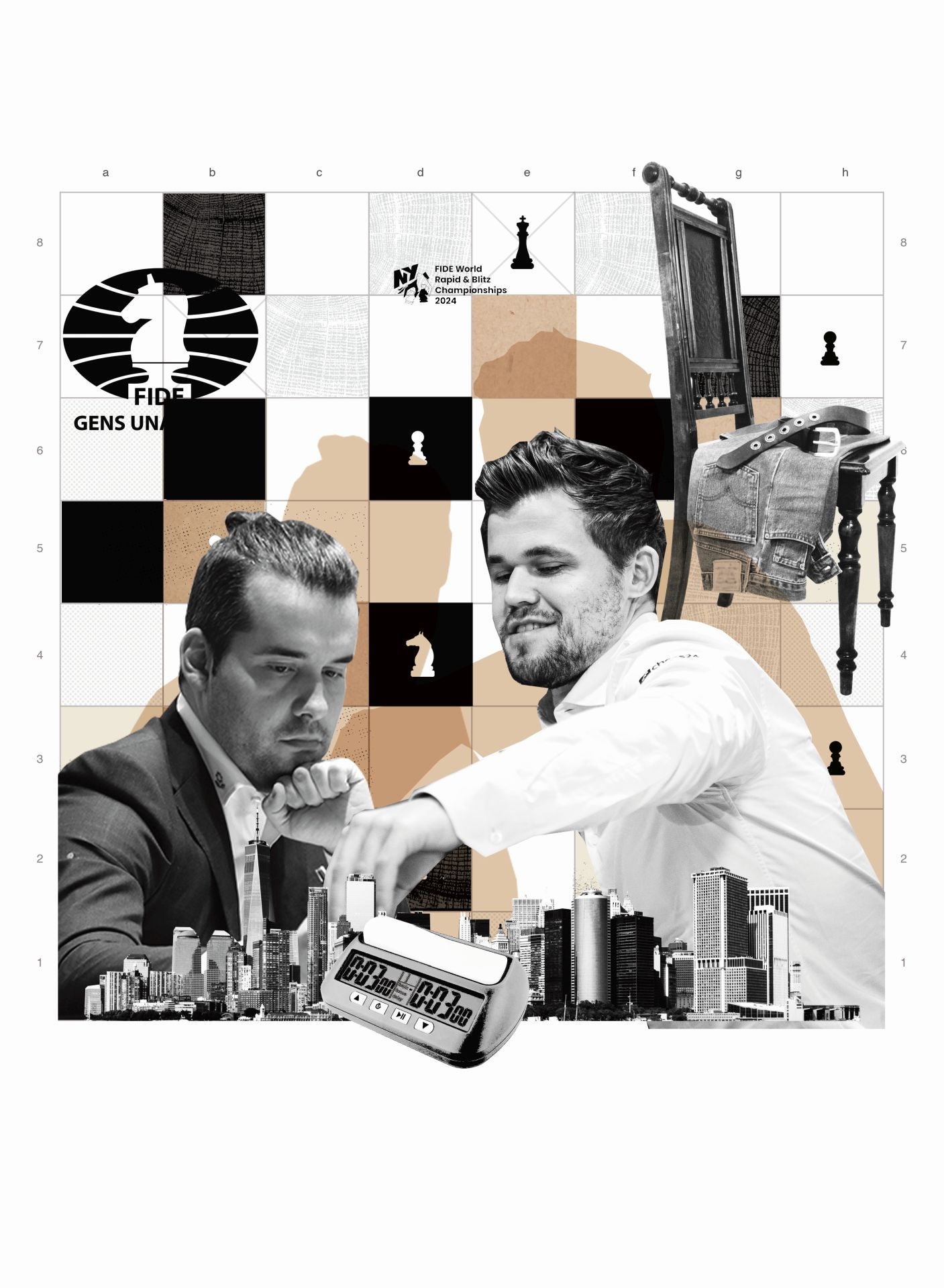

Recently, the history of chess seems to have been written by a Hollywood screenwriter. A ruthless screenwriter who strives to create and fuel one controversy after another, to fan the flames of old or new grudges, and to sow confusion, if not anger, among fans and chess players. The latest jolt or plot twist occurred in New York, in the heart of Wall Street, during the World Rapid and Blitz Chess Championship. In just one week, we have witnessed a carousel of cross tensions more typical of a farce than a sporting event. Indeed, from the point of view of spectacle, it has been unparalleled. Pure adrenaline. And I must emphasize in bold that this is both "on and off the board." Especially off, where the Norwegian Magnus Carlsen, the best chess player on the planet, has played the most controversial role of his career. A role with a happy ending, like something out of a movie, as I will tell you later.
The World Rapid Chess Championship (15 minutes for each side, plus 10 seconds increment per move) brought us a pleasant surprise. Let me set the scene. In 2019, this same tournament in New York was held at the Luzhniki Stadium in Moscow, home of the Spartak football team. The very young Volodar Murzin was then 13 years old, but despite his youth, he was considered a firm promise of Russian chess. In the eighth round of the Blitz format (known in the jargon as "lightning chess," where each player has 3 minutes with a 2-second increment), Murzin lost against the Serbian grandmaster Milos Perunovic. The boy shook hands with his opponent and burst into tears. Sobbing, he placed each of the pieces on their respective starting squares. Then he covered his face with his hands and remained seated for more than three minutes, his face veiled and his heart shrunk. The video of the distraught Murzin went viral among the global chess community. Poor kid, we all thought, he will lose many more games.
What no one expected was that, five years later, he would be crowned in New York as the best in rapid chess. The kid started at position 59 in the initial ranking, so he was far from being among the favorites. But Murzin not only finished the competition undefeated, but with sublime play, he made rivals of the caliber of Fabiano Caruana (2nd in the world), Hikaru Nakamura (3rd), Jan-Krysztof Duda (15th), and the Indian genius Rameshbabu Praggnanandhaa (13th) bite the dust. After his prodigious victory, Murzin confessed to the media: "Of course I came to win, but... I hope this is not a dream!" Remember his name: Volodar Murzin, the miracle boy.
While Murzin was astonishing everyone (he's only 18), the tournament's refereeing team had focused on Magnus Carlsen, but not on what was happening in his games, the crux was the Norwegian's jeans! The dossier that collects the tournament's dress code (and which all players knew before participating) stated explicitly: "Avoid unprofessional attire. Generally, jeans are not considered business attire." According to the rules, Carlsen was warned and fined $200. Magnus agreed to change clothes the next day, but the chief referee insisted that he had to do it immediately or he would not be paired in the next round. Thus, Carlsen stormed out of the playing hall like a basilisk.
The anger and mythical lizard venom were taken by the Norwegian to the interview he gave, in the heat of the moment, to 'Take take take', a platform he owns: "FIDE can enforce its rules. That's fine by me. My response in that case is that I'm leaving, fuck them." A real declaration of war, an intermediate move that put FIDE president, the Russian Arkady Dvorkovich, in check and announced, de facto, the worst possible news: the blitz world championship phase, just a few hours from starting, would be held without the Norwegian.
It was Dvorkovich's moment. For someone who was an economic advisor to Vladimir Putin, Carlsen's pants issue must seem like a farce. The man entered the scene, talked to Magnus' father, asked the refereeing team for flexibility in applying the dress code, and elegantly solved the problem. Meanwhile, the Dutch clothing brand G-Star signed a contract with Carlsen, making him the face of their ads in 2025. Crazy. As a finishing touch, Magnus made his participation in the Blitz phase of the championship official. Of course, he warned that he would do it, how else, in jeans.
The Armenian Karen Grigorian has been one of the great revelations of the New York event. He finished 9th, tied with the 4th place, in the rapid category. Since 2021, Grigorian plays at the Benalmádena Chess Club. I ask him about the "jeans case" and his answer is clear: "I think Carlsen is bored and wanted to show FIDE that he can do whatever he wants. In reality, he wanted to prove that FIDE has no power. And he did."
As mentioned, Carlsen attended the blitz phase. After thirteen thrilling rounds, the top eight qualifiers moved on to the knockout stage. And providence (or the ruthless screenwriter) wanted that, in the quarterfinals, Magnus had to face the American Hans Niemann, with whom he has had a frontal hate relationship since 2022. At the Sinquefield Cup that year, Carlsen lost a game against Niemann, whom he accused, without providing any proof, of having cheated. In New York, Niemann took the lead in the score, but the Norwegian pulled from pride and won the decisive game. Immediately after winning, Carlsen grabbed a few pieces and, instead of placing them gently, slammed them into the center of the board. Thor's hammer echoed loudly in the playing hall.
In the semifinals, Carlsen easily defeated the Polish Jan-Krysztof Duda (3-0). In the grand final, he faced the Russian Ian Nepomniachtchi. After a tie (2-2) in the first four games, Carlsen and Nepomniachtchi reached the 'tie-break'. The tournament regulations required that they continue playing until there was a winner. But in the tie-break, nothing changed: draws, draws, and more draws. At that point, Carlsen offered Nepomniachtchi to share the champion's trophy. The Russian thought it was a good idea, and they talked to the refereeing team: "We agree to share the title." The organization, led by Dvorkovich, had to study the unusual proposal. While waiting to know the decision, a camera captured what Carlsen, laughing, said to his friend Nepo: "If they refuse [to give us the trophy to both], we could keep making draws until they get tired." Finally, FIDE accepted the proposal and the scandal broke out.
Defenders of the measure (there are very few in the professional chess world) speak of an act of magnanimity or extreme generosity. I prefer to coin the term 'magnusnimity', a sort of new unwritten rule that seems to be imposed in the world of chess, not only in New York. To justify FIDE's decision and, incidentally, to present the gesture of Carlsen and Nepomniachtchi from the noble framework of Olympism, the example of what happened at the Tokyo 2020 Olympics is often cited, where the Qatari Mutaz Essa Barshim and the Italian Gianmarco Tamberi shared the Olympic gold in high jump.
The writer and journalist Martí Perarnau was a professional high jumper. As the Spanish champion (national record in all categories) he participated in the Moscow 1980 Olympics. I contact Perarnau to contextualize the comparison between what happened in New York and the Tokyo 2020 case. "The athletics regulations, just like in chess, say that there has to be a winner. That's why there is a tie-breaking system where each jumper has a single attempt at each height. The bar goes up or down depending on whether the two succeed or fail." Martí recalls: "I had three tie-breaks in my life. And they are harrowing moments. Sudden death every time you jump." Regarding the shared gold between Barshim and Tamberi, Perarnau is emphatic: "I thought it was horrible. And I was surprised by the goodness that then ran through the world of sports, starting with the journalists who told the scene as an example of sportsmanship. For me, it was the opposite. Just think of a Champions League final where the two teams, after playing extra time, agreed not to shoot the penalty shootout. Two trophies would have to be awarded, right? In my opinion, that's exactly what happened with Carlsen and Nepomniachtchi. I consider it an unsporting gesture."
Just after the news of Carlsen and Nepomniachtchi became known, the photographer and journalist David Llada posted on his X account (formerly Twitter) an image of the former world champion Garry Kasparov, in which the Ogre of Baku, straining, appears doing pull-ups in what seems to be a home gym. Llada wrote: "This champion would never have shared a title. I assure you." Kasparov took the bait and retweeted Llada's publication with a lapidary phrase: "There were some exceptions, no doubt, but yes, teach your children to share their toys, not their trophies."
Once crowned co-champion of the Blitz World, Magnus Carlsen still had an ace up his sleeve, a sealed move that almost no one knew: the happy ending I promised you. The Norwegian married his girlfriend Ella Victoria Malone in the Holmenkollen Chapel in Oslo. And, as you can imagine, he did not wear jeans.

Latest news





Upcoming events
12
Nov
El Desembarco, la traición de Viriato at La Caja Blanca
12
Nov
HOMER El Mero Mero at Sala Trinchera Málaga
13
Nov
Marbella Startup Lab – Innovate & Collaborate
13
Nov
Candlelight: Coldplay & Imagine Dragons at Sala Fundación Unicaja María Cristina
13
Nov
Candlelight: Tribute to Ludovico Einaudi at Anantara Villa Padierna
Similar News

Málaga Airport Makes History with More Than Three Million Passengers in One Month
Málaga

Port of Málaga looks beyond its docks to support future growth
Málaga

Guide to the Virgen del Carmen Processions in Málaga and the Province
Málaga
