


Tuk Tuk: the sustainable vehicle to explore Mijas Pueblo, an alternative to donkey taxis
They are electric, have a capacity for six people, and offer guided tours of 8 kilometers.
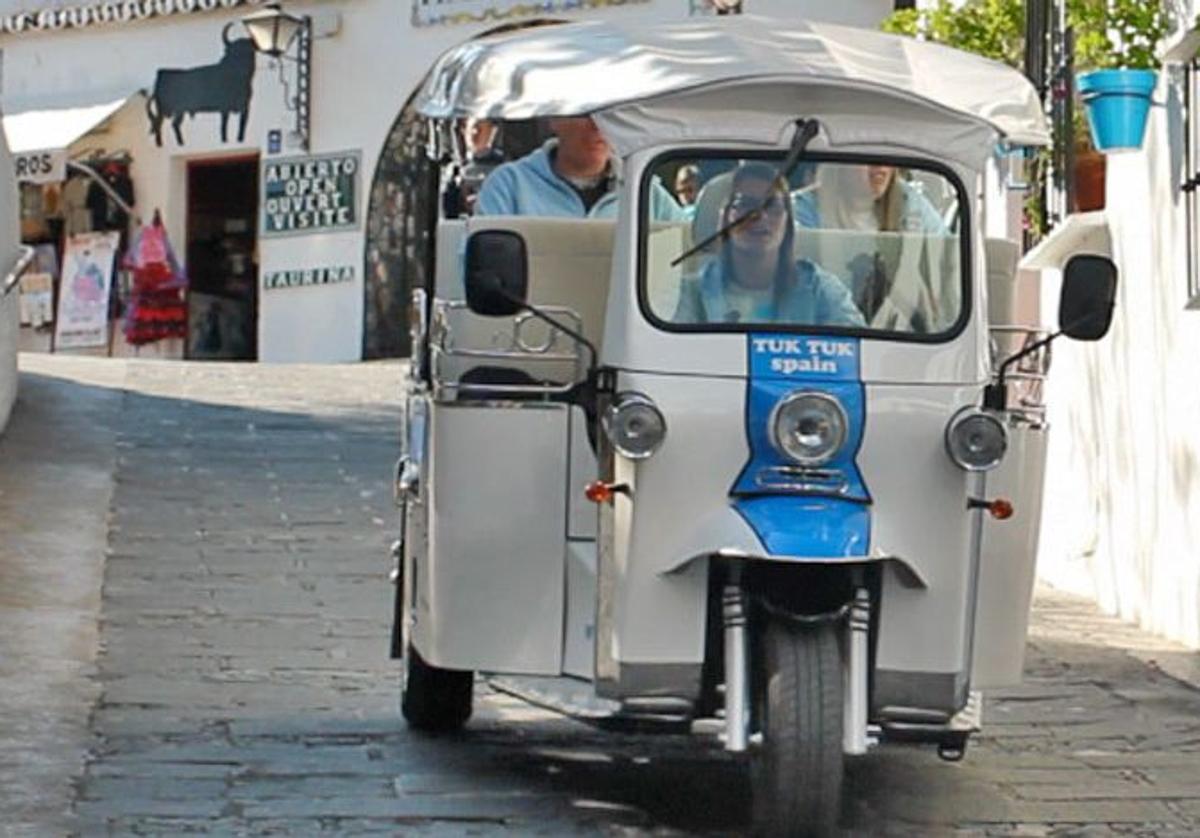

They have been operating for a decade, but without making much noise. Literally, because they are electric. Metaphorically, because their owners have shied away from rivalry and controversy with donkey taxis and horse-drawn carriages, the traditional modes of transport most associated with Mijas Pueblo.
Rudi van der Zalm, a Dutchman who has lived in this town for over thirty years, was persuaded by the project his daughter Miriam presented to him more than a decade ago. "One night she brought me all the calculations to prove that it was profitable," explains this tourism industry entrepreneur. This was the genesis of Tuk Tuk Spain, which currently has two electric vehicles, each with a capacity for six people (plus the driver), offering guided tours around Mijas Pueblo. These types of vehicles are very popular in the Netherlands, where they originated, but only operate for a few months. The climate of the Costa del Sol allows them to operate almost all year round.
Unlike donkey taxis or horse-drawn carriages, which only move in the flattest part of the urban core, Tuk Tuk Spain's vehicles can travel to many more places. In fact, in the most complete of the two options they offer their clients, they cover up to 8 kilometers. They even reach the lookout point next to the bypass road, from where you get the best view of Mijas Pueblo, lying at your feet, with the Mediterranean as a backdrop. Some customers even repeat the experience. "One client has hired it ten times to take the tour with his family and friends," says Rudi van der Zalm.
The guided tours include the main attractions of this town, protected as a Historic and Artistic Site of Andalusia. The Church of the Immaculate Conception, the bullring, museums, or chapels are some of the places these electric motor vehicles can easily access.
Unlike rides on donkey taxis and horse-drawn carriages, not only do they cover more ground and more places of interest, but they also provide detailed explanations in up to four different languages. "We provide not only information about places of interest but also interact personally with our clients, who ask us about everything, even topics not related to the town," states the manager of Tuk Tuk Spain.
Another advantage of the Van der Zalm family's 'tuk tuks' is that "they do not cause traffic jams." This is how the founder of the company explains it, referring to the speed of these vehicles; especially when compared to those pulled by animals.
Despite this, Rudi van der Zalm believes that "they are not competition" for the donkey taxis and horse-drawn carriages. Indeed, he asserts that "most of those who ride the 'tuk tuks' would not hire those options because they are even against bullfighting." However, he acknowledges that there was some suspicion from the muleteers at the beginning of their operation in the summer of 2015. "There were frowns, but then they realized that we were not taking the bread out of their children's mouths."
In August 2015, Tuk Tuk Spain, the name of the company, obtained a municipal license to offer this guided tour service, which comes in two modalities. The price varies depending on the number of occupants, but it can range from 6 euros per person for the simplest to 8 euros for the most complete. Most customers opt for the latter, as it offers a more generous tour of all that Mijas Pueblo has to offer.

Latest news





Upcoming events
12
Nov
El Desembarco, la traición de Viriato at La Caja Blanca
12
Nov
HOMER El Mero Mero at Sala Trinchera Málaga
13
Nov
Marbella Startup Lab – Innovate & Collaborate
13
Nov
Candlelight: Coldplay & Imagine Dragons at Sala Fundación Unicaja María Cristina
13
Nov
Candlelight: Tribute to Ludovico Einaudi at Anantara Villa Padierna
Similar News

A survival camp in Mijas teaches children how to make fire and build shelters
Mijas

Sarao Nights Returns to La Zambra Resort with a Launch Party Headlined by Daisy Dee
Mijas

Mijas will celebrate a jazz night to benefit the Food Bank
Mijas
