


Emma Suárez, actress:
A dazzling architect at the peak of her work and her life, tries to overcome her alcoholism: this is the protagonist of "Dismantling an Elephant," which this Friday reaches movie theaters after succeeding at every festival it has visited.
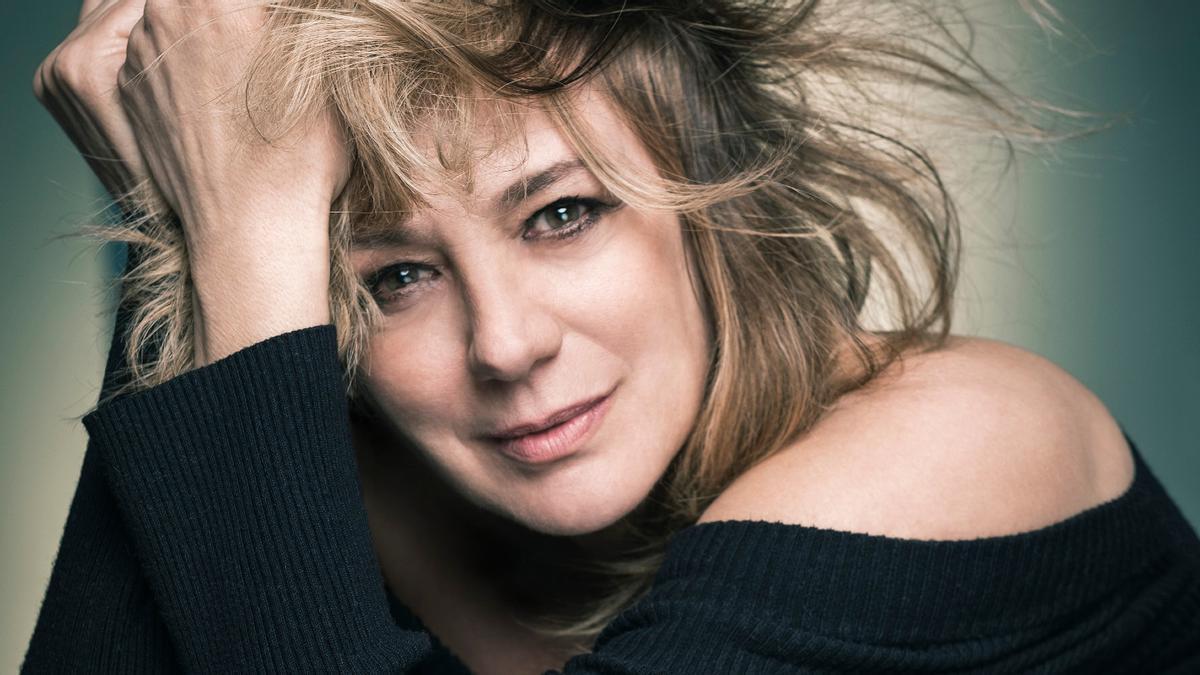

Emma Suárez remains the committed actress she has always been Emma Suárez . She has delved deep into the hell of addiction, guided by a novice director whom she admires for his elegance, Aitor Echeverría. She had no doubts upon reading the script: “We need to talk about what happens to us, stop silencing alcoholism, a too recurrent issue, because we have normalized its consumption: alcohol is a hard drug that besides being legal is at the center of our social universe.”
This was supposed to be a promotional interview (for the movie), strictly timed; but, we ended up spending half of it talking about passions we share: Galicia, children, our elderly mothers… Emma just lost hers, yet here she is while we talk, because her absence has turned into an essential, perpetual presence. The actress complains about the speed of things; having just returned from presenting the movie at the Mar del Plata Festival (Argentina), she stopped in Gran Canaria for the staging of El cuarto de atrás (a novel by Carmen Martín Gaite that will arrive at the Teatro de la Abadía in Madrid in February) and was locked in a studio that morning dubbing who knows what, and so on.
A seasoned actress like Emma Suárez does not hesitate to put herself in the hands of a novice director. What captivated her about this film?
The respectful and subtle way in which such a serious issue, which needs to be discussed, is addressed: alcoholism in our society. When cinema has looked at this issue, it always includes the drunkenness scene, and the substance: here, they toast with water and focus on the relationships of the addicted person, their emotional dependencies. There are so many families experiencing similar situations... It’s clear that professional therapeutic help is needed: no one gets out of such a situation on their own. Reading the script, I immediately felt involved in such a complex character built from silences, which also involved research into addictions, an evil that I deeply respect. This was followed by Aitor (Echeverría)'s perspective, so natural, so real and elegant at the same time.
Alcoholism is a too common hell in families, yes. Have we placed alcohol at the center of our social universe?
Undoubtedly, but then we stigmatize alcoholism, especially in women. You enter a bar in the morning and see men drinking, normal, but if you see a woman, watch out!
“A cloying and harsh flavor, like fruit when it starts to rot. And it smells.” Do you remember that line in the script? And in life?
I have not experienced it myself, fortunately. But I do know people who have suffered it: we have all seen this problem in our closest circles. I gathered a lot of information from therapeutic studies and contact with centers where addictions are treated, which allowed us to attend sessions with patients and relatives; firsthand information that has allowed me to feel what it's like to wake up with this problem every day and make the effort to live. This as an actress sensitizes you, I immediately felt a great empathy.
Often, as with your character, doesn’t this or another toxic addiction often cover up much deeper deficiencies?
Of course, that's why my work with Natalia de Molina (her daughter in the fiction) is built on silences. Miscommunication, suspicion, distrust, self-deception are present at all times. Fortunately, Natalia is a very committed and sensitive actress, and works from truth: having her eyes in front of me has been a gift, a very deep bond has been created between the two of us. And Aitor, who had been preparing this movie for 15 years while working as a director of photography, supported us both in such a way that all that vertigo I felt inevitably before this character, with his care turned into confidence. Look, yesterday we went to a Proyecto Hombre center in Guadalajara to do a screening and a discussion about the film, and in these discussions you appreciate so much gratitude, so much lack of affection and self-esteem in people who are going through therapy.
Another cardinal issue in the movie is the mother-daughter relationship: we have been hurt as children and we hurt as parents. Is it inevitable?
We all carry a backpack and, even with our best intentions, there are so many times we just don’t know how to do it… It would be too easy to know how to educate our children. I prefer to err on the side of too much love rather than too little. But we live in such a rush, we don’t have the time, and then guilt appears, like a chain we drag. I have always lived on alert, because of the nature of my work, so unstable and unpredictable, and because of my maternal personality. Deep down I think I am quite fortunate, I have not had serious problems with either of my two children.
The boy, from your first emotional relationship, is already in his thirties. Do you feel cared for by him or is it not yet time?
I am starting to feel it, yes, he tells me wonderful things like “mother I love you very much”; with boys it usually happens from the age of 26, when they realize what you have done for them. I am very proud of my children, yes, they are both beautiful. I must say it has been very difficult, especially because of the sometimes impossible reconciliation that this uncertain job entails; you learn to live with it, yes, but it is exhausting. However, there comes a good day and you say: I haven’t done so badly, look, it’s not so bad.
Emma, you have become the great young mother of national cinematography. Is it only with a lot of skill that they don't forget about you?
Acting is a profession where you depend on the success or failure of the last project. You have to try again every time with vocation. What matters is not that they don’t forget you, but to keep working, because you need it not only to live, but out of vocation.
You are always highlighted for your essentiality, alien to frivolities. People are surprised that you are a real woman, like the neighbor on the sixth floor. Is it a matter of character or is it a limit you set?
It's almost a craft: no, I'm not going to enter the universe of frivolity. It has to do with personality and also, with the way you focus your life. They say your character is your destiny, right? Well, that. Sometimes I have not chosen the easiest path, but the one that has the most to do with me.
Do you feel that the private sphere is increasingly narrow?
The perspective has changed a lot: before we had the paparazzi, don't forget, and now we are our own exhibitors, on social networks. But you have to decide what you show, and I am not very given to exhibition on networks. I come from a discreet family that taught me what modesty is from a young age, and there are certain very intimate areas of my life that I try to protect. It’s something innate, that requires vigilance, alert, protection.
Emma, you started very early in this scene, led by your mother (her mother worked as a model, her father in advertising), who put you and your siblings in model agencies as beautiful blonde children. Are you glad about it or have you ever reproached it?
Not at all, I am glad that those beginnings offered me a path, a life.
Would you do it again if you were born again?
Yes…
That yes followed by silence doesn't sound very convincing.
Because I would do it again, but with fewer mistakes: I would be more cautious. But without a doubt, I would choose this profession again, which allows me to express myself, which has so much to do with my way of being, with the passion of transforming into another person, with the psychological research of the characters, the journey, the encounter, the continuous learning. It has its other side, which is instability, the cold and the heat, living day to day: you have to be very strong to know how to cope with all this, but it has a lot to do with me and with a family that has always cultivated a passion for culture and art. Look, my mother died last year, but she is here with me, I always wear something of hers and feel the presence of her absence at all times. She is even more present than in life: loved ones die but they do not leave, they are still here, protecting us, taking care of us.

Latest news





Upcoming events
12
Nov
El Desembarco, la traición de Viriato at La Caja Blanca
12
Nov
HOMER El Mero Mero at Sala Trinchera Málaga
13
Nov
Marbella Startup Lab – Innovate & Collaborate
13
Nov
Candlelight: Coldplay & Imagine Dragons at Sala Fundación Unicaja María Cristina
13
Nov
Candlelight: Tribute to Ludovico Einaudi at Anantara Villa Padierna
Similar News

Los Boliches’ Plaza del Carmen is set for a major makeover: more accessible, more shade and no central fountain
Málaga

"Two Birds with One Stone": The Best Tribute to Joan Manuel Serrat and Joaquín Sabina Arrives in Málaga
Málaga
