


"It is likely that we will discover life outside of Earth"
Alberto Castellón, president of the Malaga Astronomy Society, does not rule out the possibility that humans could become "multiplanetary."
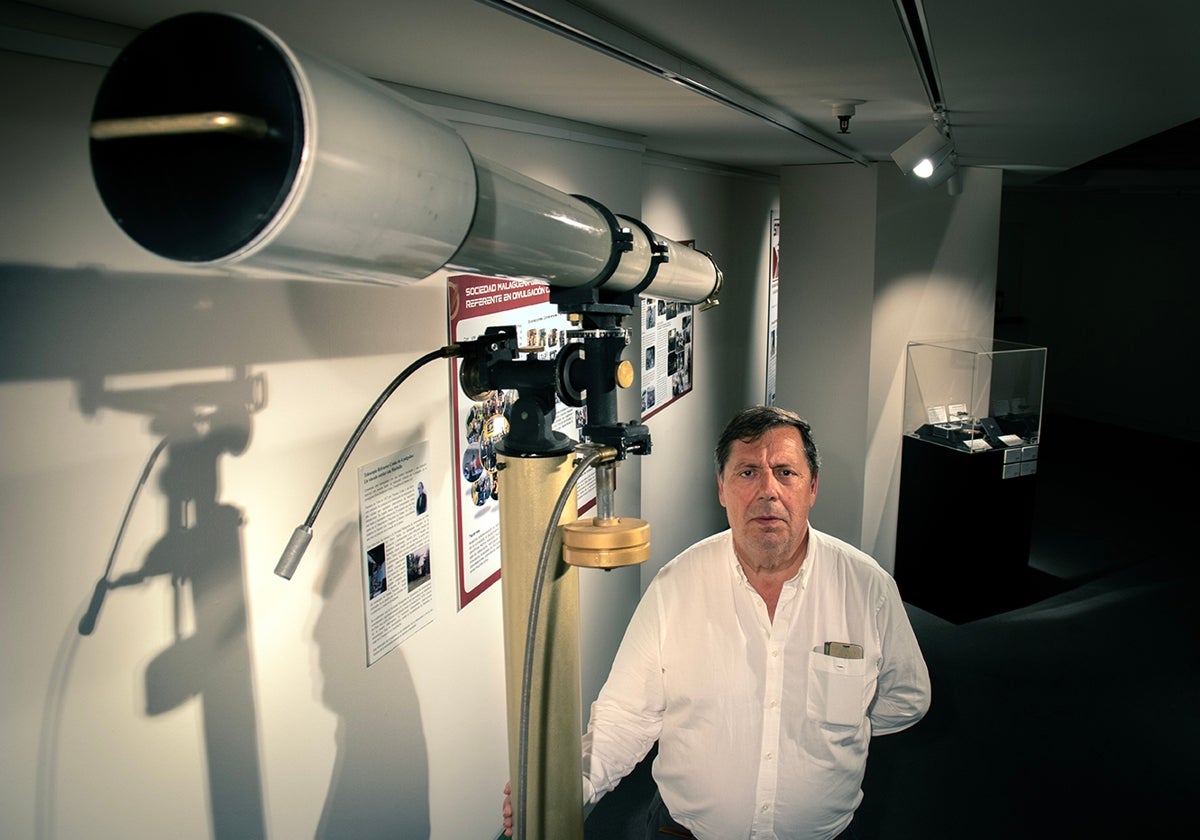

In the seventies, a group of semi-professional astronomers decided, altruistically, to join forces to research the vast empire above our heads. Thus, the Malaga Astronomy Society (SMA) was born. Now, fifty years later, it is one of the most active associations in Spain in scientific dissemination and training. It participates in dozens of activities, such as Science Week, Researchers' Night, Asteroid Day, or World Space Week. It organizes training courses on astronomy initiation, telescope assembly, photometry, among others, in addition to having active research focused on two main fields: light pollution and meteors.
Professor and astronomer Alberto Castellón presides over this society, which is celebrating its half-century anniversary. Will humans colonize other planets? Will we die from a meteorite strike? Is there life beyond our atmosphere? Castellón offers some answers and announces that he will soon step down as president of the association. "This year will be the last. Too much work," he grumbles. Although, it must be said, he has been saying the same thing for five years. Passion weighs more than fatigue.
—To what extent can religion and science coexist?
—I am not a believer, but I have colleagues who are, and that does not prevent them from carrying out their work as scientists or questioning their beliefs. In fact, the theory of the expanding universe is due to a cosmologist who was a Jesuit, George Lemaitre, a priest. Lemaitre presented his theory to Einstein, who was quite reluctant at first. But in the end, he had no choice but to accept it, because he was right. The Jesuits have always had a strong scientific tradition, and this has not prevented them from developing their faith.
—What are the chances that intelligent life exists outside Earth?
—Phew! That's unknown. It's called the Fermi paradox. There are a series of factors that multiply, and others that divide. For example: there are one hundred billion galaxies, if each galaxy has eight or ten planets the total is... and you start multiplying until you get an incredible number of planets. But then come the dividing factors. Of those zillion planets, how many are at a distance from their star that allows them to have water in liquid form? How many orbit around stars that are not killers...? And you start dividing and dividing. And then, on top of that, other factors come into play, like the probability of that civilization self-destructing. At this point, you start throwing out random numbers and it's impossible to give an exact figure. Anyway, the universe is so huge that the probability of two civilizations coinciding at the same time that have not self-destructed and are close enough to communicate is practically impossible. It's possible we might discover life, but not intelligent life.
In 1974, a transmission was sent through the Arecibo radio telescope in Puerto Rico, directed at the globular cluster M13. There are about 400,000 stars there, many of which may have planets orbiting around them, which increases the chances of someone picking up that message. But, of course, that cluster is 25,000 light-years from Earth. If there is a civilization there with its antennas pointed towards Earth, it receives the message and responds, their reply would have to travel another 25,000 light-years back to reach us.
—Probably by then we will have self-destructed...
—(Laughs). That's why I say it's complicated.
—And about a meteorite impacting Earth?
—Oh, that's much more likely! In fact, there can be catastrophic impacts every thirty or forty million years. At the beginning of the last century, in 1908, there was a famous one, in Tunguska. It is assumed to have been a comet, because there is no actual crater, which means it exploded before reaching the ground. Its explosion razed thousands of kilometers (2,150) of forest. Because it fell in an uninhabited area, but if it had been a little later according to the rotation of the Earth it would have fallen in St. Petersburg and we would now be talking about a terrible catastrophe.
Currently, bodies considered dangerous are monitored in case it is necessary to divert their trajectory, but the list of bodies to be monitored is so extensive that professional astronomers cannot cope, so amateurs are called upon. Although first you have to pass an exam in which you send measurements taken with your own equipment. When these measurements are precise enough, you enter the club, which means you are a trusted person.
—The universe hides a multitude of phenomena, which do you find most impressive?
—Well, aside from the Big Bang (the name 'Big Bang' was given by Fred Hoyle, one of the main detractors of the theory. The astronomer named the theory not with the intention of explaining it, but to ridicule it), of course, solar eclipses are wonderful. In Spain, we will have the opportunity now for three consecutive years to observe a solar eclipse. It's already being called the Iberian trio.
*Clarification from the editor: Spain will experience three consecutive eclipses, two total and one lunar. The first, on August 12, 2026, will enter through the northwest of the peninsula and exit through the coast of Valencia, Alicante, and Tarragona. The second, also total, will take place on August 2, 2027, and will be observable from Malaga. Lastly, the lunar eclipse on January 26, 2028, will also be observable from Malaga.
Copious meteor showers are also a beautiful phenomenon. The Perseids are very famous here, but the most beautiful showers of the year are the Geminids, at the beginning of December. And, of course, it's not the same to observe the stars on August 12 in the cool countryside as on a night of December 12 with tremendous cold, but with a shower that is enjoyed more than that of August. The Perseids are very fast, traveling at fifty-five kilometers per second, while the Geminids travel at twenty-five kilometers per second, which allows you to appreciate the phenomenon much better.
—How far does the known universe extend?
—The event horizon is at fourteen billion years, which is the age set for the universe. That is, if the universe is fourteen billion years old, we can only see what is, at most, that distance in light-years away, because from the rest, if there is any, the light has not yet reached us. Maybe the universe is infinite, but we can't know because the light hasn't reached us.
—And if the universe is not infinite, then what?
—That's delving fully into the realm of conjecture. The last one I read is that our universe is a black hole inside another universe. But those are theories impossible to prove, which gives one the freedom to fictionalize and speculate as much as one wants with them.
—Speaking of fiction, what movies should an astronomy lover not miss?
—Ah, the masterpiece of science fiction, and of cinema without adjectives: '2001: A Space Odyssey'. Like most of Kubrick's works. The movie, by the way, came before the novel.
—And if we talk about cinema faithful to the universe?
—Well, Kubrick's film mixes scientific fundamentals with fiction. When they leave the ship, you don't hear anything, it doesn't fall into that mistake that many directors make. 'Interstellar' is also very good. It was made with advice from an astrophysicist. Another one that is also very well made is 'Gravity'. It has very few scientific errors, although it has some. For example, the fragments that destroy (we won't say what for those who haven't seen it) couldn't be, since according to Kepler's laws, if two objects share an orbit, they go at the same speed.
—How many of the stars that dot our sky are still alive?
—The vast majority. There are stars, for example, that are about three thousand light-years away and according to theory, we can know if it is still alive or not. There was a supernova (SN 1054), which was seen several times in different years. It was seen through a gravitational lens, with its first sighting in 2011. And, ten years later, the same supernova was seen but in another place. The gravitational lens bends the light from the galaxy where the supernova occurred. This allowed calculating that, next year, we could see it again from another point. And so it was.
—It can be said that we saw and predicted the past three times.
—That's right.
—Does the universe have an expiration date?
—Yes, there are several ways that the universe could end. One of them would be the process of proton disintegration. I don't know how long the process lasts, but it's a heck of a lot of millions of years. The same particles, sooner or later, will end up disintegrating. Another would be thermodynamic death, a result of the same inflation if it exists. That continuous expansion would mean that, in the end, everything would be loose.
—In 2012, a private company, Mars One, announced that it would send humans to Mars without return. An idea that ended in bankruptcy in 2019. Do you think humans will become a multiplanetary species?
—Yes, probably. That is one of the possibilities for survival. Although I don't think I'll live to see it.

Latest news





Upcoming events
12
Nov
El Desembarco, la traición de Viriato at La Caja Blanca
12
Nov
HOMER El Mero Mero at Sala Trinchera Málaga
13
Nov
Marbella Startup Lab – Innovate & Collaborate
13
Nov
Candlelight: Coldplay & Imagine Dragons at Sala Fundación Unicaja María Cristina
13
Nov
Candlelight: Tribute to Ludovico Einaudi at Anantara Villa Padierna
Similar News

The Cat Guardian: Nearly 14 Years of Rescues and 16,500 Neutered Cats
Málaga

María Barranco resurfaces after hitting rock bottom: "No one can sink me"
Málaga

Ana Duato: "Merche taught me to be a woman, a person, and an actress"
Málaga
