


Antequera exhibits the new painting attributed to Goya that comes from France
It is a 'San Joaquín' that was plundered and is now returning to Spain by the Delgado Collection.
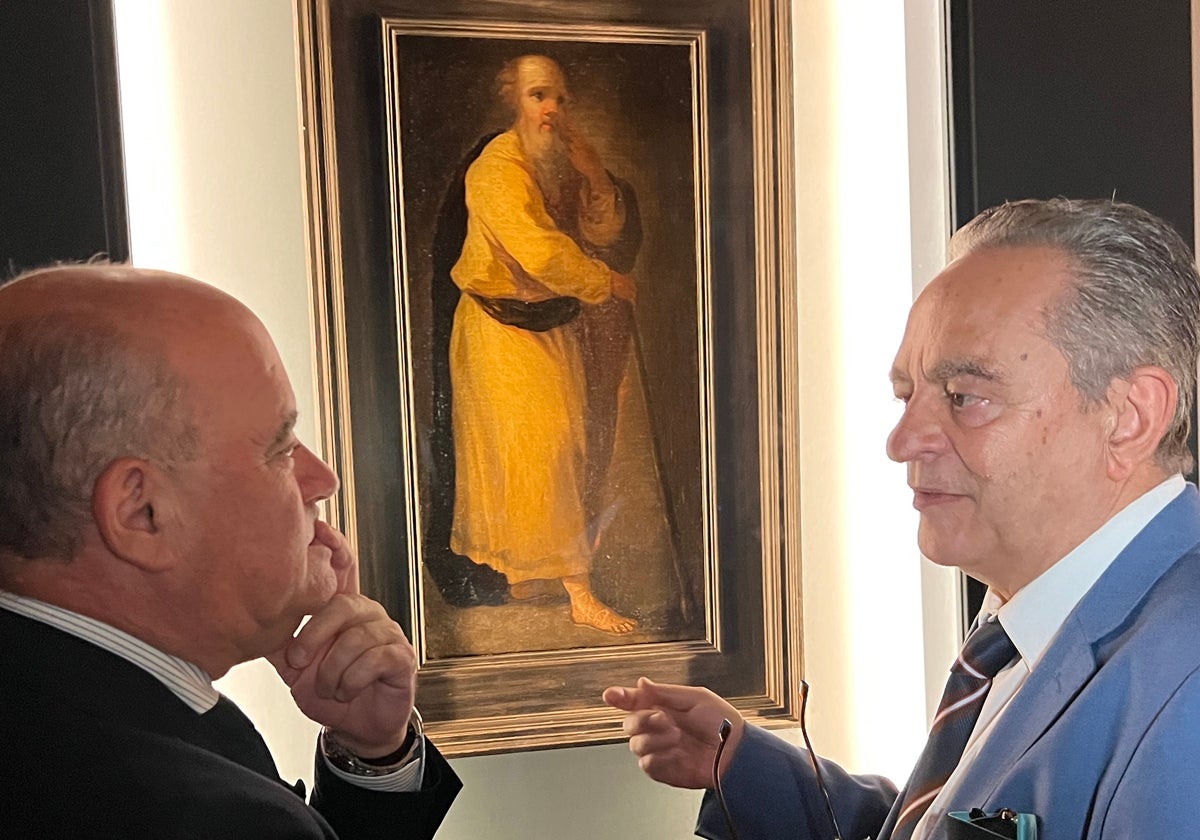

Antequera boasts a new painting attributed to Francisco José de Goya y Lucientes (1746-1828), dated to his early period and believed to have been ... plundered by the French, and now returns to Spain after being purchased by Adolfo Ferrín, a collector who started lending about thirty canvases from well-known artists like Velázquez, Murillo, Valdés Leal, Jacques Bellange, Alonso Cano, Carducho, Herrera 'el Viejo', Juan de Pareja, and now Goya, to the Antequera City Museum (MVCA) a year ago.
It was presented this Wednesday at noon in the gallery of the MVCA by the city's mayor Manuel Barón, the museum's director José Escalante, and José María Palencia Cerezo, former director of the Museum of Fine Arts of Córdoba, and the restorer Rafael Romero Asenjo, who are responsible for the attribution.
Palencia Cerezo, a member of the Royal Academy of Córdoba, shares that "it is a work that its owner acquired from a private French collection, where it was undervalued as anonymous." It was during its restoration that "we came to the conclusion that it can be perfectly attributed to Goya’s production when he was in Zaragoza, after having been in Italy."
Thus, "this piece is very much in line with the production he was doing at that time in the Carthusian monastery and we think it is indisputable," although there are no documents until now. It could have been made "for some private type oratory that should have been accompanied by a Santa Ana, as it is classic to represent the Virgin's father, but that piece that could complement it has not yet been found."
For the restorer Rafael Romero Asenjo, belonging to a specialized Madrid studio where all the technical studies on the work were done, highlights that it was found in its original frame and after conducting the analytical study "in order to compare all technical aspects with what we know of Goya's work, especially in these early days in Zaragoza."
The results, "showed a total match with the existing works, published and technical studies about Goya from this period." Especially in terms of preparation, coloration of the preparation, the pigments used, the technique, "the brushstroke was very revealing because it completely linked the work to what Goya was in his earliest moments of youth."
Now having acquired this piece, it resolves that "it could have left, surely, with the Napoleonic invasion, and has been recovered for the heritage in Spain." It has a very peculiar characteristic of Goya "which is that he leaves in many places the red preparation visible. He plays throughout his life until the end of his career with the color of the preparation." A Goya appears in Spain through Antequera and contributes one more legacy of the Aragonese master.

Latest news





Upcoming events
12
Nov
El Desembarco, la traición de Viriato at La Caja Blanca
12
Nov
HOMER El Mero Mero at Sala Trinchera Málaga
13
Nov
Marbella Startup Lab – Innovate & Collaborate
13
Nov
Candlelight: Coldplay & Imagine Dragons at Sala Fundación Unicaja María Cristina
13
Nov
Candlelight: Tribute to Ludovico Einaudi at Anantara Villa Padierna
Similar News

Málaga Airport Makes History with More Than Three Million Passengers in One Month
Málaga

Port of Málaga looks beyond its docks to support future growth
Málaga

Guide to the Virgen del Carmen Processions in Málaga and the Province
Málaga
