


What the mountain that shelters the famous Yedra fountain hides
Halfway between the Peña de los Enamorados and the Torcal, this geological site in Antequera is a box of surprises, from a doline to the 'Gnome House'
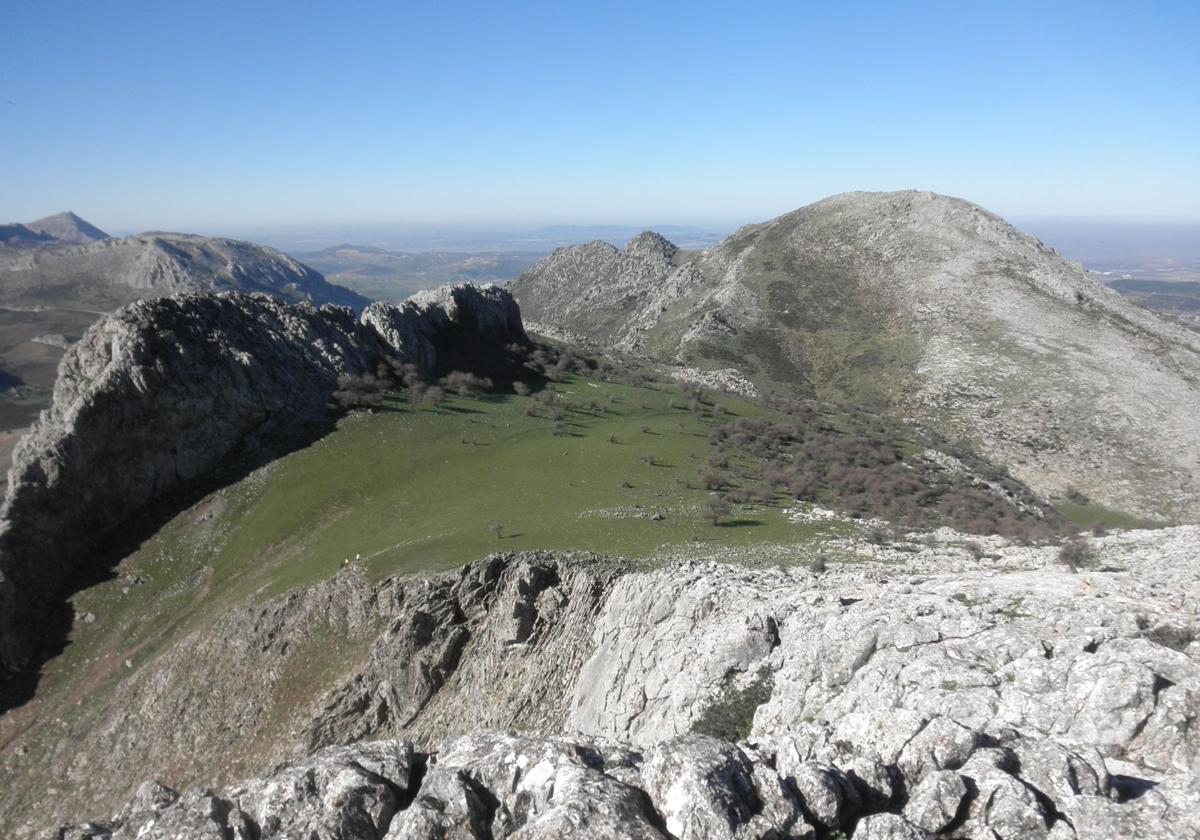

Some have passed by more than once but failed to notice it, either because they stopped only to drink water from the famous Yedra fountain or to have breakfast or lunch at the well-known inn of the same name. There is a stone giant that protects both the spring and these and other nearby dining establishments.
From there, it looks steep, almost inaccessible. There are no clear paths, only some fences that seem to mark private properties. However, the Sierra de las Cabras, as it is called, is one of those mountain ranges worth exploring, even if it requires searching through old maps and books, where many details and clues may seem outdated, yet they make sense, especially if one knows how to read between the lines.
From the abandoned road parallel to the current highway, one can make an exciting climb full of surprises for the senses: from unexpected panoramic views to geological formations that seem implausible.
Most routes lead to the peak of las Cabras, which, at nearly 1,300 meters above sea level, offers a spectacular viewpoint. The ascent is made via a somewhat vague trail where stone markers still remain as signs.
Not without effort, especially in the last section, the steepest of all, one reaches the summit, which has a geodesic vertex, but above all, spectacular panoramic views on either side. That is, you can look towards the towns of Villanueva del Rosario and del Trabuco as well as Torcal, Peña de los Enamorados, or at the foot, Villanueva de Cauche and the Puerto de las Pedrizas.
But, there is a place even more striking at the foot, a green meadow bordered by limestone, which seems to have been deliberately hidden. It is the hole of Juan Díaz. Behind this traditional and simple name hides a doline formed by the erosion of this limestone mountain range. A green meadow that becomes a small Eden. The rocks shelter from the noise of the nearby highway.
It is not the only unusual site hidden by these mountains. If one advances northwest from the peak of las Cabras, one can find an ancient stone trough dating from 1905, the Lastonares. From there, it's just a few steps to what is known as the 'Gnome's House,' a rock formation enveloped by ivy that has made more than one hiker fantasize for a moment.
Throughout this exciting journey, there are also many biological attractions. On one hand, you can see unique botanical species such as maples, hawthorns, holm oaks, as well as numerous rupicolous plants on the cliffs, beautiful peonies, and very abundant lilies in the many small meadows of this mountain range.
Especially surprising is the small grove of elms that grows in the shady part of the Juan Díaz pit. Regarding birds, there you can see species such as black redstarts, wheatears, serins, linnets, blue rock thrushes, or buntings. Being close to the Torcal de Antequera, it is easy to see griffon vultures, or even the majestic short-toed snake eagle.
And true to its name, if you move quietly, you can see small groups of Iberian ibex. Spotting a fox or even a wild boar is also possible.
Despite being classified as low difficulty due to its short duration, it is necessary to point out that most of the route has quite a steep slope, which requires a minimum level of fitness.
In addition to making this itinerary from the Yedra fountain, another route can be taken, which converges with the GR-7-E4 in its first meters, from what is known as the Boca del Asno, a pass that serves to access the Torcal from Antequera. Although the climb to the peak of las Cabras is just as demanding, from there it is just a kilometer and a half to the aforementioned 'Gnome's House'.

Latest news





Upcoming events
12
Nov
El Desembarco, la traición de Viriato at La Caja Blanca
12
Nov
HOMER El Mero Mero at Sala Trinchera Málaga
13
Nov
Marbella Startup Lab – Innovate & Collaborate
13
Nov
Candlelight: Coldplay & Imagine Dragons at Sala Fundación Unicaja María Cristina
13
Nov
Candlelight: Tribute to Ludovico Einaudi at Anantara Villa Padierna
Similar News

Málaga Airport Makes History with More Than Three Million Passengers in One Month
Málaga

Port of Málaga looks beyond its docks to support future growth
Málaga

Guide to the Virgen del Carmen Processions in Málaga and the Province
Málaga
