Want to walk the Camino de Santiago pilgrimage? Leave your phone at home

Pilgrimage
offers a chance to disengage from the everyday and think deeply about what is
important. Leaving home and spending some time on the move with no concerns
other than putting one foot in front of the other can be life-changing.
Pilgrimage
has been described as a liminal experience, which means you are neither at home
nor at your destination, caught between two existential levels. Many people
return home feeling transformed.
Since
the mid-1990s, the numbers of people walking the Camino de Santiago pilgrimage
route to what the faithful believe to be the tomb of Saint James the Apostle in
northwestern Spain have rocketed. And they continue to rise, probably
approaching the numbers who made the pilgrimage in the middle ages, when up to
2 million people are believed to have walked each year.
Medieval
pilgrims prepared for pilgrimage by setting their financial and spiritual
affairs in order: writing a will and going to confession. Pilgrimage was seen
as a rite of passage, or an individual quest where social status and networks
were traded for anonymity and poverty in constant mobility. Arrival conveyed
salvation, or perhaps a cure or a mystical revelation.
Contemporary,
postsecular pilgrimage on the Camino de Santiago is often undertaken at turning
points in the pilgrim’s life, for psycho-existential motives. Pilgrimage allows
you to take time out from your life. Authenticity and simplicity are valued and
will show you that you actually need very little. Slow mobility facilitates
introspection and may have transformative effects.
At
the same time, you can prepare for a pilgrimage as for any other activity,
using the digital tools at your fingertips to gather information from official
apps and online communities, possibly to learn some Spanish, and to make
decisions in the planning of the route, accommodation, equipment and training.
It is possible to arrange everything in advance, but you risk becoming
hyper-informed, losing the opportunities for discovery, wonder and surprise
that are part of pilgrimage.
Technology
during your pilgrimage
I
research online Camino forums. They are divided on the use of technology (such
as smartphones) while actually on pilgrimage.
Unbroken
digital interaction with family and friends at home will thwart some of the
goals of your journey. Instead of being fully in the moment you will remain
socially present in a symbolic world somewhere else, with all the worries of
that world close at hand.
You’ll
also miss opportunities to trust your intuition, and the community of pilgrims
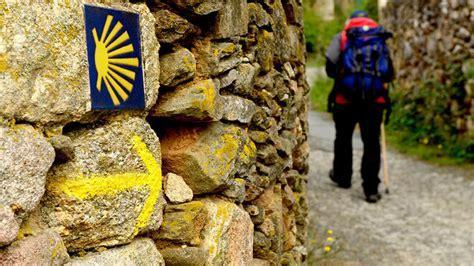
you meet on the Camino. You don’t need a map. The trail is blazed with yellow
arrows and stylised scallop shells. Without a phone you can plan your next
day’s walk using a guidebook and if you want to book a bed for the next day,
the albergue (pilgrim hostel) staff can help.

Three
people standing around a Camino sign on the ground
The
Camino path is well signposted. Soloviova
Liudmyla/Shutterstock
Many
see a Camino pilgrimage as an opportunity for a digital detox and attempt to at
least regulate the amount of time spent with a smartphone. But even if you keep
your phone in your backpack during the day and concentrate tech time to the
evening, you will be interrupting the separation from your life at home that is
necessary if your pilgrimage is to be a liminal experience. When you catch up
on news, email and family, you step back into the everyday.
Live
blogging and vlogging from the Camino is encouraged by prospective pilgrims
lurking in the Camino forums. Those who have already completed one or more
Caminos comment to relate and vicariously relive their own Camino experiences.
Live turn-by-turn reports are also appreciated by those undertaking virtual
pilgrimage.
After
your return home you can join the ranks of veterans who retell their pilgrimage
to the online community and contribute with advice to prospective pilgrims. But
doing this while on the Camino focuses your attention to other people and
places rather than the here and now.
The
liminal experience that was supposed to bring the pilgrim to insight does not
always happen, due, at least partly, to digital distraction and incomplete
extraction from the everyday environment. In the words of Camino anthropologist
Nancy Frey, use the Camino as a chance for disconnection. If you must take a
phone, keep it turned off in your backpack – strictly for emergencies.
Tourism
Walking
Pilgrimage
Hiking
Camino
de Santiago
Give me perspective

Disclosure statement
Una Cunningham does not work for, consult, own shares in or receive funding from any company or organisation that would benefit from this article, and has disclosed no relevant affiliations beyond their academic appointment.
Partners

Stockholm University provides funding as a member of The Conversation UK.
The Conversation UK receives funding from these organisations

Latest news





Upcoming events
12
Nov
El Desembarco, la traición de Viriato at La Caja Blanca
12
Nov
HOMER El Mero Mero at Sala Trinchera Málaga
13
Nov
Marbella Startup Lab – Innovate & Collaborate
13
Nov
Candlelight: Coldplay & Imagine Dragons at Sala Fundación Unicaja María Cristina
13
Nov
Candlelight: Tribute to Ludovico Einaudi at Anantara Villa Padierna