Juan Campos, Omnivorous Guitarist and Music Mason
She left the hospitality industry in Marbella to dedicate herself to flamenco and later experiment with new styles with Antonio L. Gil from Danza Invisible. The princess who avoided Marbella parties and helped AIDS patients.
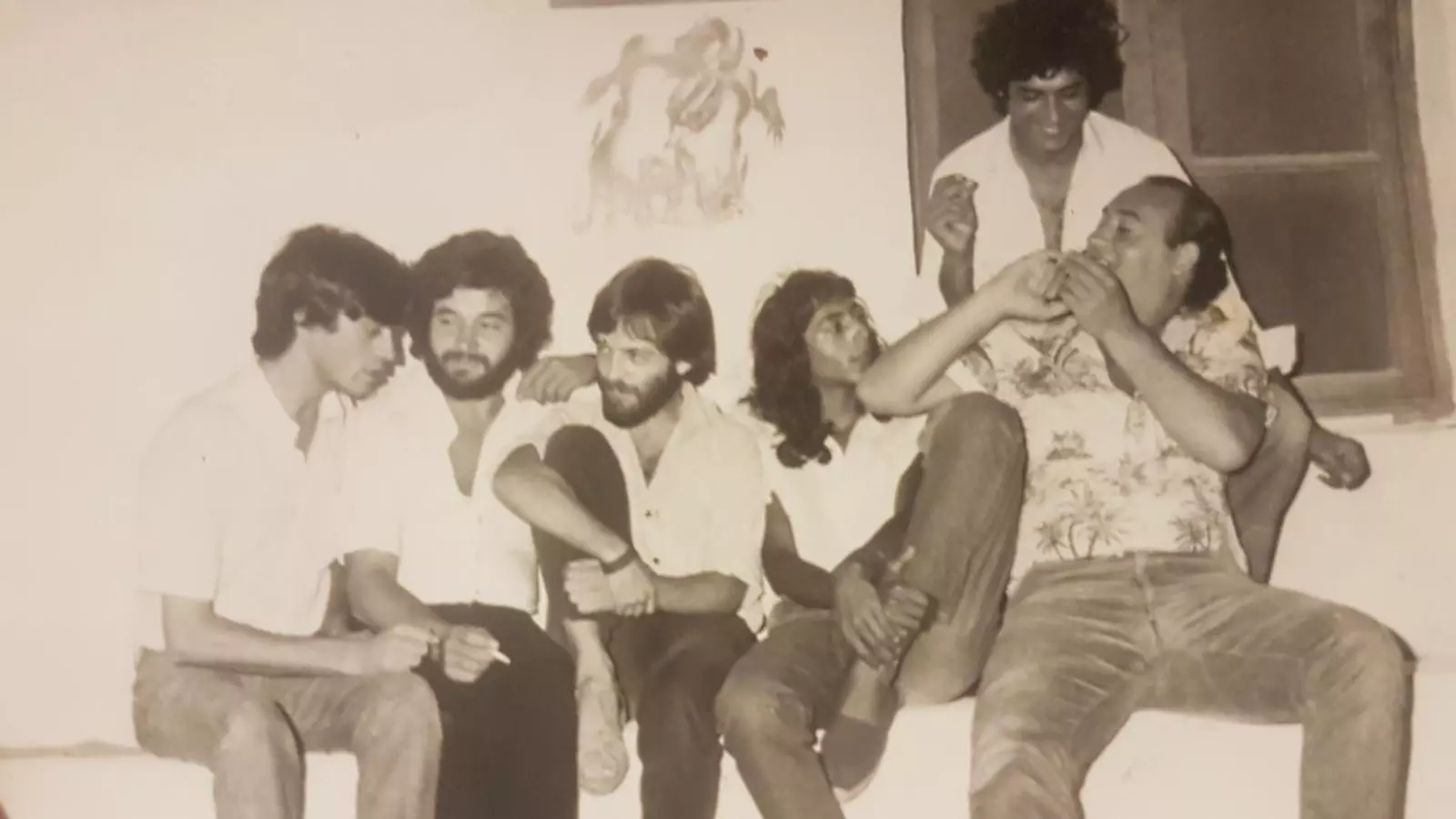

At 18, he was an accountant and had a good salary. His father was a maître d', his mother a housekeeper and his uncle head chef at the Marbella Club. His future seemed destined for the hospitality industry. Then he wondered if he wanted to see himself at 40 working in a hotel near Puerto Banús.
‘I studied economics first and got involved with Tabletón (the Malaga band that fused jazz, rock, reggae and blues with flamenco in the 1970s). The university classes were held in different places because there wasn't a single building. I enrolled in the business school and with what I learned I started working at the Fuentes del Rodeo hotel,’ says Juan Campos.
His boss was Andrés Hengge, the Swiss hotelier who in 1964 had Carlos Cano working under him at the Bex-Les-Bain spa hotel. The singer from Granada was then earning a living in Switzerland, working as a waiter, room boy and shoe shiner.
With the singer Andrés Lozano. / Personal archive–With Hengge, who was also president of the Marbella yacht club, I became very good friends, and I used to talk to him about the poet León Felipe. One day I told him I was leaving my job at the hotel.
–In 1977, after two years of unemployment, I went to take guitar lessons with Diego Montoya, who had settled in Marbella, where he had a girlfriend. I had to wake him up in the mornings, as if I were his cigarette boy. Diego Montoya played with the best flamenco singers, in the taverns of the Montes de Málaga and in the Las Terrazas and Venta Guerrero nightclubs. In Algeciras and Marbella, he played in dance groups. There were very few flamenco artists in the courtyards of Calle Málaga in Marbella.
El Güito, a legend in flamenco dancing, was the number one. I saw him dance at the Pagoda Gitana. There was a tablao in the Guadalpín hotel, which later burned down. It belonged to a Japanese man who had a chain of venues, including El Corral de la Morería in Madrid. Montoya was fundamental for me, then I learned new techniques with Antonio Morilla. I spent some time in Granada with Tere Campos, ‘la teleta’, and her husband Raúl Tomba, who later became an important manager, producer and promoter in Granada.
In the 1980s, a cultural hub was created in Marbella with the Universidad Popular (UP). Jesús Vega was the representative for the Treasury and Culture and he brought in Benito, the coordinator, who came from Vigo with experience from what he had done there. The UP had 3,000 students at one point, and Pepón Nieto, Inma La Bruja, Manuel Olarte and El Pelúo all passed through the theatre workshop.
Juan Campos with Fernando Quiñones. / Personal archive–In San Pedro there were many flamenco festivals with La Paquera de Jeréz, except for Camarón and Enrique Morente, all the greats came. Back then, every village had a flamenco festival. In Andalusia there were about 400, and I accompanied the flamenco artists hired as opening acts, such as Andrés Lozano and Pepe Lara. They, in turn, recommended me to others, and I had eight or nine singers who would call me. After five years of traditional flamenco, where having a beard was considered disrespectful, I wanted to do something else.
In 1982, we created Jarapo, a group that was romantic at first. Jarapo's album Pájaros negros was avant-garde, like a UFO; it turns out we were years ahead of our time. We did two or three tours around Spain and were very successful in the Basque Country. In the end, the group ended up doing okay, I survived, some of my colleagues couldn't continue and another got hooked on heroin. I then went back to the cantaores, waiting in Malaga for a festival to come up. I worked with Rafael Riqueni and Ricardo Pachón, who was the producer of El Sorderita, Diego Carrasco and El Niño Jero, and organised mini-tours with Nicasio Moreno and Antonio Molina. Joaquín Cortés took Nicasio Moreno away from us; it was difficult to find a cellist who could play flamenco. It was a bad time, when the horse was wreaking havoc.
My mother was a caretaker at Villa Cris, owned by Fernando Soriano, an industrialist and brother of Ricardo Soriano, in the El Rodeo area. Fernando gave me my first guitar. He never boasted about his greatness or titles. I remember that Ricardo had a sailboat, he was a bon vivant and he burned everything.
In El Rodeo there were several characters who had houses, Antonio el Bailarín, in El Martinete, there was also the dancer El Greco or Edgar Neville and Conchita Montes in their Malibu house. They had a television in a very large cabinet, and we used to go to their house to watch Bonanza. Neville had a red Ford Mustang convertible, which he used to take us to Puerto Banús when it was being built. Antonio El Bailarín did the same in a Fiat Spider. One day, my mother announced that Edgar Neville was leaving, that he had sold his house to Agent 007. We didn't believe her. Until one day, while playing on the beach, we saw Sean Connery coming out of the sea. We hid, and there was the star we had seen in the cinema, wearing blue swimming trunks and wrapped in a towel.
Left: Cris's house; right: Civil Guard barracks in El Rodeo. / Personal archive At the age of 13, I had a vocation for writing poems in the school magazine. At parties with my friends, I played songs by Serrat and Atahualpa Yupanqui. I grew up wild on my great-uncles' estate in San Pedro Alcántara. I went to school for my first communion. I spent my summers in El Rodeo.
If an omnivore is an animal that feeds on all organic substances, Juan Campos defines himself as an omnivore of music. At the age of 17, he was nourished by flamenco and the music of the Beatles and the Rolling Stones, Camarón and David Bowie. Old-fashioned flamenco and Led Zeppelin: the traditional and the avant-garde.
The guitarist and keyboardist of Danza Invisitble, Antonio L. Gil, took a chance on Juan's music and produced Cañadú's first album in the 1980s at the first digital studio in Andalusia, Sonosur in Almería. The work was presented in style at the Roman Theatre in Córdoba by Carlos Herrera and broadcast on Canal Sur.
Cañadú was an acoustic but avant-garde group. For me, we were the Astor Piazzolla of flamenco. I always wanted to do something new, something different. In the 1990s, the group was better received abroad than in Spain. We recorded three albums. We had impressed people with the song Aurora de Mercurio, but we couldn't quite sell ourselves.
Antonio L. Gil, Juanjo Alcántara and Juan Campos. / Personal archive To mark the centenary of Federico García Lorca, we did a tour of New York with the show Lorca en América. With Miguel Ángel Rojas' ballet, we added a dance show to Cañadú. Rojas was impressed by the group's professionalism.
We gave ten concerts in New York (two performances of Federico), toured New Mexico, the South of France, Andalusia Week in London and the Cultural Programme of the Spanish Embassy in Cairo. We had a great time in New York, performing at the Barcelona classical music festival, the jazz festival and the Seville Biennial.
But flamenco is always complicated. We didn't know how to sell ourselves as a cult group. Flamenco managers weren't very good at their job, they didn't know how to sell. Every two years we changed managers as if they were football coaches. We were ahead of our time.
–I had a very good relationship with the percussionist Trevor Morais, who set up the El Cortijo studio in Benahavís in the 1990s, where the Icelandic singer Björk recorded her album Hegemonic with Mark Bell, a member of LFO, and Raimundo Amador. Morais used to come to my guitar students' end-of-year recitals. He was friends with the electronic musician Goldie, who made Saturn Returnz, and we had a great time together.
Morais had been the drummer for Björk's band and for Tina Turner on her famous Better Be Good to Me in 1984. Britney Spears, Rammstein, Kylie Minogue and Sade recorded at his studio, which was later joined by the group Miloco. Juan Campos also recorded there.
In 2000, Antonio L. Gil and Juan Campos embarked on a project independent of Danza Invisible called La Carmen, a combination of flamenco and electric guitar, with which they recorded two albums. In 2001, they released the album Qué on the Warner label, featuring the house music track Flamencos a volar. Juan's flamenco guitar and Antonio's electric guitar fused flamenco with dance music and Zuri's voice. La Carmen was a lot of energy in search of 21st-century flamenco.
Antonio L Gil and Juan Campos in the studio. / Personal archive–We sold 15,000 copies, which is not bad, although it's very little compared to the seven million albums sold by Alejandro Sanz. The key to success is luck. If selling records were a sure thing, banks would be making music. Because if it's hard to get to the top, it's even harder to stay there. It requires a lot of investment, a lot of money. The fact that Rosalía is talked about every day and is in the media because of her music, her life or her boyfriend, that people are talking about her, costs a lot of money.
We were on the verge of success with a couple of albums, Flamencos a volar and No quiero ná. We managed to reach number four in the charts ahead of Shakira with Tengo que ganar dinero in 2008.
–The album released by Warner was uncharted territory. There was nothing else like it; it was about fusing flamenco with contemporary rhythms, not reviving Andalusian rock, which I never liked; it sounded more like a village version of Genesis to me.
The seven-bedroom Andalusian villa, which was Miloco's first studio outside the United Kingdom, closed in 2013. Morais took the studio equipment to a warehouse in Estepona, where the pieces were sold. Mariah Carey spent her honeymoon at El Cortijo, which is now rented out as a luxury holiday villa.
Guitarist, composer and flamenco scholar, he has composed music for theatre and film soundtracks. Although he was a flamenco musician, he was interested in the avant-garde. He participated in dozens of festivals and in the 25th anniversary of Danza Invisible.
‘Sometimes there could be frustration in the intention to make a living from music. In flamenco, you always go more or less, there's a lot of fuss, a lot of partying. I'm a bricklayer of music, I've done many things, I conducted rociero choirs in San Pedro and Benahavís and in recent years I've given guitar lessons for the Town Hall. Danza Invisible, whom I knew before they were famous, were successful and were able to devote themselves to their project. I had to do many things, like Spider-Man, working very hard to make a living from music. Sometimes I saw myself as a music mercenary, but I've been able to make a living from it.
I've collaborated on Danza Invisible albums, we've done productions and jingles. I'm still with Antonio in his recording studio on his estate in Pizarra. I want to keep writing. If I were reincarnated in another life, I'd be a percussionist, not a drummer, which is very slave-like.
Latest news


Upcoming events
17
Sep
La Pequeña Cuba Gastro-Cultural Festival in San Pedro Alcántara 2026
18
Sep
World Wellness Weekend Marbella 2026
18
Sep
Candlelight: Queen vs. ABBA in Málaga
18
Sep
Candlelight: Coldplay and Imagine Dragons in Málaga
18
Sep
3 de Corazones – Pancho Céspedes, Enrique Ramil and José Luis Jaén in Málaga
Similar News
Paco Guerrero: From Taking Care of Pigs to Serving in the Main Luxury Hotels
Marbella
Caroline Schell: Painter and Sculptor in an Actors' Clan in Marbella
Marbella
Pepe Imaz, Djokovic's Emotional Coach
Marbella