


Jane Goodall: What She Likes About Malaga and What She Doesn't
The popular ethologist sits down with SUR in the Concepción Garden, an environment that reminds her of her "home."
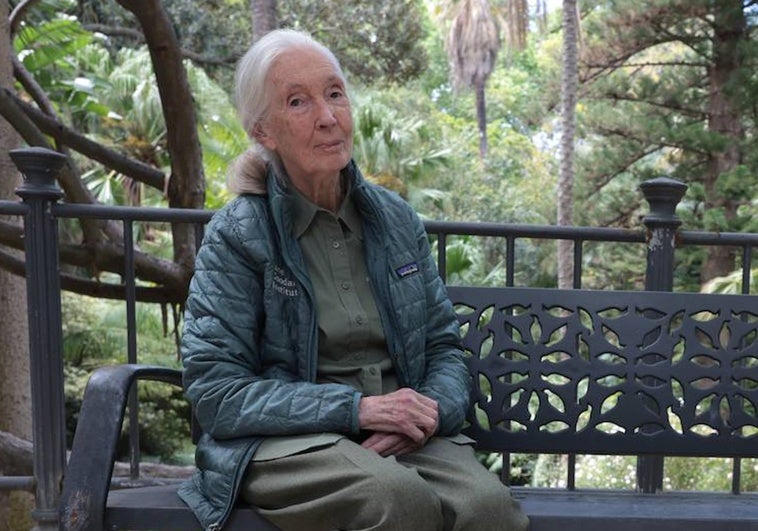

To the audience who attended her documentary 'Reasons for Hope' (Hope in Action) at the Albéniz cinema the other day, she recommended stepping out of the city and taking a deep breath. "We need to spend more time with nature." Far from being just a slogan, Jane Goodall (London, 1934), the ethologist and UN Messenger of Peace, put this into practice this Saturday during her visit to Malaga by walking through the Concepción Botanical Garden, a lung that is more than that, the green heart of Malaga. And for this naturalist accustomed to living among chimpanzees in Africa, it's the closest thing to our jungle. However, it reminded her of another place: "I loved it. The blackbirds, the smell and the fragrances are spectacular and remind me of my home, England."
In her busy schedule over the last three days in Malaga, the expert and members of the Jane Goodall Institute Spain had time this Saturday to firsthand explore the Heredia-Loring orchard. During the walk, she not only showed interest in the birds flying among the trees but also shared a conversation with SUR about the city that has hosted her these days. Dressed in hopeful green, from her socks to the quilted jacket with the logo of her conservation organization—she put it on a minute ago because it was a bit chilly—, the ethologist displays her smile and attentive eyes that listen carefully and react quickly. As if she were not 91 years old.
From the experience of these days in Malaga, she naturally keeps the Botanical Garden, although we asked her to expand on what she liked about the city... and what she did not. The question was translated by her main collaborator in Spain, Federico Bogdanowicz, director general of the Jane Goodall Institute, and the first thing she tells us is that she was surprised by Malaga's past and the recovery that is being made with the latest discoveries of Phoenician origins. "I enjoyed visiting the old wall that runs under the building of the University of Malaga," points out Jane Goodall, who confesses that she also had a very unique guide: "I went to see it with the mayor who even acted as a guide and told us the history of the city and the wall."
Precisely, Mayor Paco de la Torre has accompanied the activist and researcher to some of the events held in Malaga and, along with his team, has also explained some of the things that the visitor did not like to see. "I did not like the horse-drawn carriages that carry tourists and use animals for transportation," says the animal rights advocate who lived among chimpanzees and was the first to document their use of tools in daily life. However, she notes that she has learned "through the authorities that this is going to end very soon," referring to the city council's intention to terminate the municipal licenses for this service this year.
Another thing she has seen in the city and that she dislikes even more is something very common in large Mediterranean port cities and around the world. "Another thing I hate are the cruise ships, which not only affect Malaga, but all the places these large ships reach that pollute a lot," laments Jane Goodall, who assures that she has never set foot on these gigantic vessels nor does she plan to: "No way. It's the worst way to travel and I can't imagine why people do it."
Cities face the challenge of sustainability, so we asked for a few practical actions that, as citizens, we can also contribute to this challenge in everyday life. And what she recommends is not only governed by common sense, but is also within everyone's reach. "First of all, do not litter, do not throw garbage around, do not waste extra energy or water, do not waste and also think about the decisions we make every day to ensure they are correct when buying, eating, or dressing, thinking about the future," assures Jane Goodall who, to conclude, refers to the title of her documentary and ends the conversation with a positive message for the planet that precisely appeals to individual responsibility: "There is hope if we all come together and each one does their part."

Latest news





Upcoming events
12
Nov
El Desembarco, la traición de Viriato at La Caja Blanca
12
Nov
HOMER El Mero Mero at Sala Trinchera Málaga
13
Nov
Marbella Startup Lab – Innovate & Collaborate
13
Nov
Candlelight: Coldplay & Imagine Dragons at Sala Fundación Unicaja María Cristina
13
Nov
Candlelight: Tribute to Ludovico Einaudi at Anantara Villa Padierna
Similar News

Málaga Airport Makes History with More Than Three Million Passengers in One Month
Málaga

Port of Málaga looks beyond its docks to support future growth
Málaga

Guide to the Virgen del Carmen Processions in Málaga and the Province
Málaga
