


Nazis, from Röhm's Sexuality to Hess's Monocle
British historian Richard Evans portrays in the book 'Hitler's People' the top collaborators of the Führer.
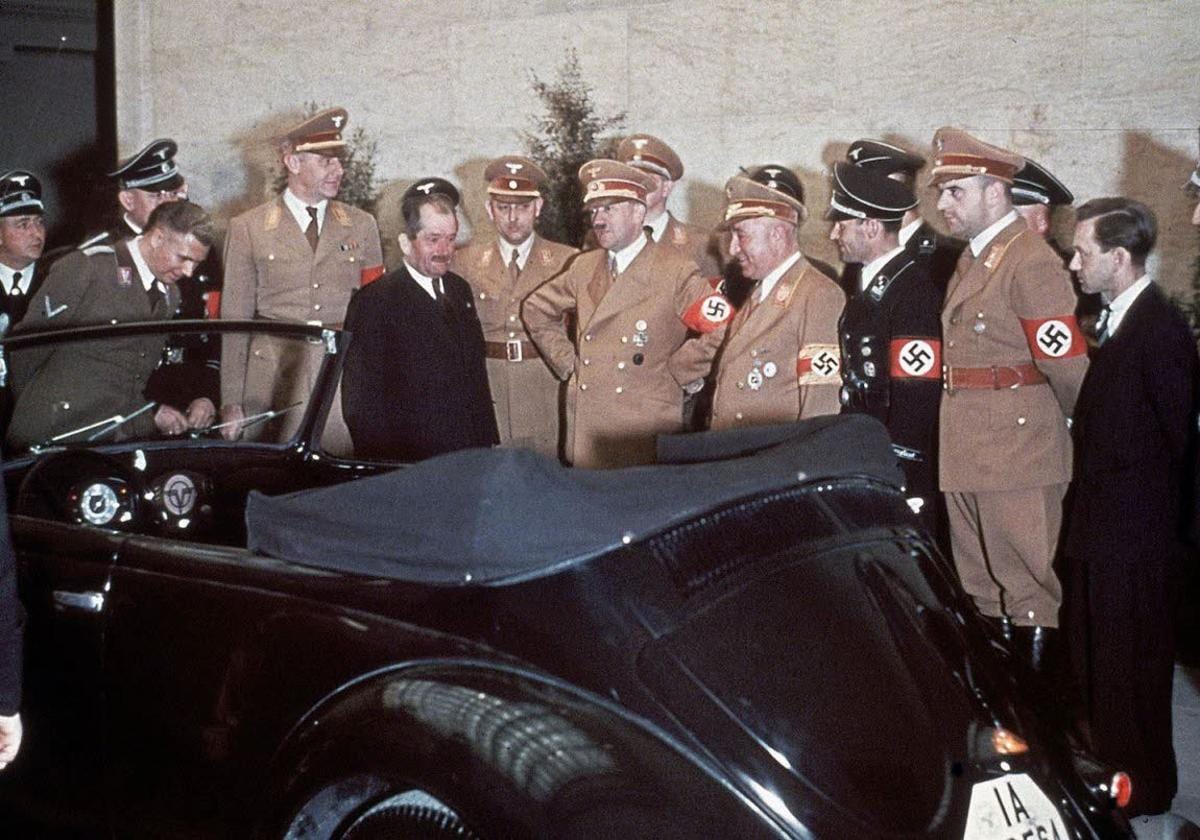

Although clichéd, the famous expression 'the banality of evil,' coined by philosopher Hannah Arendt to describe Nazi war criminal Adolf Eichmann, fits perfectly as an explanation for the new book by British historian Richard J. Evans. 'Hitler's People' (Critique) is a journey through the life stories of the men, primarily, but also the women, who built and destroyed the Third Reich, their often mundane everyday lives, their concerns, their miseries, to paint an ultimately disturbing portrait: they were not monsters or psychopaths, but human beings who resemble too closely the people considered normal.
Sir Richard Evans, Professor Emeritus of History at the University of Cambridge and one of the leading scholars on Nazism, notes that before becoming the Führer, Adolf Hitler's life aspirations were not much different from those any adult of his time might have, specifically, to find a partner, or many. "In his early forties, Hitler had finally achieved some form of personal stability in his life. Far from being a cold, asexual, and emotionless person—as many historians have imagined—he had always been susceptible to female charm. It is well known that he felt close to a number of older women, generally wealthy and well-placed," writes the author, who portrays a man who was vegetarian and teetotaler, passionate about cinema, Wagner, fast cars, and planning grand buildings, a lover of cream cakes, and who was disgusted by cigarette smoke.
However, all these traits did not hide the true face of the genocidal leader: a mediocre military man who "in his public statements hypocritically insisted that he only wanted peace. But at the same time, he assured: 'Our supreme commandment is to ensure that Germany has more living space.' His country had the right to possess more 'living space' due to the 'higher quality of life' of the German people, for their energy, for their inventiveness."
Having dissected the leader of Nazism, Evans, who has published essential books on this historical period such as the trilogy 'The Coming of the Third Reich' or 'Hitler and the Conspiracy Theories,' as well as a magnificent work about the 19th century, 'The Struggle for Power: Europe 1815-1914,' goes on to analyze a good part of his Praetorian Guard. He finds little humanity in Hermann Göring, who at one time was seen as the regime's second-in-command, but who maintained a formal relationship (always addressing each other as 'you') with the Führer.
Evans attributes to Göring unflattering qualities: "His brutality—evident in episodes like the Night of the Long Knives—his relentless ambition, his vanity, his corruption, his indifference to human suffering, and his contempt for the good customs of human conduct, among other characteristics, led various people, like Gustave Gilbert, the prison psychologist, to describe him as a psychopath." But at the same time, Evans emphasizes, "reducing everything to a personal pathology was too simplistic. If a man like Göring could rise almost to the absolute summit of power, it was only because he inhabited the twisted moral universe of the Third Reich."
Joseph Goebbels, the fearsome propagandist of Nazism, appears in Evans' view as a "servile" person towards Hitler, a sycophant who only wanted "to guess his intentions and reinforce them and encourage him to make them a reality." Of Ernst Röhm, briefly the chief commander of the SA, the assault forces of the National Socialist Party, he highlights his homosexuality, and that even his old friendship with the Führer could not save him from the Night of the Long Knives, the purge carried out by Hitler among his own ranks to finally control the structures of the German state.
The complexities and petty miseries of 'Hitler's People' are perfectly explained in the book. Rudolf Hess, who became the Führer's deputy (a position he attained among other qualities, being an excellent typist) and who is credited with popularizing the 'Heil Hitler' salute, decided to use a monocle to gain importance in Berlin circles; Hitler admired Leni Riefenstahl so much that when he met her in 1932, he told her, "When we come to power, you must shoot my films."
And the review of Luise Solmitz, a housewife who became famous for writing a diary from 1905 to 1973 that is used as a historiographical source, can be summarized in a sentence that helps understand how Nazism captured the soul of the Germans: "Like many other middle-class Germans, she was willing to accept almost any measure the Nazis adopted, if they could justify it with the purposes of maintaining order and suppressing revolutionary threats."

Latest news





Upcoming events
12
Nov
El Desembarco, la traición de Viriato at La Caja Blanca
12
Nov
HOMER El Mero Mero at Sala Trinchera Málaga
13
Nov
Marbella Startup Lab – Innovate & Collaborate
13
Nov
Candlelight: Coldplay & Imagine Dragons at Sala Fundación Unicaja María Cristina
13
Nov
Candlelight: Tribute to Ludovico Einaudi at Anantara Villa Padierna
Similar News

Málaga Airport Makes History with More Than Three Million Passengers in One Month
Málaga

Port of Málaga looks beyond its docks to support future growth
Málaga

Guide to the Virgen del Carmen Processions in Málaga and the Province
Málaga
