Celia Cruz, Jennifer Lopez, Shakira, Karol G and the Narrative of What It Means to Be 'Latina'
If there is a shout that awakens Latin pride, it is the

The ‘Queen of Salsa’ not only filled stages with her voice and dazzling costumes, but became a global symbol of Afro-Caribbean resistance and joy. Her success over more than five decades was a vindication after a case of racial and sexist discrimination. In her early days, she was rejected by a record label for not fitting the ‘Latin star’ image that dominated the market.
The ‘Queen of Salsa’ not only filled stages with her voice and dazzling costumes, but became a global symbol of Afro-Caribbean resistance and joy. Her success over more than five decades was a vindication after a case of racial and sexist discrimination. In her early days, she was rejected by a record label for not fitting the ‘Latin star’ image that dominated the market.
A black woman in a white dress holds a frame around her body.
Celia Cruz photographed by Armand in Cuba in the 1950s, in an image exhibited in the Latina exhibition. Gladys Palmera/Casa América
This canon responded to a specific concept of femininity, beauty, sensuality and controlled exoticism, represented by figures such as Lupe Vélez, Dolores del Río, Rita Montaner and María Félix.
The exhibition Latina, hosted by the Casa de América in Madrid, recovers these women who, since the 1920s, have been agents of transformation and cultural affirmation. And alongside them are other voices that did not fit into these moulds, such as Violeta Parra, Mercedes Sosa, Chavela Vargas, Chabuca Granda and, of course, Celia Cruz, who ended up being one of the most universal figures in Latin music. In fact, she is the first Afro-Latin woman to appear on a US coin.
A black woman in a white dress holds a frame around her body.
Celia Cruz photographed by Armand in Cuba in the 1950s, in an image exhibited in the Latina exhibition. Gladys Palmera/Casa América
This canon responded to a specific concept of femininity, beauty, sensuality and controlled exoticism, represented by figures such as Lupe Vélez, Dolores del Río, Rita Montaner and María Félix.

A black woman in a white dress holds a frame around her body.
Celia Cruz photographed by Armand in Cuba in the 1950s, in an image exhibited in the Latina exhibition. Gladys Palmera/Casa América
The exhibition Latina, hosted by the Casa de América in Madrid, recovers these women who, since the 1920s, have been agents of transformation and cultural affirmation. And alongside them are other voices that did not fit into these moulds, such as Violeta Parra, Mercedes Sosa, Chavela Vargas, Chabuca Granda and, of course, Celia Cruz, who ended up being one of the most universal figures in Latin music. In fact, she is the first Afro-Latin woman to appear on a US coin.
there were a Mount Rushmore of Latina artists in the United States, Celia Cruz's face would be carved on it. And it would appear alongside those of Jennifer Lopez, Shakira and Karol G.
J.Lo, iconic
Over the decades, Latin artists in the United States have faced many difficulties in gaining mainstream acceptance due to cultural, racial and linguistic stigmatisation. In fact, until 1975, there was no Latin music category at the Grammy Awards, even though it outsold jazz and classical music. Paradoxically, it is the only category that now has its own awards.

The Nuyorican (New Yorker of Puerto Rican descent) Jennifer Lopez has staked her claim in the 21st century with another slogan, ‘Mi gente latino’, which she mispronounced at an awards show in 2011.
Jennifer Lopez's trajectory perfectly reflects how the concept of Latin music in the United States has evolved in recent decades. Since the 1990s, she has been a benchmark of the ‘Latin Explosion’, cementing her status as an iconic figure in Latin entertainment. She is currently a singer, actress, dancer, fashion icon, entrepreneur and American Idol judge. In 2001, she became the first and so far only Latina woman to have a No. 1 album and movie in the same week, with her work J.Lo and her starring role, alongside Matthew McConaughey, in Wedding Plan. The Bronx diva is an icon and a pop legend, with no need for adjectives such as Latina.
The Queen of Latin pop

Colombian Shakira, currently on a world tour, challenges the limits of the Anglo-Saxon market with a strong, bilingual and multifaceted cultural identity.
Recognised as one of the most innovative artists in global pop, with more than 95 million albums sold and numerous awards, she is the most played Latina of all time on Spotify and one of the five most viewed in YouTube history.
Shakira is probably one of the best representatives of what it means to be a global artist at the moment, knowing how to transform and adapt to the new model of the music industry based on streaming and with her own hook: ‘Women don't cry anymore, women make money’.
Read more: Shakira and the Greco-Latin poetry of spite
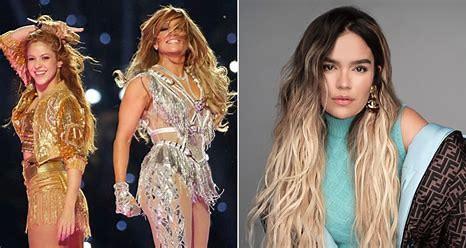
Shakira and Jennifer Lopez's joint performance at the 2020 Super Bowl was a statement of Latin pride and female empowerment to a global audience. A historic moment where the artists made their values clear and expressed social criticism and issues that affect the Latino community. They took the stage from inequality to classism, violence, ageism, migration and sexism.
Jennifer Lopez and Shakira's performance at the 2020 Super Bowl.
However, as is often the case with displays of female power, they were criticised for their ‘whitewashing’ of Latinity. Both artists enter into the specific collective imaginary of Latinos (‘güeros’ or white blondes), in which stereotypes or aspirational models are represented, ignoring the linguistic and racial diversities within the community.
The “bichota”
Far from that archetype, emerges the current most influential figure in Latin and urban music, the also Colombian Karol G. The singer received the Billboard Women in Music award for Woman of the Year in 2024. In doing so, she marked a historic milestone, as for the first time since the awards' inception in 2007, a non-US woman from a Latin American country was recognised as the most outstanding female artist of the year.

Her commitment to feminism, her roots and her language ‘have created a movement for women around the world through her empowering lyrics and inspiring confidence’, in the words of Hannah Karp, editorial director of Billboard.
With her nickname ‘La bichota’ and her catchphrase ‘MAMIII’, she is breaking down barriers for women in the industry and stigmas in a hyper-masculinised genre like reggaeton. She has been the first woman to top the Billboard 200 with a Spanish-language album, collaborates with big names and outperforms her male counterparts on streaming platforms and global festivals.
Karol G on NPR's Tiny Desk.
Over the past 80 years, Celia Cruz, Jennifer Lopez, Shakira and Karol G have shaped and, at the same time, pulverised the ideal of the Latina image. They have done so by controlling their public narrative and voice, on their own terms, with their lyrics and also with their businesses. It is precisely this economic empowerment that has given them financial and creative freedom and independence.
Moreover, they have been able to reappropriate their bodies and the concept of ‘Latina’ as a tool of expression and not of subordination, to the point of stressing stereotypes and redefining them with their music and aesthetics. They have thus become symbols of authenticity, resilience and hope.
This rise of Latina artists in the global market and in the United States is not isolated, but part of a broader transformation of the role of Spanish in the cultural industry.
Author
Lourdes Moreno Cazalla
PhD in Communication. Author of the study for the Observatorio Nebrija del Español "El boom de la música urbana latina y la expansión del español a nivel global", Universidad Nebrija
Disclosure Clause
Lourdes Moreno Cazalla receives no salary or consultancy work, nor does she own shares in or receive funding from any company or organisation that may benefit from this article, and has declared that she has no relevant links beyond the academic position mentioned above.

Latest news





Upcoming events
12
Nov
El Desembarco, la traición de Viriato at La Caja Blanca
12
Nov
HOMER El Mero Mero at Sala Trinchera Málaga
13
Nov
Marbella Startup Lab – Innovate & Collaborate
13
Nov
Candlelight: Coldplay & Imagine Dragons at Sala Fundación Unicaja María Cristina
13
Nov
Candlelight: Tribute to Ludovico Einaudi at Anantara Villa Padierna