Costa del Sol News
They are everywhere. As one walks through the city, one encounters parakeets flying or chattering with shrill sounds that drive those unlucky enough to have a nest nearby crazy. The proliferation of parakeets has become a problem that administrations are not yet aware of, according to experts, who demand a strong and uncomplicated response to address a problem that will become increasingly difficult to eradicate each year.
Currently, the exact number of specimens in the province of Málaga is unknown. There are only occasional studies in specific areas. The latest data is from 2019. At that time, an exhaustive field study estimated the number of parakeets to be between 4,000 and 5,000.
However, the current figure is unknown because no one has managed to gather enough volunteers to conduct a new census and check the species' evolution. In fact, in 2023 an attempt was made to create a new parakeet registry but it was not possible to assemble the necessary group of people to even cover the city of Málaga.
This is what most worries researchers like Antonio Román, a professor of Zoology and ornithologist at the University of Málaga, who believes that the passivity of the administrations will mean that by the time they become aware of the problem, it will be too late and vast amounts of public resources will have to be allocated for not acting in time.
Experts estimate that parakeet colonies double every five or six years. "Currently, in the province of Málaga, there are parakeets from Maro (Nerja) to Punta Chullera (Manilva)," explains Antonio Román. "They are practically all along the coast, except for some stretches, and a very small nucleus has also been detected in Archidona, another in Antequera... They begin to move up the Vélez and Guadalhorce rivers," Román explains.
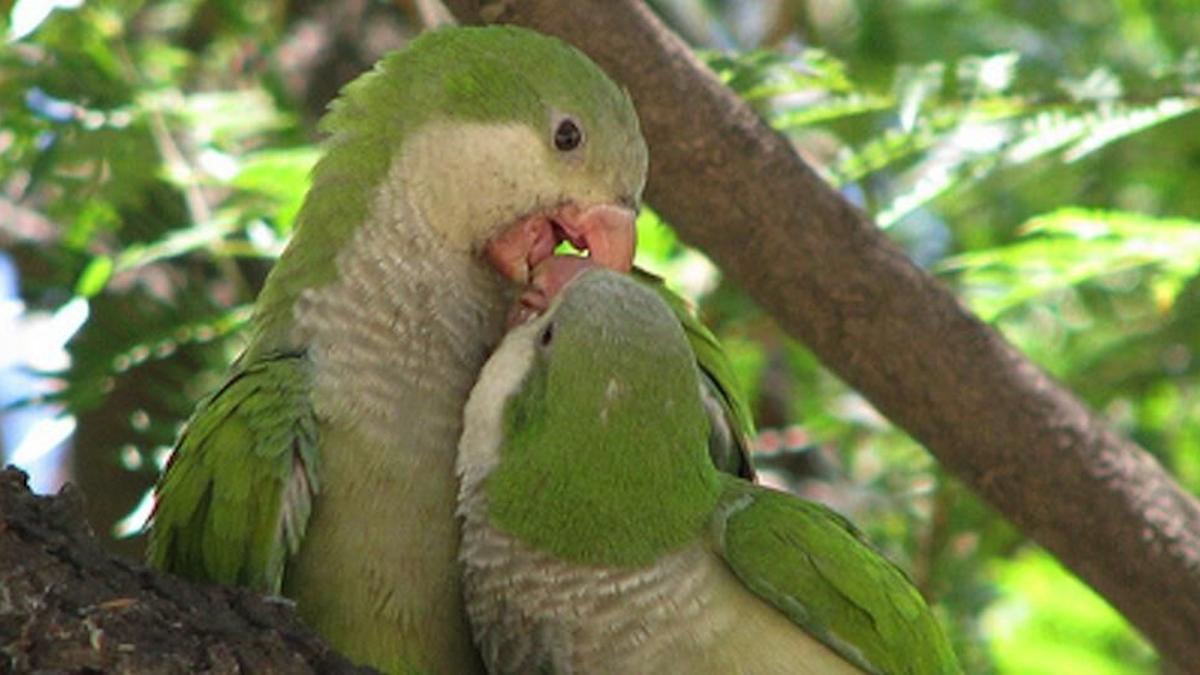
In our province, the majority are Argentine parakeets, and to a much lesser extent, Kramer's parakeets. Both have exotic green colors that captivate those who see them for the first time, which facilitated their arrival in Spain in the 70s and 80s as adorable pets, until their owners released them, fed up with the continuous commotion they create.
Royal Decree 630/2013 included the Argentine parakeet and Kramer's parakeet in the Spanish Catalog of Invasive Exotic Species as they alter the biodiversity wherever they form colonies.
The main difference between them is that the Argentine parakeet is the only parakeet in the world that builds its own nest, a space it shares with several dozen specimens and that can weigh more than 200 kilograms.
On the other hand, Kramer's parakeet, which is predominant in provinces like Seville, takes advantage of building crevices to nest.
The damage of parakeets in cities is barely noticeable except to those who have a nest near their home, because they do not stop chattering with shrill sounds until bedtime. The heavy nests that the Argentine parakeet forms in trees like plane trees and palm trees pose a danger because they can fall on someone. In the United States, Antonio Román claims, they did not become aware of the problem until they found that nests on mobile phone antennas caused communication cuts and caused fires by knocking down high-voltage towers that were overwhelmed by the action of the wind as they are not prepared to withstand so much weight.
Scientists add that these birds can also transmit psittacosis, a respiratory disease caused by the bacterium Chlamydia psittaci, which is not mandatory to declare, but is transmitted by sick birds, such as parrots, parakeets, macaws, canaries, goldfinches, and pigeons, and can degenerate into fatal pneumonia "although close contact with the animal is needed and most cases present with mild cold-like symptoms," explains Carolina Calero, head of the Public Health Service of the Health Council in Málaga.
Parakeets also cause ecological and economic damage. Ecologically because "Kramer's parakeet disputes nests with native species such as the lesser kestrel or the giant noctule, species that play an important ecosystem role as they feed on all kinds of insects, and which are being expelled by the parakeets." Scientists have found that in just a few years, Kramer's parakeets have taken over spaces like María Luisa Park in Seville, where they have reduced by more than 90% the nests of the giant noctule bat, a species protected throughout Europe, explains Dailos Hernández Brito, a researcher at the Doñana Biological Station.
This scientist adds that a few years ago, they even had to install nets to protect the façade of the Reales Alcázares of Seville because Kramer's parakeet pecked at the plaster to absorb minerals that helped it tolerate certain toxins and was causing significant damage to the monument.
The economic damage can be even greater. Once outside the urban environment, the parakeet wreaks havoc on crops. Being a granivorous species, it feeds on grains and seeds of all kinds of fruits. Parakeets devastate sunflower seed crops and peck at almonds, olives, or oranges that when not entirely eaten are left unsuitable for commercialization. "I often cycle from Málaga to Nerja and I have seen parakeets in Almayate eating artichokes," explains Antonio Román. "Imagine the damage they can cause when they reach the mango and avocado crops of the Axarquía."
The law is clear. Invasive species must be eradicated or at least controlled. The problem is how. Ecologists raise the alarm as soon as the use of air rifles to kill them is mentioned. Instead, they advocate sterilizing them by installing feeders with sterilizing food, but experts have found that not only do they not achieve the expected results, but they also endanger other birds.
Another option would be to sterilize them one by one, but this would not prevent them from continuing to damage the ecosystem when released again, during the 15 or 20 years these birds live. Attempts have also been made to coat the eggs with paraffin so they do not hatch or to replace them with plastic ones, but as soon as the females realize, they lay more eggs and the problem is not addressed.
Another alternative is to apply euthanasia, one by one, but this is a titanic and unmanageable task when the colonies consist of several hundred specimens.
So far, explains Dailos Hernández, there are only three cases in the world where parakeets have been eradicated. One occurred a few years ago in La Palma, where they installed cages to eradicate about 200 specimens of Kramer's parakeet. The technicians caught most of them but found that the last 50 no longer entered the cages "because they are very intelligent animals, capable of transmitting information to each other." In the end, they had to resort to a rifle with a telescopic sight to finish them off.
Another case occurred in Zaragoza, where a few years ago a colony of about 2,000 Argentine parakeets was eradicated. Initially, they tried with traps but, seeing that they did not work, they closed the parks one by one to shoot all the birds. The third case occurred in the Seychelles Islands, where they managed to eradicate a colony of 700 Kramer's parakeets using a rifle.
Contrary to the suspicions of ecologists and animal rights activists, ornithologists explain that it is not about shooting pellets and injuring the birds, but about precise shots to the head or heart, to end their lives quickly, without suffering, explains Dailos Hernández.
In this regard, experts say that there is a lack of education for citizens, explaining to people the damage these animals cause and the most effective methods to end them. "You will never convince 100% of individuals about which method is most effective, but that does not mean you can stop acting," explains Antonio Román. Therefore, they criticize that political leaders back down when ecologists start criticizing the use of the rifle. "Small colonies can already be seen flying over the crop fields of Vélez-Málaga and Torre del Mar," Román explains. "If we continue to apply patches, soon there will be many more, they will cause greater damage and will be more difficult to eradicate." Instead of looking the other way, they urge those responsible to be brave when applying methods that have proven effective against these invasive species and think that if they do not allocate enough public resources now, in a couple of years they will have to allocate many more.
They even go further and add that it is useless to act in one municipality if the neighboring one does nothing because the problem will move elsewhere and resurface in time. Therefore, they warn of the need to adopt at least provincial and sustained action plans over time to end a species that alters the ecosystem and is increasingly proliferating.