Giant US Navy warship arrives in Málaga for month-long stay at the port
The USS Lewis B. Puller, a 239-metre-long US Navy expeditionary sea base, has docked at Málaga's Levante Pier for an expected stay of approximately one month. The enormous military vessel, designed to support naval operations and helicopter missions, returns to the Costa del Sol after a previous visit in April 2025.
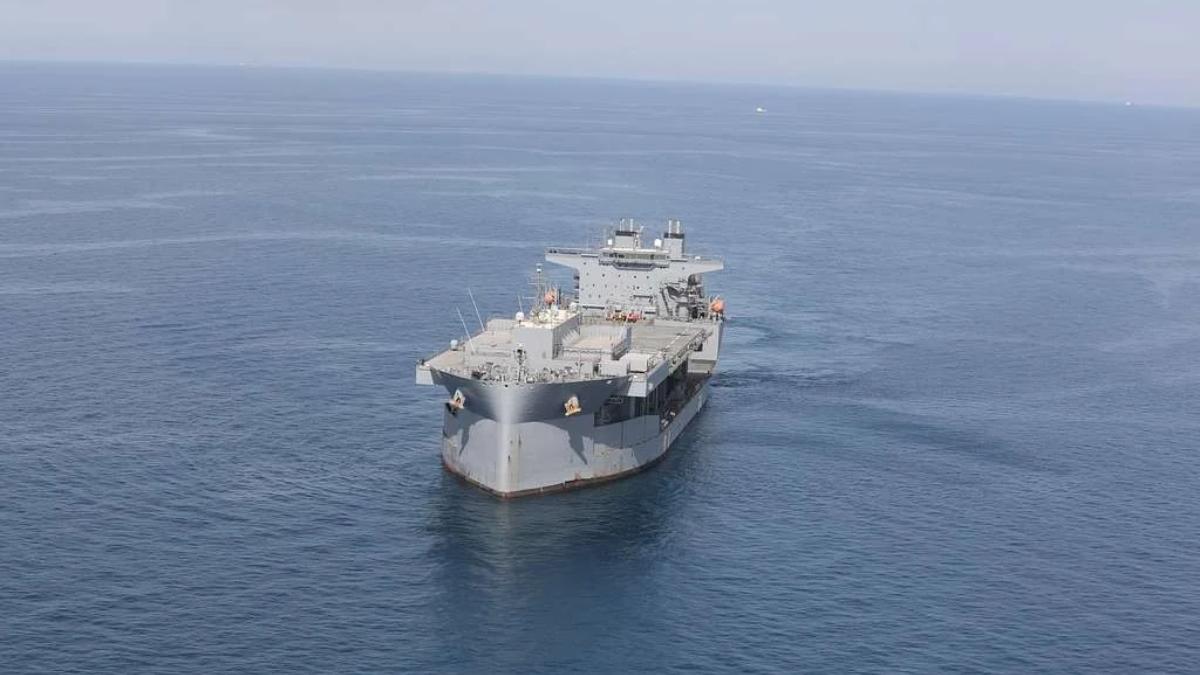

The Port of Málaga has welcomed one of the most unusual vessels in the United States Navy fleet. The USS Lewis B. Puller (ESB-3), a massive floating platform designed to support military operations at sea, arrived in the Andalusian city on Sunday 22 November 2026, with plans to remain docked for around a month.
The vessel is currently berthed at Levante Pier (Muelle de Levante), where its impressive dimensions and distinctive design make it an unusual sight along Málaga's waterfront.
Measuring 239 metres in length and 50 metres in width, the ship stands out for its enormous flight deck and its appearance, which differs considerably from conventional destroyers, frigates and other military vessels.
This is not the ship's first visit to Málaga. It previously made a short stop at the port in April 2025.
Its return brings one of the US Navy's most distinctive support vessels back to the Costa del Sol, where it is expected to remain until approximately the second half of December.
How long will the USS Lewis B. Puller stay in Málaga?
The American naval vessel arrived in Málaga on Sunday 22 November 2026, according to reports on activity at the port.
Its initial schedule indicates that it will remain at Levante Pier for approximately four weeks.
This would place its departure around the second half of December 2026, although an exact departure date has not been publicly confirmed.
The planned visit is considerably longer than the ship's previous stop in April 2025.
It also recalls a similar visit in the summer of 2024, when another American expeditionary sea base, the USS Hershel 'Woody' Williams, spent several weeks at the Port of Málaga.
Both ships belong to a class of vessels developed to provide operational and logistical support to the US Navy.
The specific operational reasons for the Lewis B. Puller's latest visit have not been publicly detailed, nor have any particular activities during its stay been officially announced.
A 239-metre military ship that operates as a floating naval base
The USS Lewis B. Puller belongs to a category of ships known as Expeditionary Sea Bases (ESBs).
Unlike conventional aircraft carriers, which are primarily designed to deploy combat aircraft, these vessels provide operational and logistical support to military forces.
Their design allows them to accommodate personnel, equipment and helicopters while serving as mobile bases for operations at sea.
The Lewis B. Puller was developed using a hull concept derived from large commercial vessels, particularly oil tankers, helping explain its enormous dimensions.
Its main technical characteristics include:
| Feature | USS Lewis B. Puller details |
|---|---|
| Name | USS Lewis B. Puller |
| Identification | ESB-3 |
| Country | United States |
| Naval force | US Navy |
| Vessel type | Expeditionary Sea Base |
| Length | Approximately 239 metres |
| Beam | 50 metres |
| Displacement | Approximately 90,000 tonnes at full load, according to the US Navy |
| Shipbuilder | General Dynamics NASSCO |
| Delivered | June 2015 |
| Commissioned as a warship | August 2017 |
| Current berth | Levante Pier, Málaga |
The ship's size provides the space needed for facilities supporting military operations, maintenance work and logistical activities.
Its configuration also allows specialist personnel and equipment to be deployed according to the requirements of individual missions.
What is a US Navy expeditionary sea base used for?
One of the most distinctive characteristics of the USS Lewis B. Puller is its versatility.
Rather than being designed primarily for direct naval combat, the vessel serves as a platform supporting a range of military operations.
Its capabilities include assisting special operations forces, supporting certain mine countermeasure activities and facilitating helicopter operations.
The ship features a large flight deck capable of accommodating military helicopters used for transport and operational support.
It also contains accommodation facilities, equipment storage areas and maintenance spaces.
One of its main advantages is its ability to provide these services without relying entirely on permanent military installations ashore.
The expeditionary sea base concept allows military personnel and equipment to operate from a mobile maritime platform, adapting to different operational requirements.
However, the ship's presence in Málaga does not necessarily mean that any of these missions will take place during its stay.
These are the general capabilities for which the vessel was designed.
An enormous flight deck designed for helicopter operations
One of the most striking features of the Lewis B. Puller is its extensive flight deck.
The vessel provides space for helicopter operations, including aircraft used for transport and military support missions.
According to the specifications of this class of vessel, its facilities include several helicopter operating positions and equipment to support maintenance activities.
These capabilities are particularly useful when naval forces need to deploy resources far from their permanent bases.
The ship also contains working areas and storage facilities designed to support different maritime operations.
This combination of functions explains why expeditionary sea bases look so different from more traditional military vessels.
Rather than concentrating their design on visible weapons systems, much of their structure is dedicated to operational space and logistical support.
From a naval support ship to a commissioned US Navy warship
The USS Lewis B. Puller's history began before it was officially incorporated into the US Navy as a commissioned warship.
The vessel was built by General Dynamics NASSCO, an American shipbuilding company based in San Diego, California.
It was delivered in June 2015, originally operating under the designation USNS Lewis B. Puller.
During this initial period, the ship was associated with the Military Sealift Command, an organisation responsible for providing maritime transport and logistical support to US naval forces.
The vessel was subsequently commissioned into the United States Navy.
This transition took place in August 2017, when it received the designation USS Lewis B. Puller.
The change formally brought the ship into the Navy's commissioned warship fleet.
Although its commissioning involved changes to its operational structure and command arrangements, vessels of this type can operate with a combination of military personnel and specialised civilian mariners.
This reflects the ship's unusual role in supporting both logistical and military activities.
Who was Lewis B. Puller, the Marine who gave the ship its name?
The vessel is named after Lewis Burwell Puller, one of the most famous figures in the history of the United States Marine Corps.
Widely known by his nickname, Chesty Puller, he had a long military career and served in several conflicts during the twentieth century.
He is recognised as one of the most highly decorated Marines in American military history.
His name was chosen for the expeditionary sea base as part of the US Navy's tradition of naming vessels after significant military figures.
The Lewis B. Puller also represents an alternative approach to naval capabilities, focusing primarily on supporting and sustaining maritime operations rather than performing the same role as traditional combat ships.
Málaga welcomed another giant American military vessel in 2024
The USS Lewis B. Puller's latest visit follows another notable American naval stopover in Málaga.
During the summer of 2024, the USS Hershel 'Woody' Williams (ESB-4), another expeditionary sea base belonging to the same class, made an extended visit to the city's port.
That arrival attracted attention because of the ship's dimensions and unusual design compared with the commercial vessels and cruise ships that regularly visit Málaga.
The Hershel 'Woody' Williams shares many characteristics with the Lewis B. Puller, having been developed to provide similar maritime operational support.
The visits of these two vessels demonstrate that Málaga has previously hosted American expeditionary sea bases.
The Lewis B. Puller itself also visited the port in April 2025, although that stop was significantly shorter.
Its arrival in November 2026 therefore marks another return to the Andalusian port.
Why does Málaga receive international military vessels?
The Port of Málaga occupies a strategically important geographical position in southern Spain, with maritime connections between the Mediterranean Sea and the Atlantic Ocean through the Strait of Gibraltar.
This location places the city along routes used by commercial ships, cruise liners and other vessels navigating the western Mediterranean.
The port has infrastructure capable of accommodating large ships, including certain types of military vessels.
Naval port visits can serve several purposes, such as crew rest, replenishment and logistical support.
However, the specific purpose of the Lewis B. Puller's current stay has not been publicly confirmed.
It would therefore be inaccurate to assume that its presence is connected to any particular military mission or operation.
What has been reported is its arrival at Levante Pier and its expected stay of approximately one month.
Can the public visit the USS Lewis B. Puller in Málaga?
The arrival of such an enormous military vessel may attract interest from residents and visitors hoping to see it.
However, the fact that the ship is docked in Málaga does not mean it is open to the public.
No public tours or open days aboard the USS Lewis B. Puller have been announced during its stay in Málaga.
As an active military vessel, access is subject to authorisation and security restrictions.
It is also important to distinguish between viewing the ship from publicly accessible areas and entering restricted port facilities.
Anyone hoping to see the vessel from the waterfront should respect all signs, security instructions and access restrictions.
Any potential public visiting arrangements would need to be officially announced by the relevant authorities.
The USS Lewis B. Puller becomes an unusual sight on Málaga's waterfront
The arrival of the American military vessel represents one of the more distinctive port visits recorded in Málaga during November.
Its 239-metre length, extensive flight deck and configuration as an expeditionary sea base make it noticeably different from the ships normally seen in the harbour.
The expected month-long stay means the vessel could remain at Levante Pier until approximately the second half of December.
Its earlier visit in April 2025, together with the extended stop by the USS Hershel 'Woody' Williams in 2024, places this latest arrival among several visits by large American naval support vessels to Málaga.
Although the activities planned during the stay have not been publicly disclosed, the Lewis B. Puller has once again brought one of the US Navy's most unusual operational platforms to the Costa del Sol.
For approximately one month, Málaga's port will have one of the giants of the American Navy as part of its waterfront landscape, while confirmation of the vessel's final departure date is still awaited.

Latest news


Similar News

More than 2,400 Andalusian schoolchildren to help protect beaches and marine wildlife
Málaga

Málaga's Baños del Carmen beach transformation takes shape as expansion to 12,700 square metres progresses
Málaga

Matías Prats to switch on Málaga's Christmas lights on November 27: times, El Kanka concert and what's new
Málaga