


Holy Week Movies in Malaga: A Guide to Watching One a Day and Where to Find Them
From classics to thrillers, the brotherhoods have lent their robes and thrones to films featuring Manolo Summers, Carmen Sevilla, Paco Rabal, and Mario Casas.
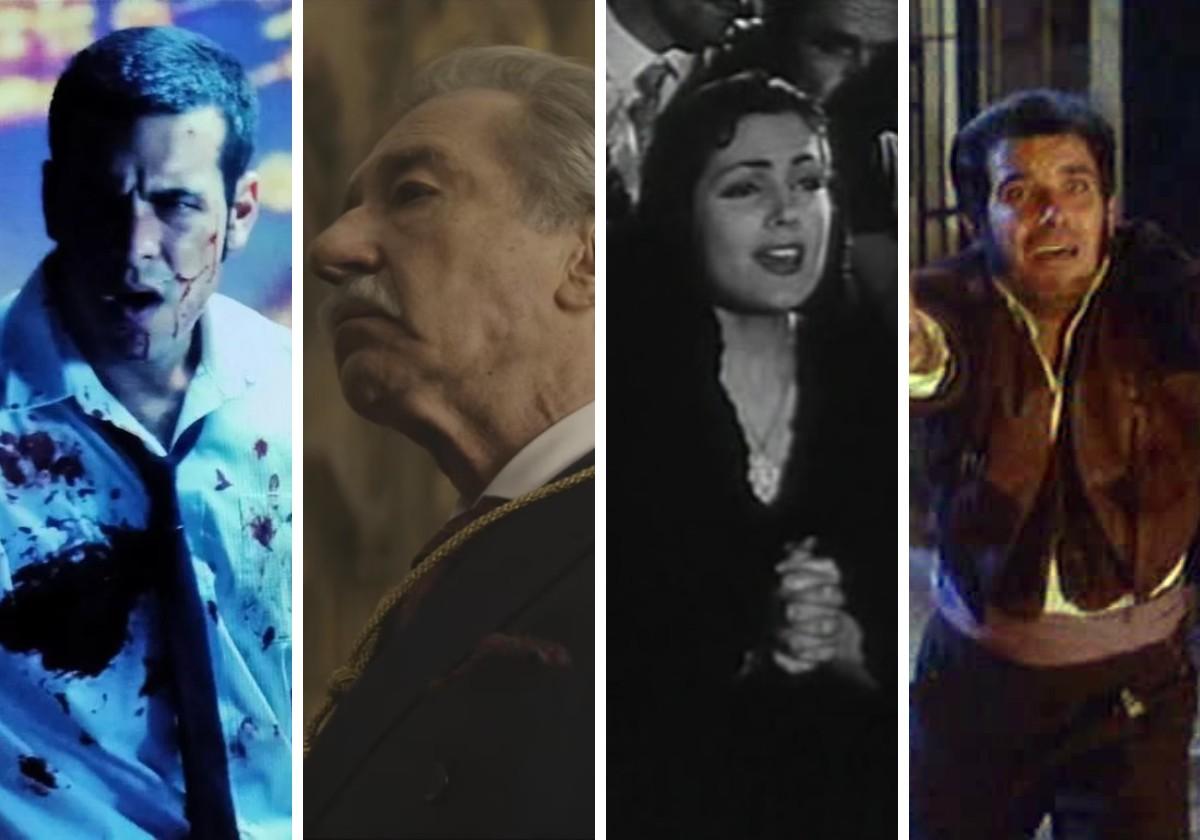

The streets are full. Just stepping into the historic center confirms that the Passion is lived with passion indeed. And that its fascination transcends the religious. A spectacle and magnetism that fiction cinema has also tried to capture on the big screen. Thus, the leaders of the Malaga brotherhoods have witnessed life-or-death tragedies, romantic dramas, devotions beyond faith, and even some refreshing feminist comedy about the world of the brotherhoods themselves. Here is an itinerary to watch a movie each day and where to find them:
'Toro': Mario Casas and the mafia's elder brother
No, El Cautivo does not have a movie. But if you're looking for a captivating story to start this journey through our Holy Week, here's one of the most recent productions: 'Toro' (2016), a vibrant thriller with Mario Casas showing off his muscles. The actor and Luis Tosar underwent their particular penance in this film by Kike Maíllo, in which the great Pepe Sacristán plays a mafia boss who does everything possible to be named elder brother of a brotherhood. Set in Malaga and Torremolinos, the script was not very appealing to the brotherhoods, so the shooting inside a brotherhood house had to be moved to the Collegiate Church of Antequera. And a Virgin was commissioned for the movie from the Malaga sculptor Juan Vega. The carving stars in the last scene of the film, alongside Casas, Sacristán, and generous doses of Christ's blood.
The first feature film that brought the thrones of Malaga to fiction came from France. 'Desire and Love' (1951), directed by Henri Decoin, was an early film in some respects, as it was one of the pioneering international shoots in the province during the dictatorship era, and it proposed a cinema-within-cinema storyline with the story of a French film crew arriving in Malaga to shoot a feature film. In the expedition travels the protagonist, a blonde 'vamp' (Martine Carol), whom a fisherman (the heartthrob Antonio Vilar) rescues from drowning. The one who ends up caught in the net is her savior, who even comes to abandon his virtuous partner (Carmen Sevilla). A melodrama with too much moralism, -spoiler alert- as the fisherman falls off the horse like Saint Paul after hearing his wife sing a saeta to the virgin during Holy Week. It is worth it for the images of Torremolinos in the 50s and the scenes of the thrones, among which the Virgin of the Dolores Coronada (Brotherhood of the Expiration) can be recognized.
Probably the most mythical film of the Holy Week in Malaga. This drama by José María Forqué mixed bandit cinema with touches of western to end up introducing the religious setting with a finale in which the spotlight falls on El Rico, who steals the scene from the very Paco Rabal. The brotherhood and the diocese gave their blessing for this shooting and, at the end of November 1956, the brotherhood and all its procession paraded again through Malaga during the three days that the shooting of the famous and tragic final sequence with the throne entering the Customs, where the gallows of the three prisoners sentenced to death awaited. Two awaited death and one, pardon thanks to the indulgence of El Rico. 'Dawn at Dark Gate' (1957) crossed borders and won the Silver Bear at the Berlin Festival.
Being one of the parades that arouses the most excitement in Malaga, it was not strange that the Brotherhood of Mena also had its movie. And for the same reason that it brings thousands of people to the streets every Thursday: the Legion. 'Fiancés of Death' (1974) was a drama-thriller from the late Franco era that portrayed a plot that was not at all liked by the official instances in those times of regime instability: a drug dealer who becomes a legionnaire to avoid accounting to justice and is followed by an old accomplice when he gets out of prison to take revenge. Despite the direction of the effective craftsman Rafael Gil, the film has not aged well, although it retains a seventies scene of the parade down Larios street of the throne of the Good Death and its legionary escort.
This Holy Week film can be described as a real rarity and feminist film that has remained hidden in the filmography of Holy Week in Malaga until recently. 'I Am a Woman Now!' (1975) bears the signature of the most uncomfortable, critical, acidic, and funny filmmaker of Spanish cinema of the late Franco era and the transition, Manolo Summers, who tells the story of a young woman who falls in love with a priest. With the novelty of a narrative from the woman's point of view, the plot takes the young protagonists to Malaga to attend and participate in the parades of Good Friday and the Royal Brotherhood of Love and Charity. The brotherhood lent about ten tunics with which a mock procession was set up for the shooting in the middle of July, which later in the editing were mixed with real images recorded that same Holy Week and which also have their documentary value by showing the thrones of Love and Charity through the Tribune of the Poor, in addition to the Virgin without the canopy with which she is currently processed.
On Holy Saturday, there are traditionally no processions, so we can take the opportunity to watch a movie that brings a smile to the world of Holy Week. It is 'My Beloved Brotherhood' (2017) and marked the directorial debut of Marta Díaz de Lope from Ronda with a comedy about a woman dedicated to her brotherhood who aspires to be the elder sister against the official candidate: a man. A fresh film that uses irony and humor to sharpen another chapter in the hard-fought conquest of women to open doors that were closed until very recently. Some as large as those of the brotherhood houses. Alongside the protagonists, Gloria Muñoz, Pepa Aniorte, Juan Gea, Joaquín Núñez, and Carmen Flores, the Royal Brotherhood of the Holy Burial of Ronda also lends its thrones and images to the frames.
The exception to this fictional filmography are the oldest films preserved about Holy Week in Malaga: two documentaries from the silent era, restored by the Filmoteca de Andalucía. The oldest depicts Holy Week 1926 in 'Andalucía: Málaga', of which only a seven-minute fragment is preserved, but which portrays unique images of the singular privilege mass that was celebrated on Holy Saturday in the Church of Santo Domingo and the procession of Resurrection Sunday as it passed through Larios street, with the throne of the Risen One, and Nazarenes from all the brotherhoods of the era. The other documentary, 'Holy Week Processions in Malaga 1930', has a misleading title since this film was edited in the thirties with images that had been shot in 1927 for the German movie 'Valencia'. The film shows great mass scenes on the steps of the Cathedral and the passage of the processions of the Blood, Hope, or Humiliation with carvings lost after the burning of convents and churches in 1931.

Latest news





Upcoming events
12
Nov
El Desembarco, la traición de Viriato at La Caja Blanca
12
Nov
HOMER El Mero Mero at Sala Trinchera Málaga
13
Nov
Marbella Startup Lab – Innovate & Collaborate
13
Nov
Candlelight: Coldplay & Imagine Dragons at Sala Fundación Unicaja María Cristina
13
Nov
Candlelight: Tribute to Ludovico Einaudi at Anantara Villa Padierna
Similar News

Málaga Airport Makes History with More Than Three Million Passengers in One Month
Málaga

Port of Málaga looks beyond its docks to support future growth
Málaga

Guide to the Virgen del Carmen Processions in Málaga and the Province
Málaga
