The Málaga streets with the highest concentration of holiday rentals
The historic centre has the highest pressure, with some streets where more than eight in ten homes are registered as tourist accommodation
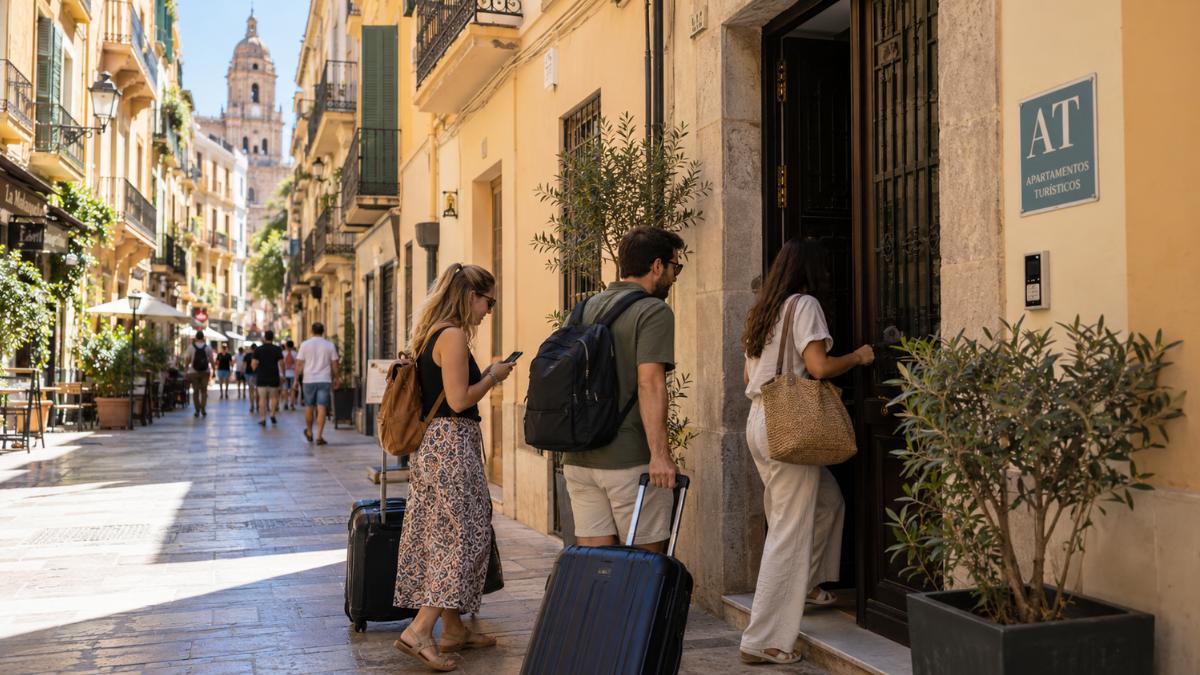

Málaga’s holiday rental map reveals a very uneven picture across the city. While some neighbourhoods still have a relatively limited presence of tourist accommodation, certain streets in the historic centre and La Malagueta show exceptionally high concentrations.
By combining data from the Andalusian Tourism Register with residential figures from the Land Registry, it is possible to identify both the streets with the highest number of registered holiday lets and those where tourist accommodation represents the largest share of the local housing stock.
Victoria and Carretería among Málaga’s top streets for holiday rentals
By total number of registered properties, Calle Victoria leads the ranking with 166 holiday rentals.
Close behind is Carretería, with 159, representing around 46.5% of all homes counted on the street.
Six streets have around 100 or more registered tourist homes
Several other streets also stand out for their sheer volume:
- Pacífico: 127
- Ollerías: 118
- Martiricos: 108
- Peña: 105
- Jinetes: 98
The figures reveal two different patterns: some streets have high numbers because they are large, while others stand out because tourist accommodation accounts for most of the housing available.
One street in La Malagueta is almost 90% holiday rentals
One of the most striking cases is Calle Pintor Martínez Virel, a small street close to La Malagueta beach.
Of the 49 homes listed in the Land Registry, 44 are registered for tourist use.
That puts the concentration at close to 90%.
Jinetes also exceeds 80%
A similar pattern appears on Calle Jinetes, close to the Cervantes Theatre.
More than eight in ten homes on the street are included in the tourist accommodation register.
Other streets with particularly high concentrations include Montaño, Peña, Dos Aceras, Madre de Dios, Sebastián Souvirón, Carretería, Lagunillas, Ollerías, Álamos and San Juan de Letrán.
Carretería, Ollerías and Jinetes form one of the main hotspots
The area around Carretería, Ollerías, Montaño, Jinetes and Peña has become one of the clearest hotspots for holiday rentals in central Málaga.
It is not just about the number of properties.
On several of these streets, tourist accommodation represents more than half of the total housing stock.
How local businesses have changed
The residential shift has also been accompanied by visible changes at street level.
In recent years, the area has seen a growing number of businesses aimed mainly at visitors, including:
- luggage storage facilities
- laundries
- cafés
- restaurants
- tourist-oriented shops
- services linked to short-term accommodation.
The result is a gradual transformation of both the residential and commercial character of these streets.
Málaga city centre contains more than half of all tourist rentals
The difference between districts is also significant.
The Centro district has around 7,072 registered tourist homes, accounting for approximately 56% of the citywide total analysed.
Málaga East and Carretera de Cádiz are far behind
The next districts with the highest numbers are Málaga East and Carretera de Cádiz, with around 1,500 each.
Even so, both remain far below the concentration found in the historic centre.
Cruz de Humilladero accounts for more than 5% of the total, while Bailén-Miraflores comes close to that figure.
Being registered does not mean a property is currently being rented
There is an important distinction.
A property appearing on the Andalusian Tourism Register does not necessarily mean it is currently advertised or available on holiday rental platforms.
It does, however, mean that it is registered to operate legally as tourist accommodation.
The figures therefore measure the amount of housing authorised for tourist use rather than the exact number of properties available on any particular day.
Málaga has stopped new holiday rental registrations
The growth in tourist accommodation led Málaga City Council to introduce progressively stricter measures.
The restrictions have developed in several stages.
First measure: independent access
The City Council first introduced an urban planning rule requiring, in certain cases, tourist properties to have independent entrances and services when located in buildings that also contain residential homes.
Second measure: the 8% threshold
Málaga later restricted new tourist accommodation in neighbourhoods where holiday rentals already represented more than 8% of the residential housing stock.
Dozens of neighbourhoods were already above that level.
Third measure: a citywide moratorium
Finally, the City Council introduced a temporary suspension of new holiday rentals across the entire municipality while changes are made to the city’s urban development plan.
The measure came into force on 23 August 2025 and can remain in place for up to three years, unless the new planning rules are approved sooner.
Málaga’s restrictions are also being challenged
The new rules have not been free from controversy.
Spain’s National Markets and Competition Commission, the Secretariat for Market Unity and the Andalusian Competition Agency have all examined the municipal restrictions.
The main issue is whether the measures are sufficiently justified and whether they represent the least restrictive way of regulating the activity.
The wider debate: tourism versus residential housing
Málaga reflects one of the major urban debates currently affecting popular tourist cities.
On one side, holiday rentals generate economic activity, accommodation for visitors and business opportunities.
On the other, very high concentrations can reduce the availability of long-term residential housing and change the everyday character of neighbourhoods.
When a street stops being mainly residential
The examples of Pintor Martínez Virel and Jinetes show how dramatically that balance can shift.
When 80% or 90% of homes are linked to tourist use, the character of a street can change substantially.
Visitor turnover increases while the proportion of permanent residents falls.
The streets that best illustrate Málaga’s tourist rental pressure
The latest figures highlight several particularly significant areas.
By total number of tourist homes
Victoria, Carretería, Pacífico, Ollerías, Martiricos and Peña rank among the streets with the largest absolute numbers.
By percentage of total housing
Pintor Martínez Virel, Jinetes, Montaño, Peña and Dos Aceras are among the streets where tourist accommodation accounts for the largest share.
They are two different ways of measuring the same phenomenon.
Málaga enters a new phase in its holiday rental debate
With more than 12,000 tourist properties registered and a moratorium preventing new additions, Málaga has entered a different stage in the regulation of short-term accommodation.
The debate is no longer only about how quickly the sector is growing.
It is now increasingly focused on how existing tourist rentals should be managed, which neighbourhoods are under the greatest pressure and how much space should remain available for permanent residents.
The map of Málaga’s most heavily affected streets makes it clear where that challenge is currently most concentrated.

Latest news