


Inma Aguilera:
The writer from Malaga extends the success of 'The Lady of the Charterhouse' with 'The Painter of Light', in which she advocates for the Expo of '29 and Andalusian regionalist architecture.
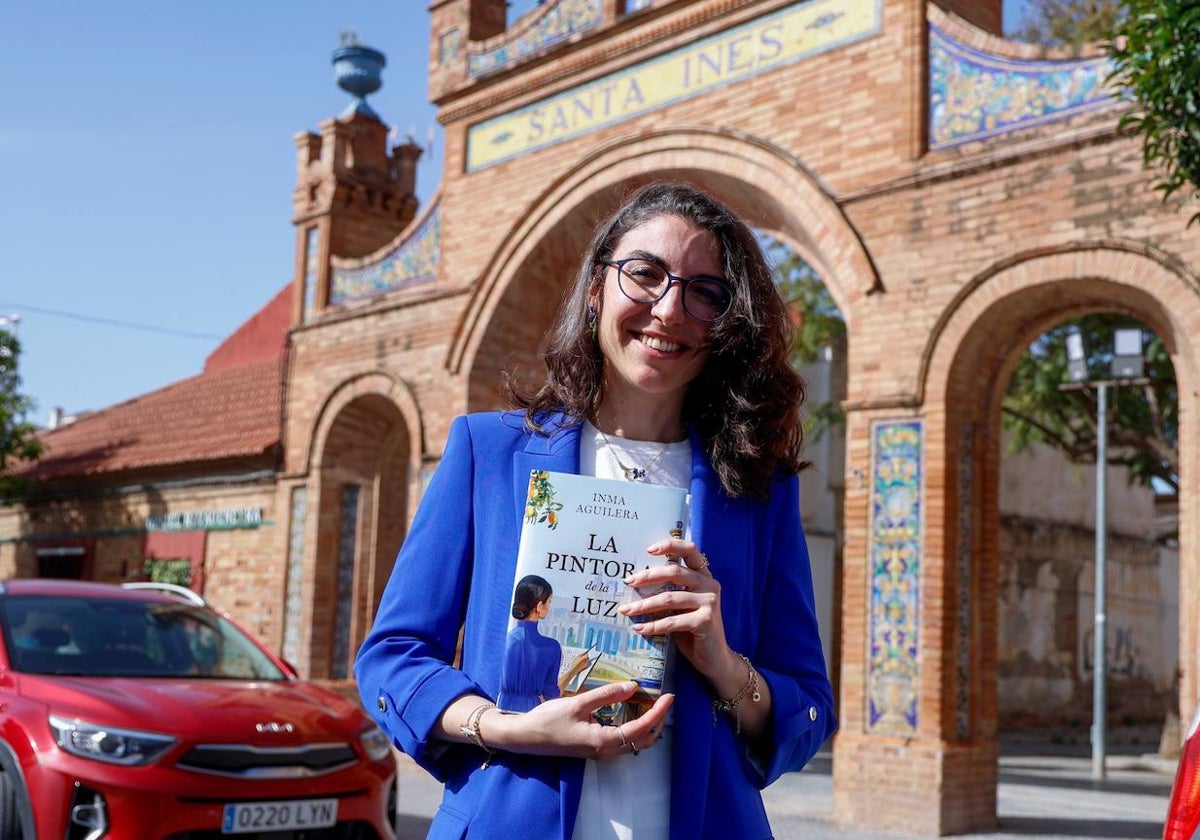

The clay "casas mata" of Navarro Ledesma signal that we are nearing the old working-class neighborhood born from the brick factory in this area... of Teatinos. A factory that not only supplied stone for the houses but also gave them their name: Colonia de Santa Inés. We have agreed to meet Inma Aguilera (Málaga, 1991) at the regionalist-style entrance arch to talk about her new novel, 'The Painter of Light,' set in the Seville that hosted the Ibero-American Exposition of 1929. From here, not only bricks came out but also labor for the famous Plaza de España and the pavilions of that event that revolutionized the city architecturally, but also socially modernized it. These changes are the focus of this book that mixes historical and romantic narrative in the powerful tile industry, and it is a sequel to 'The Lady of La Cartuja,' published last year and which earned the writer the title of "breakout author" after reaching five editions. The paradox is that Aguilera is no newcomer.
Expand
Writer Inma Aguilera tells the story of a painter in the Seville that illuminated the Expo of '29."The truth is that I am honored and I feel fortunate, but it amuses me because I have written all my life. 'The Painter of Light' is my thirteenth novel," admits Aguilera, who nearly a decade ago won the Young Ateneo Award of Seville with her fourth book, 'The Flutter of the Butterfly'. However, she admits that her case is common. "For the public, people who become known seem to come out of nowhere and I always remember Chiquito de la Calzada, a genius all his life, but fame came to him late. So, in that sense, I've been quite lucky," the author concedes, who does not hide that her success also came unexpectedly.
The Novel
-
Title: 'The Painter of Light'
-
Author: Inma Aguilera
-
Publisher: Ediciones B, 2025, Spain, 570 pages, 23.90 euros
"I have written all my life and always hoped that my stories would resonate, but suddenly it was with a historical novel that, truthfully, pleasantly surprised me," admits Inma Aguilera, who started in a very different genre, fantasy, until in 2020 she tried a period tale set in 19th-century Málaga with the backdrop of the real character of Amalia Heredia, 'The Eccentric Mr. Dennet', and her own story as an author changed. "Let's see where all this takes me. I hope I can keep writing and that they keep reading me all my life," confesses the novelist, who comes from comics and has been a journalist and broadcaster, voice actress, and professor at UMA. Activities she has set aside to focus on writing, which she considers a "privilege."
The Architect of a City
"There is a lot of helplessness in Trinidad because she cannot be herself, she cannot say what she wants, and she cannot show herself as she is until there comes a moment when she says: 'Enough.' And that, deep down, is what has happened to us women," the writer confesses about her protagonist who interacts with historical characters, like the stubborn Marchioness Pickman, owner of the La Cartuja factory; King Alfonso XIII, obsessed with his latest car model, and particularly Aníbal González, the great architect who designed the Expo of '29, with whom Laredo will work hand in hand. Brick by brick. A relationship with which the author "claims" the regionalist urbanism that emerged from the "Andalusian identity" against the prevailing modernism of Gaudí at the time.
"The young people at the beginning of the 20th century were in a very similar situation to now: precariousness and difficulty in finding a house"
Inma Aguilera
Writer
"Anibal has been the great discovery I made while researching this topic because he was practically the rebuilder of the city of Sevilla, as we know it. I found his figure very moving, both as a creative, artistic, and architectural genius, but also for how he got involved in the life of the workers of that time," reflects the author, who also imbues her narrative with a social tone with the difficult labor conditions in the factories at the beginning of the 20th century, the strikes, and the protests. A view with touches of 'Les Misérables', which also has parallels with the present day.
"When researching the conditions of society back then, I was fascinated by the difficulties of Sevillian society and of all of Spain in general. The novel is set shortly after the Tragic Week of Barcelona and I was surprised that a series of things were happening to the young people of that time, between 20 and 40 years old, whose situation was very similar to now: labor precariousness, multiple jobs, difficulty in finding a house or a rental, and delay in the age of marriage. In contrast with our parents and grandparents, this is happening again and that frustration and social hardships reminded me a lot of 'Les Misérables' and the present moment, which is why I think today's young people will identify with the characters," argues the writer who has a very personal connection with the era and the Ibero-American Exposition.
Thus, her great-grandfather, Manolo Lozano, was the chauffeur and caretaker for Modesto Escobar, the businessman of the brick factory in the Colonia de San Inés. "In those times, he took him many times to Sevilla because he was very involved in the construction of the Expo," explains Inma Aguilera, who glances at the arch that serves as the setting for our chat. No more words are needed from her choice for this interview as a 'breakout writer'. Readers have known her for the historical novel, but she confesses that she is still drawn to 'romantasy', the mix of fantasy and love plots. "Every author ultimately seeks their own style and I suppose I am on my way to getting to know Inma Aguilera and see how she writes. Let's see if I can catch the trick."
Session Limit Reached
Access to Premium content is open courtesy of the establishment where you are, but currently there are too many users connected at once.
Please try again in a few minutes.
Session Closed
When logging in from a different device, for security, the last session on this one was closed.
To continue enjoying your digital subscription, log in on this device.
Log in More informationDo you have a subscription? Log in
Comment Report an error
Latest news





Upcoming events
12
Nov
El Desembarco, la traición de Viriato at La Caja Blanca
12
Nov
HOMER El Mero Mero at Sala Trinchera Málaga
13
Nov
Marbella Startup Lab – Innovate & Collaborate
13
Nov
Candlelight: Coldplay & Imagine Dragons at Sala Fundación Unicaja María Cristina
13
Nov
Candlelight: Tribute to Ludovico Einaudi at Anantara Villa Padierna
Similar News

Málaga Airport Makes History with More Than Three Million Passengers in One Month
Málaga

Port of Málaga looks beyond its docks to support future growth
Málaga

Guide to the Virgen del Carmen Processions in Málaga and the Province
Málaga
