


Ronda, the Málaga Town That Captivated Orson Welles and Became His Final Resting Place
The director of Citizen Kane maintained a close relationship with Spain and bullfighter Antonio Ordóñez’s family for decades. His ashes rest on a private estate in Ronda, a town that still preserves several public tributes to the filmmaker.

Orson Welles’ Fascination with Spain
Orson Welles found in Spain a landscape, culture and way of life that would accompany him throughout much of his career. The American director, actor and screenwriter first discovered the country as a young man and developed a particular fascination with Andalusia and bullfighting.
His relationship with Spain went far beyond occasional visits. Welles travelled through different cities, attended bullfights and turned the country into both a setting and a source of inspiration for several film projects.
Of all the places he encountered, Ronda held a particularly important place. The Serranía landscape, the dramatic gorge, the historic bullring and the town’s distinctive atmosphere captivated the creator of Citizen Kane.
A Close Friendship with Antonio Ordóñez
Welles’ connection with Ronda grew stronger through his friendship with Antonio Ordóñez, one of the most celebrated bullfighters of the 20th century. The filmmaker became close to the Ordóñez family and spent time at El Recreo de San Cayetano, their estate outside the town.
The property became a place of rest and companionship for Welles. He attended gatherings and celebrations there, gradually becoming regarded as a member of the family.
Welles was deeply interested in bullfighting as a cultural expression and ritual. This fascination appeared in several of his audiovisual works and unfinished projects about Spain, in which he documented festivals, landscapes and popular traditions.
His Ashes Rest on a Ronda Estate
Orson Welles died in Los Angeles on 10 October 1985 at the age of 70. Two years later, his ashes were brought to Ronda and placed inside an old dry well at El Recreo de San Cayetano.
The small ceremony took place in May 1987 and was attended by his daughter Beatrice Welles, Antonio Ordóñez and a limited group of the filmmaker’s friends. The urn was covered with earth and sand from the bullring.
An inscription commemorates the relationship between Welles and the town: “Ronda, to the master of masters.” Some of Antonio Ordóñez’s ashes were later placed in the same well.
The estate remains private property, meaning the filmmaker’s resting place is not one of Ronda’s publicly accessible attractions.
A Public Tribute Beside the Bullring
Although the burial site cannot be freely visited, Ronda preserves Welles’ memory in one of its most prominent locations.
A monument dedicated to the filmmaker stands beside the historic bullring and the entrance to Paseo de Blas Infante. Unveiled in 2015, it shares the area with another tribute to Ernest Hemingway, who was also closely associated with Ronda and bullfighting.
Visitors can continue through the Blas Infante gardens and along the paths beside the gorge. Their viewpoints provide sweeping panoramas of the Serranía and help explain why the landscape impressed so many international writers, artists and travellers.
One of the town’s walkways also carries Welles’ name, incorporating his story into an itinerary combining cinema, literature, history and local heritage.
Exploring the Ronda Known by Welles
The bullring provides an appropriate starting point for a route inspired by Welles’ relationship with Ronda. Opened in the 18th century, it is regarded as one of the most significant places in the history of Spanish bullfighting.
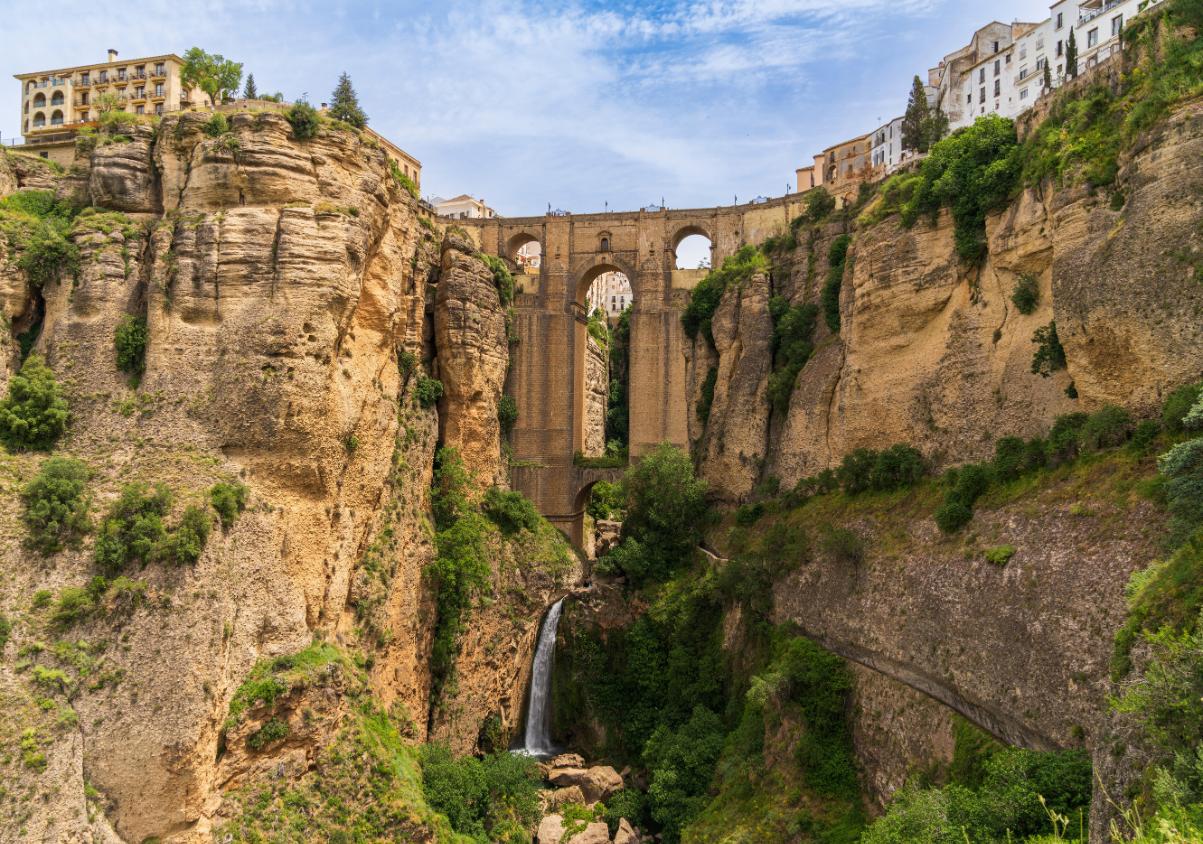
Just a few minutes away, Alameda del Tajo is a historic garden with mature trees and balconies overlooking the surrounding mountains. From here, visitors can walk towards Puente Nuevo, Ronda’s most recognisable landmark.
The bridge crosses a gorge approximately 100 metres deep and connects the Mercadillo district with the historic quarter. On the other side are palaces, churches, stately houses and streets that retain elements of their medieval layout.
The route can continue to the Arab Baths, Mondragón Palace, Casa del Rey Moro and the walls of the former medina. Together, these landmarks reveal a town shaped by different cultures and one of the most dramatic geographical settings in Andalusia.
A Refuge for Artists and Travellers
Orson Welles was not the only international figure to fall under Ronda’s spell. Ernest Hemingway wrote about its bullfighting traditions, while numerous artists and authors found inspiration in the gorge, the Serranía and the monumental historic centre.
Welles’ relationship with the town remains especially remarkable because it continued beyond his lifetime. Ronda was not simply a travel destination or a picturesque setting, but the place chosen by his family as his final resting place.
Decades after his death, the filmmaker remains part of Ronda’s cultural and emotional heritage. His public monument allows visitors to remember that connection while exploring the places that explain his fascination with the town.
The relationship between Orson Welles, Antonio Ordóñez and Ronda is also documented by the official tourism website of Andalusia.

Latest news





Upcoming events
12
Nov
El Desembarco, la traición de Viriato at La Caja Blanca
12
Nov
HOMER El Mero Mero at Sala Trinchera Málaga
13
Nov
Marbella Startup Lab – Innovate & Collaborate
13
Nov
Candlelight: Coldplay & Imagine Dragons at Sala Fundación Unicaja María Cristina
13
Nov
Candlelight: Tribute to Ludovico Einaudi at Anantara Villa Padierna
Similar News
How Wines Are Made in the Serranía de Ronda: Tradition, Precision and Craftsmanship
Ronda
