


Marbella releases two loggerhead turtles back into the Mediterranean after their recovery
Pepa and Hulia were released more than two miles off the coast after recovering from serious health problems caused by dehydration, lung complications and marine debris.
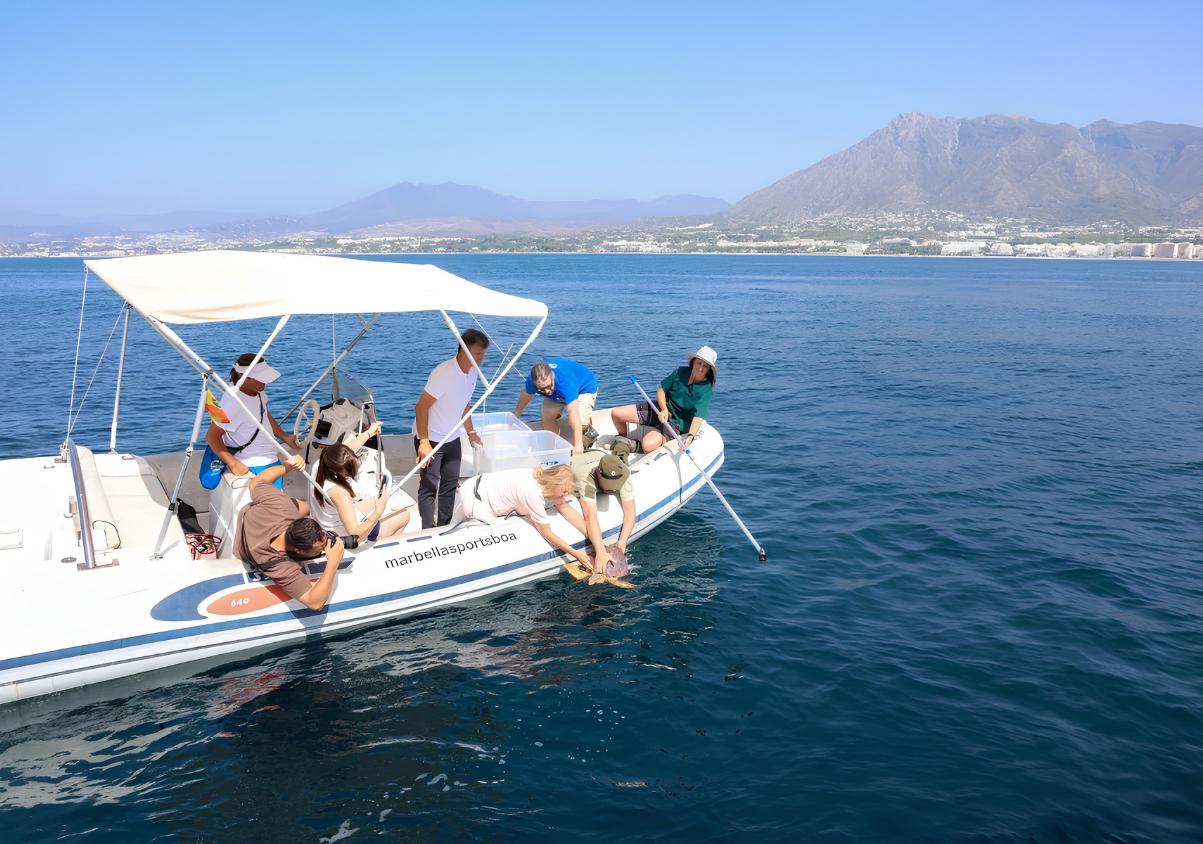

Two new inhabitants have returned to the Mediterranean off Marbella after months of veterinary care. Pepa and Hulia, two loggerhead turtles (Caretta caretta), have been released after successfully completing their rehabilitation and receiving approval from specialists to return to the wild.
The release took place from a boat that departed from Marbella’s Virgen del Carmen Marina and travelled more than two miles offshore before returning the animals to their natural habitat.
The moment brought two very different survival stories to a positive end. One turtle had been found stranded and severely dehydrated in Rincón de la Victoria, while the other was discovered in Almería entangled in marine debris around its neck and all four flippers.
Pepa: from being stranded in Rincón de la Victoria to returning to the sea
Pepa’s story began on 4 March 2026, when the turtle was found on a beach in Rincón de la Victoria.
Officers from Seprona, the environmental unit of Spain’s Guardia Civil, initially took responsibility for the animal, which was in a condition that seriously threatened its survival.
Pepa weighed just 4.3 kilograms on admission and was suffering from severe dehydration.
Specialists also detected buoyancy problems and lung complications, requiring intensive veterinary treatment.
The turtle’s condition was serious enough to require assisted feeding through a tube before it gradually began to recover.
Pepa was later transferred to the Andalusian Marine Environment Management Centre (CEGMA), where specialists monitored its progress and assessed whether it had regained the skills needed to survive independently in the wild.
Months later, those tests finally confirmed that Pepa was ready to return to the Mediterranean.
Hulia was trapped in raffia sacks and other marine debris
The second turtle, Hulia, highlights one of the major threats facing marine wildlife in the Mediterranean: abandoned waste.
Hulia was found on 30 June 2026 on a beach near Retamar, Almería, suffering from severe entanglement.
Raffia sacks and other pieces of marine debris had become wrapped around the turtle’s neck and all four flippers, causing constriction injuries.
When Hulia was rescued, the turtle was also dehydrated and in poor physical condition, weighing 6.3 kilograms.
A programme of veterinary treatment, wound care and rehabilitation then began, aimed not only at healing the injuries but also at ensuring the turtle could once again swim, feed and move normally without assistance.
Its recovery progressed successfully and specialists eventually determined that Hulia was ready to return to the sea.
Released more than two miles off Marbella
Pepa and Hulia were not released directly from the beach.
A boat departed from Virgen del Carmen Marina and transported the two turtles to a location more than two miles off the Marbella coast.
Before their release, specialists had carried out all the necessary checks to confirm that both animals were capable of surviving independently.
The operation marked the end of a coordinated effort involving environmental authorities, veterinarians and security services.
Those involved included the Andalusian Regional Government’s environmental department, biodiversity specialists, Seprona, CEGMA veterinary teams and the Seville Aquarium, among other professionals and organisations.
Marbella and loggerhead turtles: a relationship that extends to its beaches
Loggerhead turtles are not only seen swimming through the waters off Marbella.
In recent years, the municipality has also recorded nesting activity on its beaches, an important development for the monitoring and conservation of the species.
Marbella Town Hall has highlighted nesting episodes in areas including Calahonda and Nueva Andalucía.
These events require special monitoring to prevent nests and eggs from being damaged by pedestrians, beach machinery, animals or changing beach conditions.
Organisations such as ProDunas, together with residents and volunteers, have been involved in protecting nesting areas and raising environmental awareness.
Marbella has already witnessed particularly unusual scenes linked to the species, including hatchlings emerging from nests and beginning their journey towards the Mediterranean.
Why marine waste is so dangerous for turtles
Hulia’s case provides a particularly clear example of how rubbish entering the sea can become a serious threat to marine wildlife.
Ropes, netting, plastic bags, sacks and other materials can become wrapped around animals as they swim.
In Hulia’s case, debris affected both the neck and all four limbs, causing significant injuries.
The release therefore also served as a reminder of the importance of preventing rubbish left on beaches, promenades and other outdoor areas from reaching the sea.
Protecting the coastline does not depend only on major environmental programmes. Everyday actions such as picking up plastic, disposing of rubbish correctly and avoiding leaving waste behind can reduce the risks faced by species travelling through the Mediterranean.
What should you do if you find a sea turtle in trouble?
Pepa’s recovery began because the turtle was located and could then be treated by professionals.
Finding a turtle apparently motionless on a beach does not necessarily mean it should be handled or immediately returned to the water.
If the animal is injured, tangled in debris, struggling to move or stranded onshore, it should be left to specialist professionals and emergency services.
Trying to remove debris yourself can make injuries worse, while placing a weak turtle back into the water could prevent it from receiving the treatment it needs.
The recovery of Pepa and Hulia shows that proper veterinary care can allow turtles found in serious condition to return to the sea months later with a genuine chance of survival.
A recovery that ends where it began: in the Mediterranean
The release marked the final stage of two rescue operations that began hundreds of kilometres apart.
Pepa went from being stranded, dehydrated and suffering from lung problems on a Málaga beach to once again being capable of swimming freely.
Hulia recovered from injuries caused by waste wrapped around almost its entire body.
Now both share the same destination again: the Mediterranean.
Their return also adds to Marbella’s wider conservation efforts surrounding a species that is becoming increasingly familiar along its coastline and has even chosen some of the municipality’s beaches as nesting sites in recent years.
Pepa and Hulia: their recovery at a glance
🐢 Species: Loggerhead turtle (Caretta caretta).
🌊 Release: Off the coast of Marbella.
⛵ Departure point: Virgen del Carmen Marina.
📍 Release point: More than two miles offshore.
🐢 Pepa: Found on 4 March in Rincón de la Victoria.
⚖️ Pepa’s weight on admission: 4.3 kg.
🩺 Condition: Severe dehydration, buoyancy problems and lung complications.
🐢 Hulia: Found on 30 June near Retamar, Almería.
⚖️ Hulia’s weight on admission: 6.3 kg.
🪢 Condition: Entangled in raffia sacks and other debris around the neck and all four flippers, as well as dehydration and poor body condition.
🏥 Recovery: Veterinary treatment and specialist rehabilitation before being cleared for release.
Pepa and Hulia’s story has therefore ended in the best possible way: after months of treatment and rehabilitation, both turtles are once again swimming freely off Marbella, while their rescue serves as another reminder of the importance of keeping beaches clean and protecting the Mediterranean ecosystem.
Full details of the rescue, rehabilitation and release of both turtles can be found in the official information published by Marbella Town Hall.

Latest news





Upcoming events
12
Nov
El Desembarco, la traición de Viriato at La Caja Blanca
12
Nov
HOMER El Mero Mero at Sala Trinchera Málaga
13
Nov
Marbella Startup Lab – Innovate & Collaborate
13
Nov
Candlelight: Coldplay & Imagine Dragons at Sala Fundación Unicaja María Cristina
13
Nov
Candlelight: Tribute to Ludovico Einaudi at Anantara Villa Padierna
Similar News
Marbella introduces new rubbish disposal hours from November 1: updated times, recycling rules and fines
Marbella

Marbella postpones Halloween celebrations to November 1 following national mourning for Toledo train crash victims
Marbella
Marbella wins ‘Best Hub’ award at Startup OLÉ Salamanca for its innovation strategy
Marbella
