


The ships 'Castilla' and 'Galicia' dock in Malaga after participating in NATO's largest exercise this year and can be visited
In the Dynamic Mariner/Flotex-25, which has tested the Navy's ability to command a naval force in the waters of the Gulf of Cádiz, 5,000 military personnel from eight Alliance countries participated.
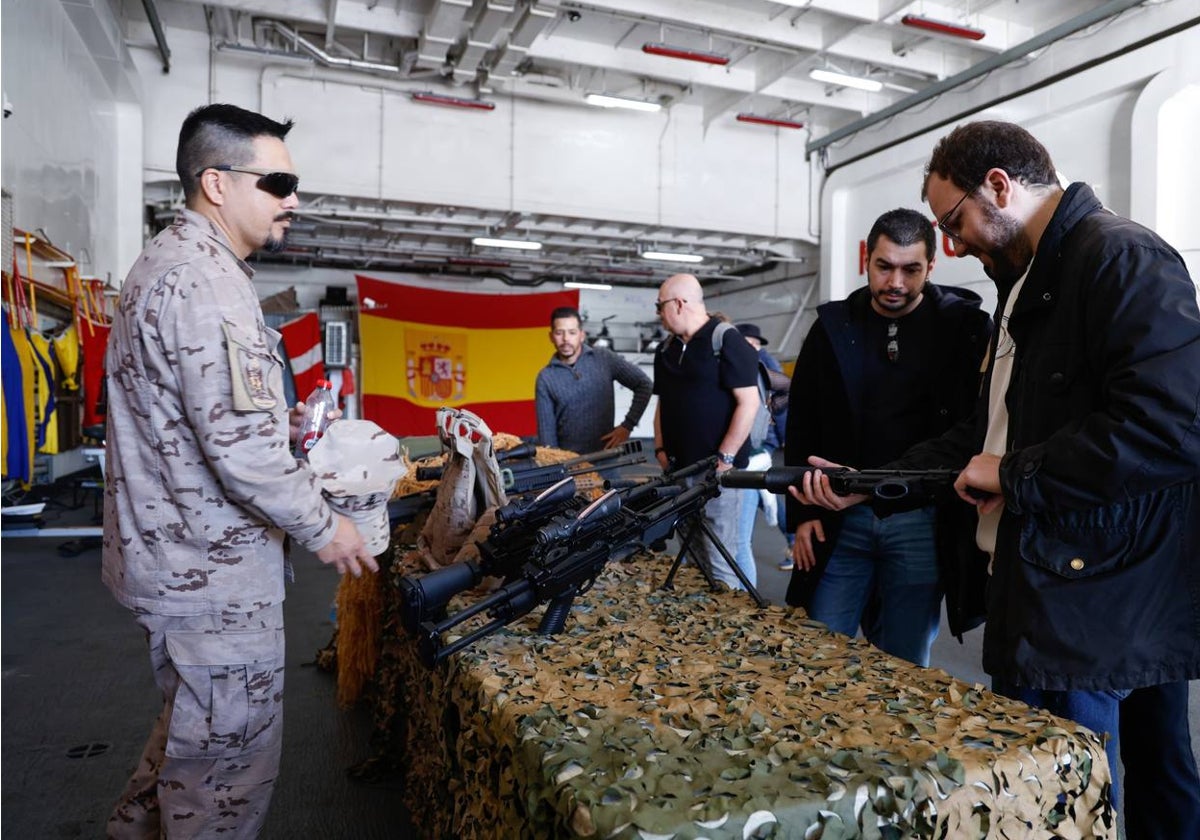

There was half an hour left until the opening at 10:00 AM, and several people were already waiting at pier 2 to visit the amphibious assault ship 'Castilla' this Saturday. Along with its twin 'Galicia', docked at the Levante dock, they have made a stop at the Port of Málaga after participating in NATO's largest naval exercise this year. For two weeks, 5,000 military personnel from eight Alliance countries (Germany, the USA, France, Greece, Italy, Portugal, and Turkey, in addition to Spain), 30 ships, and two Spanish submarines, including the Isaac Peral, as well as maritime patrol aircraft, helicopters, and drones were deployed in the Alboran Sea and the Gulf of Cádiz to test their capabilities and enhance their training level in preparation for a future intervention. Visits to the ships 'Castilla' and 'Galicia' can be made this Sunday morning, from 10:00 AM to 1:00 PM (entry stops at 12:30 PM) and in the afternoon, from 4:00 PM to 7:00 PM (last pass at 6:30 PM) but only on the ship 'Galicia', as its twin will be departing.
Carlos Núñez and his ten-year-old daughter were among the first to peek onto the flight deck where the helicopters operate, and where the young girl was able to board a fast 'Orca' boat, capable of transporting seven marines. "I did my military service in the Army and you always miss it, so when I heard that the ship could be visited, I didn’t think twice. Open house days like this were unthinkable before, but I think they are a great idea, especially for the youth. They are the next generation, maybe one day my daughter will be one of them."
Many other visitors found the opportunity to visit both this ship and the 'Galicia' during a walk through the Palmeral de las Sorpresas. "We went out this morning taking advantage of the spectacular day and when we saw that it could be visited, we went in. I didn’t imagine it to be so big; nor that we could firsthand see the type of weaponry they use," shared Amalia Gómez, who arrived on Friday from Jaén with her family to see some friends.
Precisely, the hangar (where the aircraft are stored when not in operation), with its walls covered with flags (each with a different meaning) was the most crowded space and the one that raised the most excitement. Here they displayed small-caliber handguns, assault rifles, machine guns, and precision rifles, the latter arousing the most curiosity among children, "because they see them in video games," noted the military member supervising them. Visitors also had the chance to "suffer" the weight of a seven-kilo bulletproof vest and four kilos of a helmet on their bodies.
The exercise Dinamic Mariner/Flotex-25, conducted by NATO in recent weeks, has recreated a fictional conflict scenario in the Gulf of Guinea (in this case, the Gulf of Cádiz), where instability supposedly reigns and a terrorist group threatens to detonate bombs with radioactive material in several European cities, causing the highest number of casualties. "Our mission is to intervene, locate all that radioactive material, and defeat this organization," explains to this newspaper Vice Admiral Juan Bautista Pérez Puig, commander of the High Readiness Maritime Headquarters and the Spanish Maritime Forces Headquarters (SPMARFOR).
Specifically, the maneuvers in the Gulf of Cádiz were also aimed at their certification to lead NATO's Reaction Forces (ARF) from next July until July 2026, a period during which the Navy will assume naval command of this high readiness force, prepared to respond immediately to any crisis affecting the security of the Atlantic Alliance.
The goal is thus to put into practice the Navy's ability to exercise command and control of a naval force far from the coast in a medium or high-intensity scenario, "capable of projecting naval power and exercising control of the sea," he specifies.
Despite the uncertainty of the current geopolitical scenario, Pérez emphasizes that this exercise is not as extraordinary as it might seem: "We will be on guard for only one year, but whoever follows us must start getting ready to be on guard the following year. The Alliance needs to schedule these large-scale exercises regularly, and that is done regardless of the current international situation," he stresses.
He assures that this exercise also generates a "deterrence effect," being able to mobilize 5,000 military personnel and a naval force with many capabilities. "It is a way of telling everyone that the Alliance is ready to intervene and that we are capable of using that force appropriately."
-Has it also been a way to show that there are no cracks within NATO?
"Well, these exercises, at least from my perception of using units and military personnel from eight allied countries, is that we have worked together and that there are no cracks. It is a professional and prepared force, and the idea is for each unit to fulfill the tasks it is given. We have worked together as a single unit, under a single flag, the NATO flag, and we have all achieved the success of the exercise," expresses Pérez Puig.

Latest news





Upcoming events
12
Nov
El Desembarco, la traición de Viriato at La Caja Blanca
12
Nov
HOMER El Mero Mero at Sala Trinchera Málaga
13
Nov
Marbella Startup Lab – Innovate & Collaborate
13
Nov
Candlelight: Coldplay & Imagine Dragons at Sala Fundación Unicaja María Cristina
13
Nov
Candlelight: Tribute to Ludovico Einaudi at Anantara Villa Padierna
Similar News

Málaga Airport Makes History with More Than Three Million Passengers in One Month
Málaga

Port of Málaga looks beyond its docks to support future growth
Málaga

Guide to the Virgen del Carmen Processions in Málaga and the Province
Málaga
