


When Luxury Embraced Art
The Cartier Foundation is preparing the opening of a new museum opposite the Louvre to celebrate its 40th anniversary.

A decade before the glass pyramid of Pei was inaugurated to provide access to the Louvre Museum on the outskirts of Paris, a name associated with diamonds and other very expensive precious stones, the king of jewelers and at the same time the jeweler of kings, launched a non-profit entity. We are referring to the Cartier Foundation for Contemporary Art in the French capital. It was October 1984, and perhaps without realizing it, or being fully aware of what he was doing, executive Alain-Dominique Perrin would revolutionize the artistic and cultural landscape.
The entity was established under three founding principles, which are still in effect today. The first of these is that there would be no interference between the Cartier firm and the Foundation, with both being completely independent. The focus of the second has been directed over these 40 years at both French and foreign artists. "We help them, we exhibit them, and we buy a large part of their work," said the president, the first great patron in the luxury universe of the late 20th century.
Perrin was not alone in this adventure. The famous architect Jean Nouvel has accompanied him, especially since 1994, when the Foundation was located in the French capital, in the Montparnasse district. He asked him to "make a monument of Paris; and he succeeded." A minimalist, multi-level glass construction, a must-visit for art lovers.
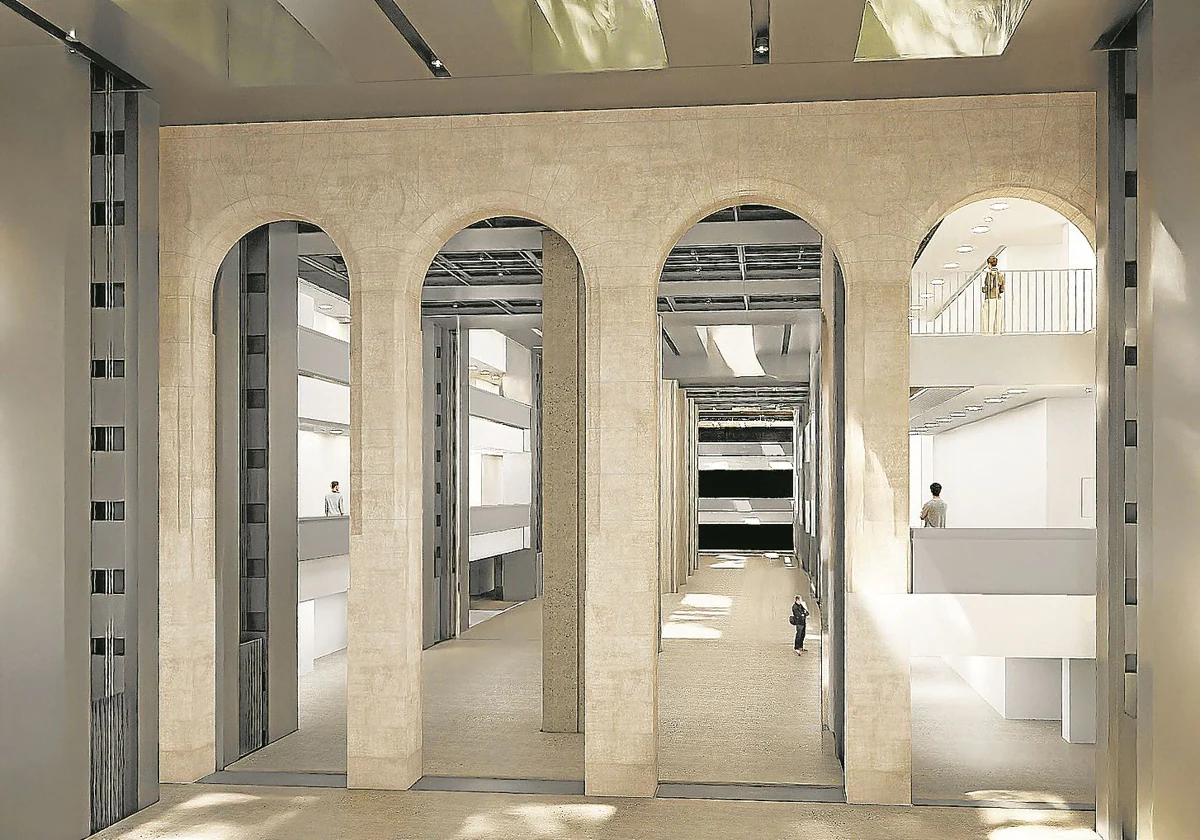
Looking ahead to 2025, the Foundation will move its headquarters to a gigantic Haussmann-style building, whose interior is now being completely transformed by Nouvel. It spans 8,500 square meters, of which 6,500 will be exhibition spaces; next to the Louvre, the most visited museum in the world.
Inside the building, five innovative platforms will reign that can hold a ton per square meter available to artists and decorators, something unheard of in current exhibition centers. There will be a play of lights, between the artificial ones inside and the natural light from outside. Additionally, it will have a restaurant, auditorium, and bookstore, also neighboring other cultural entities, such as the Museum of Decorative Arts, the Comédie Française, the Bourse de Commerce-Fondation Pinault, and the Opéra Garnier.
With a facade 150 meters long, the size of the Pompidou, it is part of the national French heritage and respects its original appearance. The interior architecture, on the other hand, completely transforms the space that was once a hotel, as well as the headquarters for the city's antique dealers. An exterior that does not announce the surprise that the interior holds. And as Jean Nouvel says, "architecture, like art, is always a surprise; one must perpetually cultivate mystery."
In these four decades, the Foundation has presented more than 300 exhibitions in France and abroad, a collection of 4,500 works made by half a thousand artists from 50 countries, and more than 200 books published. These are just some of the numerous figures that could be extracted from the activity of a contemporary art center that has been among the places to visit in the French capital for decades due to its programming and interesting exhibitions. Like the first retrospective in Europe of Colombian Olga de Amaral (until March 16, 2025), which they are now proposing in the building erected three decades ago.
While waiting for the completion of the works of the new building, an anniversary book has been published, 'Voir venir Venir voir' (See coming Come to see). It is a review of 40 years through photographs and interesting texts, where the philosopher Emanuele Coccia delves into the rich artistic programming. At the end of next year, when the new space opens, the inaugural exhibition will be that of the Cartier Foundation collection, a selection of its rich holdings.
Dominique Perrin was the first name in luxury to embrace art. Later, others would follow his lead, such as the Loewe Foundation in the field of music and poetry; the Fondation Louis Vuitton, with its museum... But that is another story. If Salvador Dalí was the first significant artist to collaborate with a fashion creator, as in the case of Elsa Schiaparelli, Cartier was the first 'maison' to erect an independent institution that promotes and disseminates the work of contemporary artists.

Latest news





Upcoming events
12
Nov
El Desembarco, la traición de Viriato at La Caja Blanca
12
Nov
HOMER El Mero Mero at Sala Trinchera Málaga
13
Nov
Marbella Startup Lab – Innovate & Collaborate
13
Nov
Candlelight: Coldplay & Imagine Dragons at Sala Fundación Unicaja María Cristina
13
Nov
Candlelight: Tribute to Ludovico Einaudi at Anantara Villa Padierna
Similar News

Málaga Airport Makes History with More Than Three Million Passengers in One Month
Málaga

Port of Málaga looks beyond its docks to support future growth
Málaga

Guide to the Virgen del Carmen Processions in Málaga and the Province
Málaga
