


The Soliva Lagoon: The Failed Exploitation to Extract Clay That Has Become an Ecological Oasis in Málaga
The southern frog, the natterjack toad, the little owl, or the common bee-eater are some of the species that have been spotted in this artificial wetland.
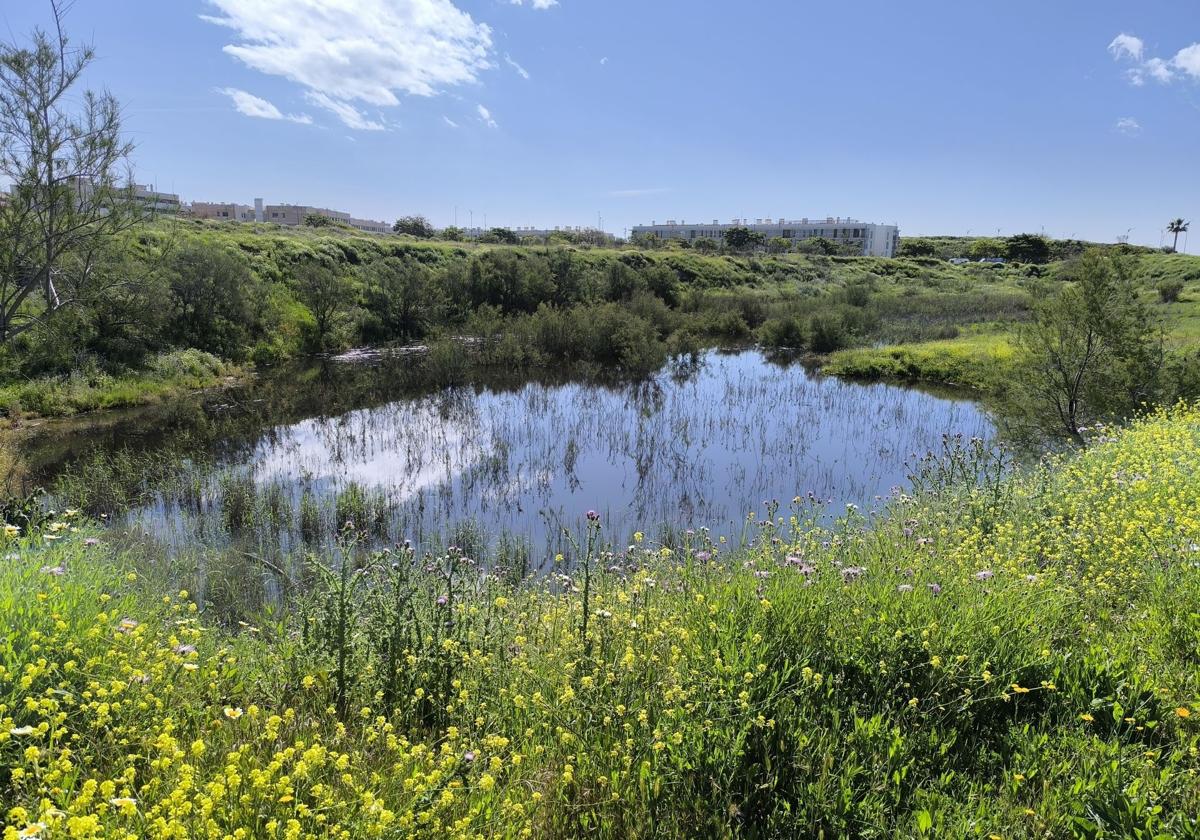

Long before the current neighborhood of Soliva was built, to the west of Teatinos, this area was one of many attempts in the region to extract clay for brick-making. This particular attempt was unsuccessful. As in other similar sites scattered around the area, drilling here was so extensive that it broke the water table and groundwater surfaced. It was the origin of a true ecological oasis, located in this neighborhood that came to life years later with the construction of subsidized housing.
Over time, the abandonment of that clay quarry caused it to gradually fill with living nature. Water and vegetation (tamarisks, reeds, rushes, and bulrushes) led to the appearance of animal species that have found an ideal habitat in this enclave, also located very close to the westernmost area of the Teatinos Campus—from there one can see the buildings of The Green Ray and La Mayora.
Amphibians, reptiles, birds, or mammals make up an ecosystem with hundreds of animal species that have been seen in the lagoon or its immediate surroundings, in an area of about 20,000 square meters. Rabbits, hares, or even foxes have been observed around the wetland.
More importantly, the chapter on birdlife. Whether permanently or just passing through, members of the local group of the Spanish Ornithological Society (SEO) have certified the presence of birds of prey such as the common buzzard, the lesser kestrel, the little owl, and the booted and short-toed eagles.
Other spotted species include the partridge, the bluethroat, the European bee-eater, the black-eared wheatear, the spectacled warbler, the crab-plover, the partridge, the little grebe, the mallard, and the red-rumped swallow, among many others.
The Soliva wetland has also become a true paradise for reptiles and amphibians. Among the former are from the common chameleon to four types of snakes (viperine, ladder, bastard, and hooded), while among the latter, the presence of the stripeless tree frog, the southern froglet, the common toad, and the common frog has been confirmed.
This artificially originated enclave has seen its water flow considerably increased after the last rains in March. Long before, the landowners had once dried up the wetland, but nature is sometimes stubborn and has reactivated it, although it never completely disappeared as an oasis of fauna and flora.
Now, however, there is a significant threat to this Soliva lagoon. Paradoxically, the same urbanism that facilitated it for brick manufacturing could be what ends it, as a partial plan, with more than a thousand homes, was definitively approved in 2012. In recent years, a platform of neighbors and associations has been created to prevent the Soliva lagoon from disappearing and to continue being that ecological oasis in this area of the city.
To this end, the Almijara association has even proposed integrating the wetland with the green ring that is being created after the ecological restoration of the old Asperones landfill. This would also allow connecting this wetland with other seasonal ones in the area.

Latest news





Upcoming events
12
Nov
El Desembarco, la traición de Viriato at La Caja Blanca
12
Nov
HOMER El Mero Mero at Sala Trinchera Málaga
13
Nov
Marbella Startup Lab – Innovate & Collaborate
13
Nov
Candlelight: Coldplay & Imagine Dragons at Sala Fundación Unicaja María Cristina
13
Nov
Candlelight: Tribute to Ludovico Einaudi at Anantara Villa Padierna
Similar News

Málaga Airport Makes History with More Than Three Million Passengers in One Month
Málaga

Port of Málaga looks beyond its docks to support future growth
Málaga

Guide to the Virgen del Carmen Processions in Málaga and the Province
Málaga
