


Alejandro Montiel, artist: "I'm not looking to shock or make people laugh, but I do want something to happen"
The creator from Malaga, who participates in the ephemeral exhibition 'Rebellion in the Factory', plays with discordant and out-of-place elements in his work.
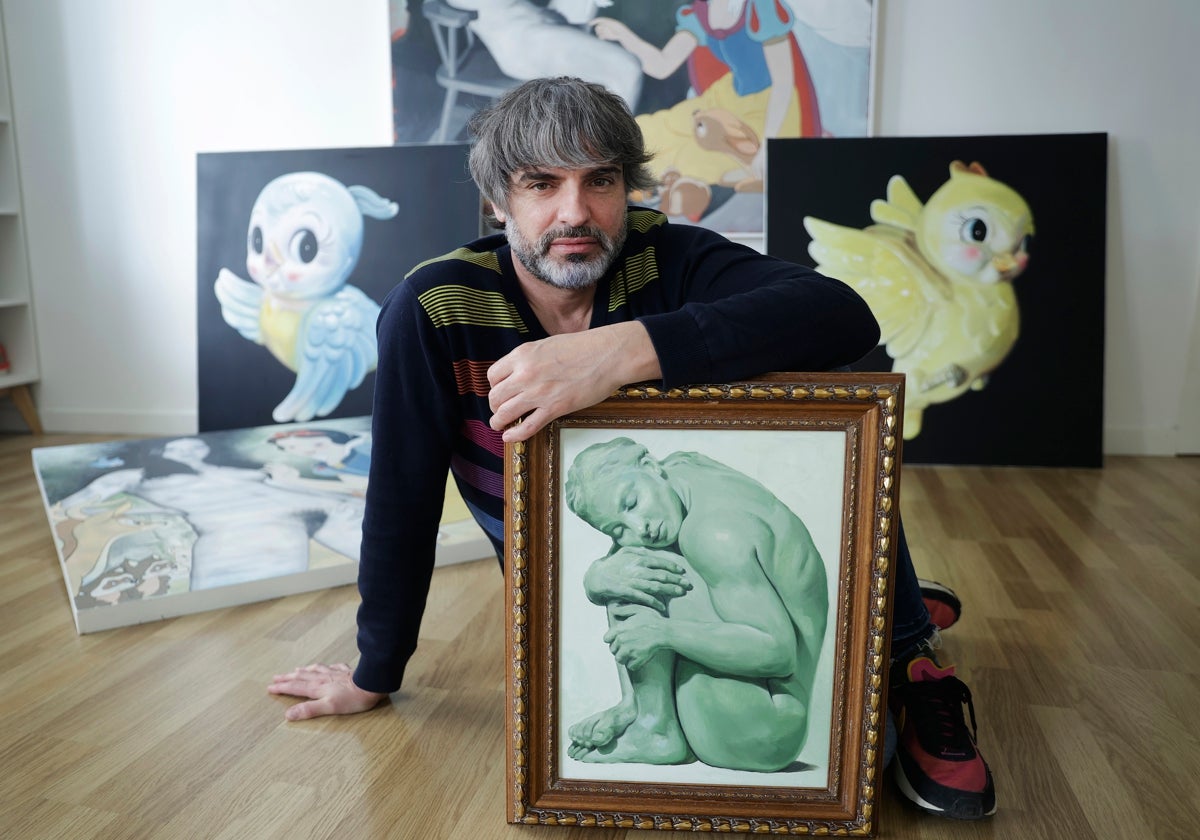

Alejandro Montiel's work is never indifferent. There is always something out of place, something that shouldn't be there, or at least not in that way. Like that classically styled naked woman leaning on a wild bull against a snowy mountainous landscape. A possible but highly improbable scene. In this vein moves the painting of the artist from Malaga, who will participate with the work 'Landstrange' on April 10th in 'Rebellion at the Factory,' the first ephemeral exhibition of Malaga artists organized by the Aula de Cultura de SUR at the Victoria Beer Factory, sponsored by Cervezas Victoria and Fundación Unicaja (19.00 hours, free entry with prior registration at forossur@diariosur.es).
–In your art, there is always something unexpected. Do you like to make an impact at first sight?
–Yes, I like there to be some element that is a bit discordant. Combining things that in principle should not be participating in the same scene, on the same plane, and make them work. I like to create situations that are different, that are not standard things like still lifes or landscapes. I use those references, but I always try to give it a twist.
–With the goal of provoking a reaction?
–I do it because I like to create that situation myself, because I like it aesthetically. And also, of course, because I always think it will cause something, at least attract attention. I'm not looking for anything specific, not to scandalize, bother, or make laugh. But I do want something to happen, something unexpected.
–But in the end, someone will be scandalized by seeing Disney princesses in front of a sexual scene, and someone will laugh at Philip IV riding an inflatable T-rex.
–I don't do it for any specific reason, but in the end, it captures that whole spectrum. Each person interprets and sees it in their own way. There will be people who are bothered by it, but I don't do things that are too provocative. I'm not looking for scandal just for the sake of talking about the work. Some people use iconic images against religion or the Church to get talked about. It's a form of marketing, and I don't like that. If you do it, it should be because it means something interesting for your proposal, not just to attract attention.
–Do you see art as a game?
–Actually, yes. From the moment you start looking for the elements you are going to include in the work, it's like a scavenger hunt. You look for references and see how they will combine. My work is not very conceptual, it is more of an aesthetic thing, almost visual, more pop, I have always seen it that way.
–Pop art, but starting from tradition.
–Yes, because I have always had a classical and academic training. I rely on that, on the technique, on the references, on what I have studied, because it really works. I'm good at it, I'm not going to give it up, and it's a basis that helps me later incorporate the things that make what I do a little different.
–That's ideal: mastering the technique and then inventing from there.
–Whatever your way of working or even the media you use, whether you paint with oil, spray, wax, or mud, you need to have training. That's indispensable. There are many people today who have no idea about anything and start making trash and sell it as something modern and conceptual. In the end, it shows when people have some training.
–Do you feel like an 'outsider' in the art circuit?
–A bit, yes. Now less because I am participating in more things. But when I started, yes. I didn't really like the endogamous vibe that was going on, they were very closed groups, the same people in the same places, always doing the same thing. Since I came from Granada, I wasn't really involved in the scene here either. But it wasn't something I sought out.
–Because I get the feeling that you like painting, but everything that involves painting, like management, bureaucracy, promotion… you like less.
–I handle that worse, I've always been bad at that. But well, there's always people who do it for you or who help you. What I like most is producing.
–Do you feel there's a lot of posturing in the art world?
–Yes, of course. In the art world, in the music world, in everything. Many people understand art that way, being there, moving from one place to another, appearing in places...
–And you, do you make a living from art?
–I do, yes, more or less. I survive (laughs).
–For many years you worked more on commission than for exhibitions.
–Yes, I started with portraits by commissions, by word of mouth. Now I dedicate myself more to painting what I want. That doesn't mean that if I get a commission, I won't do it, because in the end it's also money, it's security. But mostly, I paint what I feel like.
–And you enjoy it more.
–Yes, always. It's done in a different way, you do it more relaxed, you don't have the slavery of time. Although there are also commissions that are more free.
–There's another Montiel, Antonio, very famous for his portraits. Do you have any connection?
–He was my teacher when I was a kid. And we do have something in common... He is from Antequera and Almogía, and my grandparents on my father's side were from Almogía. You always have the temptation to try portraiture. It's a difficult thing, but I like it a lot. It's very beautiful to make a portrait of someone and have that person see themselves and like it.
–Tell me about the work you are going to exhibit at the Factory.
–I want to prepare a series of works following a line of work that I feel like doing with landscapes, outdoors. It's about finding those somewhat impossible images, with out-of-place elements that you then combine to create something aesthetic and powerful.
–Eroticism is a constant in your work. It is also present here.
–The nude has always existed. It's super academic, models have always been used for learning. Depending on the context in which you place it, it can have an erotic, pornographic, or even religious connotation, even the little angels are naked. It's very versatile and aesthetically very beautiful. It adds that classical aspect that I have, although to slightly different things.

Latest news





Upcoming events
12
Nov
El Desembarco, la traición de Viriato at La Caja Blanca
12
Nov
HOMER El Mero Mero at Sala Trinchera Málaga
13
Nov
Marbella Startup Lab – Innovate & Collaborate
13
Nov
Candlelight: Coldplay & Imagine Dragons at Sala Fundación Unicaja María Cristina
13
Nov
Candlelight: Tribute to Ludovico Einaudi at Anantara Villa Padierna
Similar News

Málaga Airport Makes History with More Than Three Million Passengers in One Month
Málaga

Port of Málaga looks beyond its docks to support future growth
Málaga

Guide to the Virgen del Carmen Processions in Málaga and the Province
Málaga
