


Happiness or Balance?: The Seven Keys by Enrique Rojas to Achieve It

11/06/2026 Updated 12/06/2026 - 17:12h.
To start, a clarification, although it may seem obvious: absolute happiness does not exist. Sometimes, everything seems perfect. Friends are seated around the table, the food tastes good, and the wine is fine. But, precisely when everything seems to align to reach that coveted state, it doesn't fully arrive. Sometimes, the opposite happens: the conversation does not flow smoothly, the night progresses unevenly, and one realizes that things are not moving as one would wish.
Then comes enlightenment, and memories of the past confirm it: the best nights are those that are unplanned, those that end with everyone dancing in the kitchen without anyone being able to explain exactly why. What is happiness, after all? The renowned psychiatrist offered some keys in a masterful lecture, which took place within the framework of the 'Expert Minds' talks.
There are many ideas about what true happiness is; indeed, aspiring to it is one of the vital drivers of existence. A pessimist would say that happiness is merely the absence of suffering; hedonists might find it in consumption; a neurobiologist would say it's pure chemistry, and Aristotle wrote that it consists of self-sufficiency.
The pursuit of happiness is booming. Psychology, neurology, sociology, or economics... there is hardly a discipline that has not tried to answer the ancient question of how to achieve it and whether each individual has the tools to reach it. In the end, everyone knows people who have overcome great setbacks, as well as others who walk through life with sorrow despite having been dealt favorable circumstances.
Related News
So, is happiness a destination, pre-written by our genetics, or based on experiences from our earliest childhood? Or can happiness be learned? And behind all this, a much broader question looms: Does the human being have the capacity to construct their own happiness?
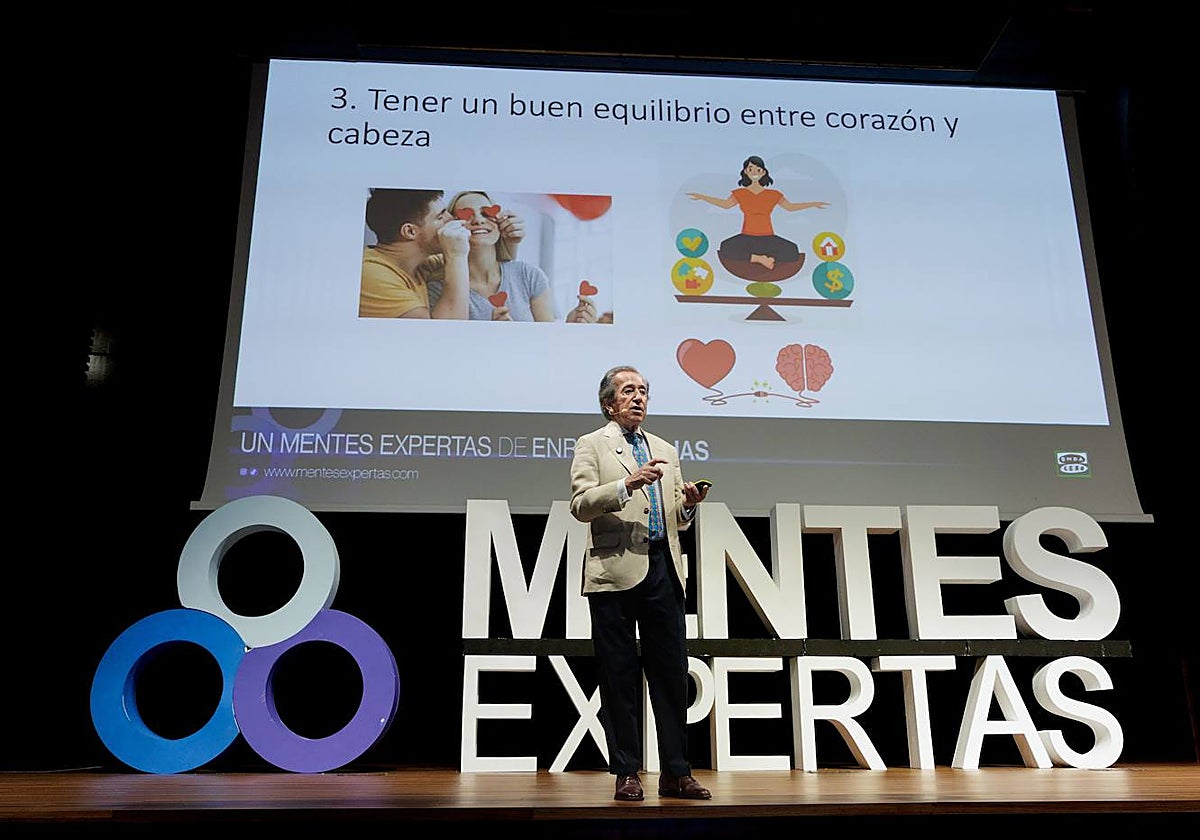
The renowned psychiatrist Enrique Rojas would answer with a "yes." At least, in part. This Thursday he was in Málaga, at the Palacio de Ferias, to address such a universal concept and talk about his latest book, whose suggestive title is 'Seven Tips for Happiness'.
Eternal Yearning
Initially, Rojas made an introduction about the classic definitions of happiness: Seneca, Plato, or Pythagoras... The list of thinkers who have delved into the subject is as extensive as it is overwhelming. Rojas suggested that happiness is a kind of lush tree and called for differentiating between momentary happiness and structural happiness.
While the former is fleeting, the latter would be the state that is truly worth aspiring to, which is based on an adequate balance between love, friendship, work, and access to culture. "When seeking happiness, we must be very clear that absolute happiness does not exist," he concluded.
Subsequently, the psychiatrist began to outline the seven tips that for him are key to reaching that relative happiness, which could indeed be conquered:
Good balance between heart and mind: means achieving emotional maturity. Rojas holds that a balanced person is not one who suppresses their feelings nor one who is blindly swept away by them, but one who allows reason to guide emotion without stifling it.
Knowing oneself: is the cornerstone of psychological maturity. He defines knowing oneself as conducting an honest and deep radiography of our own person, accepting what we find in it to, from there, be able to improve.
Healing past wounds and forgiving: for Enrique Rojas, these acts do not represent acts of weakness, but are the most powerful psychological engineering tools to achieve happiness and emotional balance.
Enrique Rojas signing some of his books, before giving the lecture. (Marilú Báez)Having a coherent life project: means for Rojas having a life that encompasses the five major areas of human life, maintaining a good proportion between them and minimizing internal contradictions (for example, desiring a very united family life but not dedicating real time to it due to excessive work). These four areas are as follows: love, the affective life (partner, family, etc.); work, professional development and fulfillment through effort; culture, the cultivation of the mind, reading, and knowledge; friendship, deep and sincere social relationships.
Being independent of people: Rojas does not understand independence from people as isolation, selfishness, or absolute self-sufficiency, but as a synonym for emotional maturity and inner freedom. In the lecture, Rojas discussed self-esteem, happiness, and emotional balance.
Learning to talk about things and put problems into perspective: the psychiatrist considers that learning to talk about things that affect oneself provides great relief. He also points out that putting problems into perspective is a fundamental therapeutic and personal growth tool. Both are part of what he calls "behavioral engineering" and are key to achieving psychological maturity and inner peace.
Having a solid moral: he insists that a solid moral is equivalent to being an integral person. This means that there is a close harmony between what you think, what you say, and how you act. The opposite of this is leading a double life or having a double moral. For the psychiatrist, the lack of coherence psychologically fragments the person and fills them with contradictions, preventing them from achieving real inner peace.
comments Report an error
Latest news





Upcoming events
12
Nov
El Desembarco, la traición de Viriato at La Caja Blanca
12
Nov
HOMER El Mero Mero at Sala Trinchera Málaga
13
Nov
Marbella Startup Lab – Innovate & Collaborate
13
Nov
Candlelight: Coldplay & Imagine Dragons at Sala Fundación Unicaja María Cristina
13
Nov
Candlelight: Tribute to Ludovico Einaudi at Anantara Villa Padierna
Similar News

Málaga Airport Makes History with More Than Three Million Passengers in One Month
Málaga

Port of Málaga looks beyond its docks to support future growth
Málaga

Guide to the Virgen del Carmen Processions in Málaga and the Province
Málaga
