


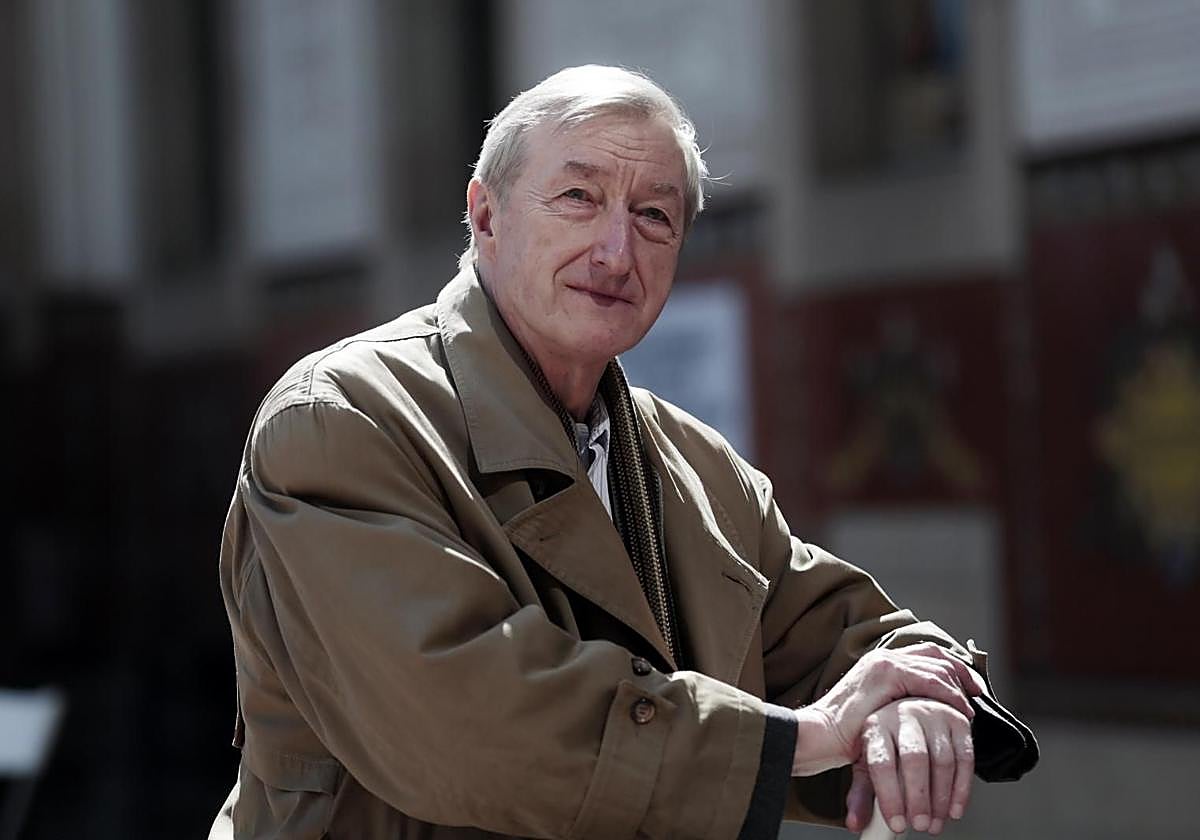
Julian Barnes concludes his brilliant literary career with the Princess of Asturias Award for Literature

M. F. Antuña
Gijón
10/06/2026 Updated at 18:43h.A prolific and good-humored author who was a lexicographer, critic, and editor before becoming a globally successful writer. Julian Patrick Barnes (Leicester, England, 1946) concludes his brilliant career with the Princess of Asturias Award for Literature. The jury chose this Wednesday in Oviedo among 37 candidates, this graduate in Modern Languages from Oxford who has managed to hybridize his literature like no one else, infusing it with nostalgia, humor, and irony, and has managed to consolidate a unique and personal voice by playing the metaliterary game and delving into memories and forgetfulness, loves and losses, and how we narrate ourselves with the deceitful memory as both ally and perfidious accomplice. And perhaps few awards are as timely, so on point, with a cancer diagnosis he has been dealing with since 2020, at eighty years old and with the literary farewell signed this very year.
The jury highlighted his condition as an extraordinary narrator and essayist, endowed with humor, irony, and a "melancholic optimism and cheerful pessimism," in his own words. "Barnes offers a lucid, warm, and compassionate view of humanity, and uses memory as a shaper of identity without renouncing imagination, with love as an essential principle. His work re-elaborates, with a Europeanist view, the history of literature, art, music, and even gastronomy, reaching a unique style, which distinguishes him within a generation of particularly brilliant British authors, who have marked contemporary literature."
Related News
Barnes has a large number of awards that place him in a position of honor in very different literary geographies. Among them, some as important as the 2011 Man Booker Prize for ‘The Sense of an Ending’. There are three other novels under his signature that were finalists for the Man Booker Prize, namely, ‘Flaubert's Parrot’, 1984; ‘England, England’, 1998; and ‘Arthur & George’, 2005. The Somerset Maugham Award (1981), the Geoffrey Faber Memorial (1985); the Prix Médicis (1986); the E. M. Forster Award (1986); the Gutenberg Prize (1987); the Grinzane Cavour (1988), and the Prix Femina (1992) are also in the possession of the man who was named Chevalier de l’Ordre des Arts et des Lettres in 1988, Officier de l’Ordre des Arts et des Lettres in 1995, and Commandeur de l’Ordre des Arts et des Lettres in 2004, who in 1993 received the Shakespeare Prize from the FVS Foundation, in 2004 won the Austrian State Prize for European Literature, and in 2011 received the David Cohen Prize.
Related News
But the great prize is always in the applause of the public, and he has found it in works like the acclaimed ‘Flaubert's Parrot’, a perfect example of his taste for mixing biography, essay, and fiction, which narrates the quest of Geoffrey Braithwaite, a doctor who obsessively searches for the exact stuffed parrot that inspired the story ‘A Simple Heart’ by Gustave Flaubert. ‘The Sense of an Ending’, another of his most celebrated works, delves into the analysis of how memory deceives us, how we lie to ourselves, how we narrate ourselves to protect from guilt. Tony Webster is the character chosen for this reflection that will hardly leave anyone indifferent.
The Passage of Time
The passage of time is present in the work of this Englishman who joins a very British roster of the Princess of Asturias Awards 2026, which has also honored David Klenerman and Shankar Balasubramanian in Scientific and Technical Research and Timothy Garton Ash in Social Sciences. And if the latter has written a book about Europe in ‘Seven and a Half Chapters’, Barnes signs ‘A History of the World in Ten and a Half Chapters’. It is a journey in stories that starts with Noah's Ark and of which Salman Rushdie has said this: "It is a brilliant book, imaginative, bold, iconoclastic, original, and a true pleasure for the reader." Little more can be asked of someone who is also capable of touching very diverse subjects with his literature. In ‘Nothing to Be Frightened Of’ he talks about the fear of death and aging with humor; in ‘Levels of Life’ he dwells on love and pain in the face of loss, and in ‘The Lemon Table’, his latest novel, he plays clearly with farewell.
Having turned eighty last January, he has said he will not write anymore, that this is his last book. Love, old age, and mourning are again put into black and white in what is a literary and philosophical testament with illness present: "You must continue until you have said everything you had to say, and I have reached that point," stated the British author. Here is a button of his thoughtful reflection that appeals to everyone present in that volume: "What we conventionally consider a memory is something that we have been recalling, frequently or infrequently, throughout our life, and that has been mutating a little each time we recount it until it solidifies into a version we convince ourselves is true."
The truth of his literature now finds new applause. His own life of commitment also receives a resounding ovation with the Princess of Letters. The defense of human rights has always been in his sights, and he actively participates in the organizations Freedom from Torture and Dignity in Dying.
- More topics
- Princess of Asturias Award for Literature

Latest news





Upcoming events
12
Nov
El Desembarco, la traición de Viriato at La Caja Blanca
12
Nov
HOMER El Mero Mero at Sala Trinchera Málaga
13
Nov
Marbella Startup Lab – Innovate & Collaborate
13
Nov
Candlelight: Coldplay & Imagine Dragons at Sala Fundación Unicaja María Cristina
13
Nov
Candlelight: Tribute to Ludovico Einaudi at Anantara Villa Padierna
Similar News

Málaga Airport Makes History with More Than Three Million Passengers in One Month
Málaga

Port of Málaga looks beyond its docks to support future growth
Málaga

Guide to the Virgen del Carmen Processions in Málaga and the Province
Málaga
