Rosa Rodríguez: The Marbella Ceramist Who Said No to Carmen Thyssen
She has been leading the municipal workshop created by the Universidad Popular for 40 years, which Jesús Gil aimed to eliminate and demolished the theater hall where she was going to celebrate her wedding.Benito Gómez: played against Real Madrid, was a municipal police officer and a unionist in Marbella.
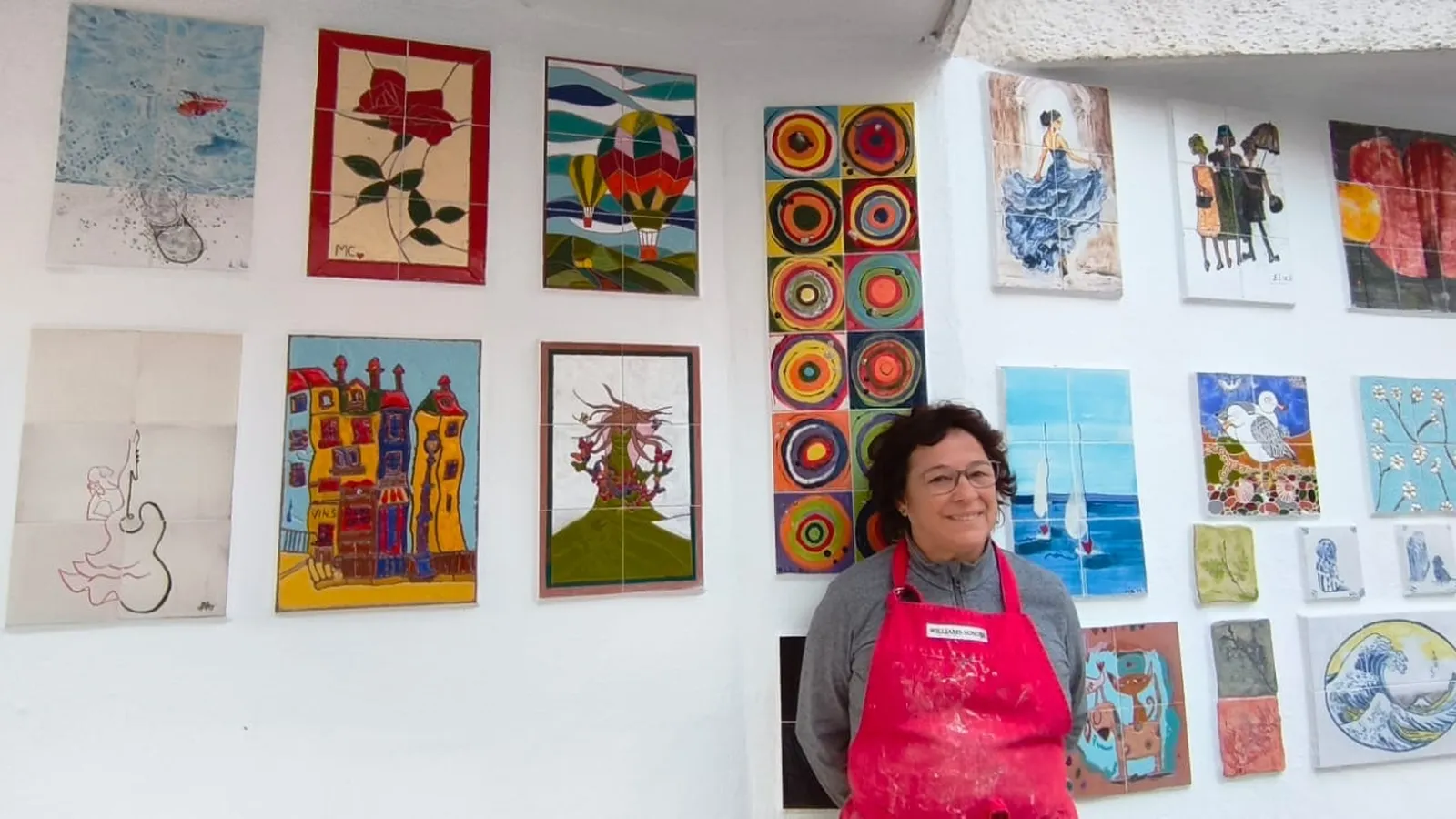

"What is that?", the neighbors asked when they saw us dragging an extremely heavy object up the stairs. A German washing machine, I told them. It was huge. We lifted it up to the third floor of the Divina Pastora apartment block. I placed it on the terrace, which I always kept closed, so nobody would see the gas kiln for firing pottery. I started my first workshop in an apartment. I worked there with the kiln for a long time, fearing that one day, rightly so, they would kick me out. Rosa Rodríguez recalls, who is about to retire after teaching pottery for forty years at the municipal workshop in Marbella.
I arrived here in 1984. I came from Salamanca, although I was born in Huelva, where I lived until I was fourteen, when my family moved north. I fell in love with Marbella; it was love at first sight. I came from a city, or a house, very dark. Always with the curtains drawn, filled with sadness. And suddenly here, where my sister lived, the light that seeped into the house was like medicine. I set myself to absorb that energy. On the street, I saw people from every country, each dressed in their own way. On Ricardo Soriano, I would cross paths with women in black scarves and masks next to girls in bikinis coming from the beach. And the local people strolled calmly, unbothered.
By 1985, my friends were Omar and his brother Pablo. The former, a sculptor born with the fingers of an artist, has been a teacher in San Pedro. We lived together and were looking for stable jobs. We decided to start a pottery business, as it could have been anything else. The three of us, very young, went to Unicaja to ask for a loan to buy a kiln, a wheel, and some clay. "I like you guys; I trust you will do it," the bank employee told us and granted us the loan.
The three of us went to learn a special way of making glazes, of firing pottery, which is a very broad technique. We did it with the team of potters Al Yarrar, from Granada, some Spaniards converted to Islam, who taught us to make the Arabic or metallic reflection. A glaze that shines like gold. In Marbella, we sold it very well because this technique was not known here. Those who saw it bought it; I hadn't even put the piece in the kiln and they paid for it. But I am not at all commercial. In the summer, the art schools close and I thought of offering to teach a course on the technique I had learned. I took my kiln to the pottery workshop to teach a one-month course. It went very well. The instructors who taught the pottery course here, a couple from Seville, missed their homeland and left. For the following course, that position had to be filled through an exam. Many people applied, but I got the position.
There was a small book from the Provincial Council about a local potter, the pottery that used to be here, which made bird drinkers, chicken drinkers, and pitchers. We made works of this man with the first group. Pottery has more tradition in Granada, Seville, Ronda, Almería, or Jaén, which is the cradle of pottery.
The municipal workshop was in Plaza de José Palomo, a place with a beautiful courtyard; it had magic, we held student exhibitions. I asked them to prepare a good collection of pieces and organized an exhibition for them. People were motivated, and passersby who asked were interested in what we were doing. Sometimes Rosario Flores, Aurora Bautista, or Beatriz Carvajal would come. Once Carmen Thyssen came; she wanted me to do a tile job for her house. The reproduction of two Paul Gauguin paintings for the pool. I told her that I didn't take those commissions. Someone else did it, a girl, who told me she wasn't paid. I've never gotten involved in that. I'm not impressed by famous people.
The word luxury grates on me. Does having a certain car or the clothes that so-and-so wears in Hello make you better? They seem like nonsense to me. However, I live using a luxury that is wasting time. I tell my students: Why are you rushing the clay? It's going to get angry and break. Here we come to waste time. Otherwise, what's the need to spend two months in the workshop to make a pitcher, when you can buy one? The luxury is having the time and being able to waste it.
The Popular University did an important social work in Marbella. It was a transformation movement, aimed at getting people to learn and become literate. There was a lot of illiteracy among women, sailors, or people from agriculture. It was difficult to attract them, to tell them: "Come, I want you to learn to read." To achieve this, they thought of doing courses, workshops, so they would come. One of the first, for women, was hand embroidery. The workshop worked very well when people were illiterate. In the literacy school, teachers offered free courses, making it easier for older people to attend, who discovered a new world and then some wrote poetry. The courses that remain offer people a workshop where they can learn a trade.
The era of Jesús Gil was very hard. He wiped us off the map, he said: "Out! I'm not interested in this." The idea of the Popular University sounded like communism to him. We managed to meet with him in the municipal plenary hall to convince him of who we were, of our trajectory; we somewhat succeeded. He demanded that our activities be self-financing, that they not cost the City Council. Then we promised him yes, but we didn't do it.
My husband, Wim, who was the sound and lighting technician for the City Council. He had a dispute with the Culture delegate over a labor issue. Gil had closed the auditorium in the Constitution Park, where the summer cultural program took place. He did it to turn it into the TV set for his programs This and That. The artists who had been contracted to perform at the auditorium ended up in the courtyard of the Río Verde school. There was my husband, with the cables, receiving the angry artists because of the change of location. This made him very angry and he argued with the Culture delegate. She made his life miserable and, as punishment, they sent me to a terrible place, down some stairs to a basement full of cockroaches and rat droppings, where a bakery had once had its kitchens. A den without windows, with a skylight that opened onto the sidewalk. Sewage was removed with a truck. My complaints about the lack of hygiene were never addressed. I think for two courses I must have taught poorly in that place that took away my light and joy. Secretly from councilor Mariló Miñones, I managed to talk to other politicians and they put me in the Miraflores workshop, where we are now.
Gil changed the name of the Popular University to the Foundation of Art and Culture, and since it wasn't very legal to be in a foundation for 40 years, we moved to the City Council. What hurt me the most about that time was when they tore down the old theater, the exhibition hall, to put a restaurant. They demolished the building at night, without even putting up a sign or anything. It affected me directly because we were going to get married there. We had obtained the permits from the City Council to celebrate our wedding in the theater, because my husband worked there. We had organized to have music and even do some theater, and a few weeks before they tore it down.
The workshop today has a great reputation; there's a bunch of people waiting to get in. There are some who have been trying for three years. There are few spots. Since the pandemic, I don't see the applicants; the City Council does it with an application. Before, they would line up and fill out a card; I liked it better. I saw the people; one who wanted to do wheel, I saw him more in artistic pottery. I have an average of 60 students, some do only wheel and others pottery, in a maximum of four years. That the people of Marbella can do it is a stroke of luck. The workshop is well known and they write to me. Two weeks ago someone told me: "I am a potter in Peru, I am going to Spain and I would like to perfect on the wheel." He asked if he could visit the workshop. How did he find out that wheel classes are given? I don't know, but it's very nice. The pottery workshop is the one with the highest demand and it is very well known by word of mouth.
I continue with the same enthusiasm and deeply involved in this, I take it very seriously because I am very passionate. I demand a lot from my students and, if at some point they present me with something that they have not done well, that they have not put any interest in, I tell them: this is crap. I'm not worried that they have skill in their hands; that will come as they practice. But to abandon thought, worry, and to put all the mind in the clay. Clay is very healing; doctors and psychiatrists recommend it. The first thing to do is to leave your problems at the door. Don't bring them here. Get to work and only think about what you are doing. When you leave, you will have to look for the problem you left parked; maybe it's no longer there, it got bored and left. This way, classes work well.
In the classes, I have older people, young people, creators, designers who invent many things, a very nice atmosphere. I remember two guys, Edgar and Cristóbal, who worked a lot and came to the workshop. They were the kind of people who leave all the day's problems behind and get down to it. One worked at El Corte Inglés and the other in a factory, I also have a motorcycle mechanic who focuses and doesn't say a word. Rocío Rivas is a potter who has her own shop and enters all the contests with beautiful works. Stella Kamazón, a very recognized artist, has also passed through the workshop, who worked the wheel with me and then mixed it with painting. There are others who are setting up their own workshop and teaching classes, there are many people working outside.
I have always hated eating in a restaurant with a large group and being next to two people and not being able to talk to the others. That's why at the end of the course in June, we celebrate with a beach barbecue, and at Christmas, we have a party inside the workshop, where each student brings a dish.
That Marbella, where nothing seemed strange, no longer exists. Today it is more classist; you belong to this area, I to another; everything is stratified. I still don't see the love you have to have for Marbella, which is adorable, which enchants. I am tired of the massive tourism today, a crowd of people on the street, making it difficult to walk through the old town.

Latest news


Upcoming events
17
Sep
La Pequeña Cuba Gastro-Cultural Festival in San Pedro Alcántara 2026
18
Sep
World Wellness Weekend Marbella 2026
18
Sep
Candlelight: Queen vs. ABBA in Málaga
18
Sep
Candlelight: Coldplay and Imagine Dragons in Málaga
18
Sep
3 de Corazones – Pancho Céspedes, Enrique Ramil and José Luis Jaén in Málaga
Similar News

Marbella Launches ‘Summer Youth’ Programme with 2,500 Free Places
Marbella
Premium Tourism Drives Marbella’s Hotel Profitability to Record Levels as Overnight Stays Exceed 291,000
Marbella
‘Machos Alfa’ seeks extras in Marbella for filming of its sixth and final season
Marbella