


Eight Curiosities That Will Make You Visit Faraján, the Village Where the Town Hall and Water Got Married

Málaga
07/06/2026 at 00:15h.A wedding between the City Hall and water. That's where one of the most unusual stories of Faraján begins. But it's not the only one. This small village in the Valle del Genal also captivated Ernest Hemingway, maintains an unexpected connection with Picasso's family, and hides two waterfalls just minutes from its main square.
Surrounded by dense forests and marked by centuries of history, Faraján accumulates curiosities that go unnoticed by many travelers who tour the Serranía de Ronda. Some date back to the Andalusian period, others occurred just a few decades ago, but all help to understand why this town deserves a much longer stop than its size might suggest.
-
1
The day the City Hall and water got married
Few villages can boast of having celebrated a wedding between a building and a water tank. However, that was exactly what happened in Faraján on August 8, 2002. To celebrate the inauguration of the new municipal facilities and the commissioning of infrastructure that would end water supply problems in summer, the residents organized a full-fledged ceremony. There were sponsors, guests, music, banquet, and even a wedding cake. More than six hundred people attended that unique symbolic link between the City Hall and water, a party that still ranks among the most curious episodes in the recent history of the Serranía de Ronda.
-
2
The view that captivated Hemingway himself
Ernest Hemingway arrived in Faraján during one of his excursions through the Serranía de Ronda, a territory he knew well beyond the city of Tajo and his passion for bullfighting. The visit was brief, but enough for the American writer to be captivated by the landscape surrounding this small town in the Valle del Genal. Upon seeing the white village surrounded by a dense mantle of chestnut trees, holm oaks, and cork oaks, he left a description that the locals still remember today: "a white swan swimming in a pond of green hope." More than half a century later, the image still accurately describes the contrast between the whiteness of the village and the lush vegetation that embraces it, especially in spring and summer, as the chestnut grove surrounding it brings different hues in autumn and winter.
-
3
The disappeared hamlets that gave rise to the village
Before the current Faraján existed, these mountains were dotted with small Andalusian hamlets like Balastar, Chúcar, or Senegil. Over the centuries, those settlements disappeared and the population ended up concentrating in the current nucleus. Of all of them, Balastar is the one that best allows imagining that past. Although no buildings are preserved, the terraced plots, the orchards, and the ancient irrigation system that takes advantage of the stream water are still visible. In fact, many of the irrigation techniques still used in the area have their origin in that agricultural organization inherited from Al-Andalus. Thus, the landscape that hikers and visitors see today also constitutes one of the best testimonies of Faraján's medieval history.
-
4
Two secluded waterfalls at the foot of the urban area
Few villages in Málaga can boast having two spectacular waterfalls practically at the foot of their urban area. In Faraján, the so-called Chorreras de Balastar are just a few minutes from the last houses, in an environment of orchards and lush vegetation that surprises the visitor. A circular trail of about 2.5 kilometers allows reaching both waterfalls following the course of the Balastar stream. Although the distance is short, the route requires some caution, as it crosses steep slopes and wet areas where ropes have even been installed to facilitate passage and prevent slips. The effort, however, is rewarding: contemplating two of the most unique and photogenic spots in the Valle del Genal.
-
5
A small village turned into a reference for Iberian pork
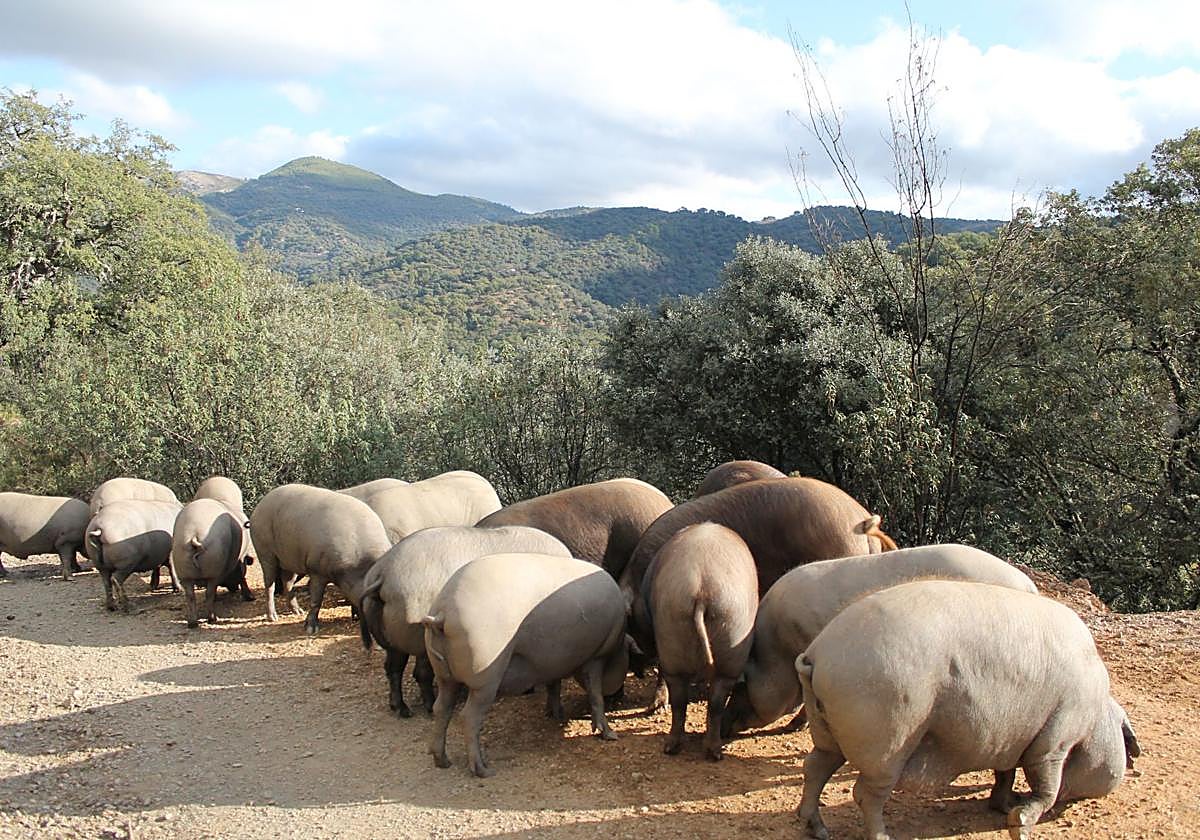
Faraján maintains a very close relationship with Iberian pork to the point of concentrating several of the main producers in the province of Málaga. In its dehesa woodlands, the animals are raised in semi-freedom among holm oaks, cork oaks, and chestnut trees, an environment that has given fame to products as unique as the well-known chestnut ham, so named because the animals' diet incorporates this fruit so characteristic of the Valle del Genal. The importance of this tradition has even led to a slaughtering festival held every December. Additionally, some companies have gone a step further and organize guided tours through the farms to closely learn about the breeding of Iberian pigs and later taste sausages and hams made in the area, a unique experience in the province.
-
6
The unexpected connection of Faraján with Picasso
At first glance, no one would relate a small village in the Valle del Genal with Pablo Picasso. However, the church of Nuestra Señora del Rosario holds a curious connection with the Malaga-born artist. Part of the restoration work carried out in the temple was financed by a cousin of the painter and her husband, a help that allowed preserving one of the most emblematic buildings of the town. The history of the temple, moreover, dates back to the early 16th century and is built on the site that previously housed a mosque. Among its curiosities is also the disappearance of one of the two towers it once had, demolished centuries ago by an earthquake. Thus, the main monument of Faraján brings together in the same building traces of its Andalusian past, the history of the Serranía, and even an unexpected link with the universal genius born in Málaga.
-
7
The small village that was awarded by a king
Faraján not only survived the War of Independence but also received exceptional recognition for it. In 1814, once the conflict against the Napoleonic troops ended, Fernando VII granted the municipality the Royal Charter of Villa as a reward for the perseverance, loyalty, and sacrifices endured by its residents during those tumultuous years. The document also authorized the village to use the arms of the Spanish Crown and the title of "Very Noble and Most Faithful Villa of Faraján." More than two centuries later, that privilege remains one of the most unique and least known historical episodes of this town in the Alto Genal. Some even point out that the most popular nickname of the town, celestón, is related to one of the episodes that occurred in the area during that war.
-
8
The fountain that lives between history and legend
On the outskirts of Faraján, next to the road leading to Alpandeire, there is an old drinking trough traditionally known as the drinking trough fountain of Allá Arriba. However, today it is much more popularly known by another name: the Duke of Arcos fountain. A plaque commemorates that on September 16, 1568, the troops of Antonio de Luna and the Duke of Arcos drank there during the so-called War of Granada. However, some historical research places the presence of these military leaders in the Serranía de Ronda at later dates, so the episode remains shrouded in some uncertainty. Whether reality, tradition, or a mix of both, the fountain remains one of the most curious and unknown spots in the surroundings of Faraján.
- More topics
- Summer
- Curiosities
- Málaga
- Faraján
- Málaga (Province)
- Landscape

Latest news





Upcoming events
12
Nov
El Desembarco, la traición de Viriato at La Caja Blanca
12
Nov
HOMER El Mero Mero at Sala Trinchera Málaga
13
Nov
Marbella Startup Lab – Innovate & Collaborate
13
Nov
Candlelight: Coldplay & Imagine Dragons at Sala Fundación Unicaja María Cristina
13
Nov
Candlelight: Tribute to Ludovico Einaudi at Anantara Villa Padierna
Similar News

Málaga Airport Makes History with More Than Three Million Passengers in One Month
Málaga

Port of Málaga looks beyond its docks to support future growth
Málaga

Guide to the Virgen del Carmen Processions in Málaga and the Province
Málaga
