


It looks like a monument from a movie, but it's in Malaga and almost no one knows about it: 52 meters high and 100 meters long.
The Eagle Aqueduct impresses with its size, its history, and its location between ravines and cliffs. The most famous beach bar in Malaga where the waiters "auction" the dishes and the lines never stop.
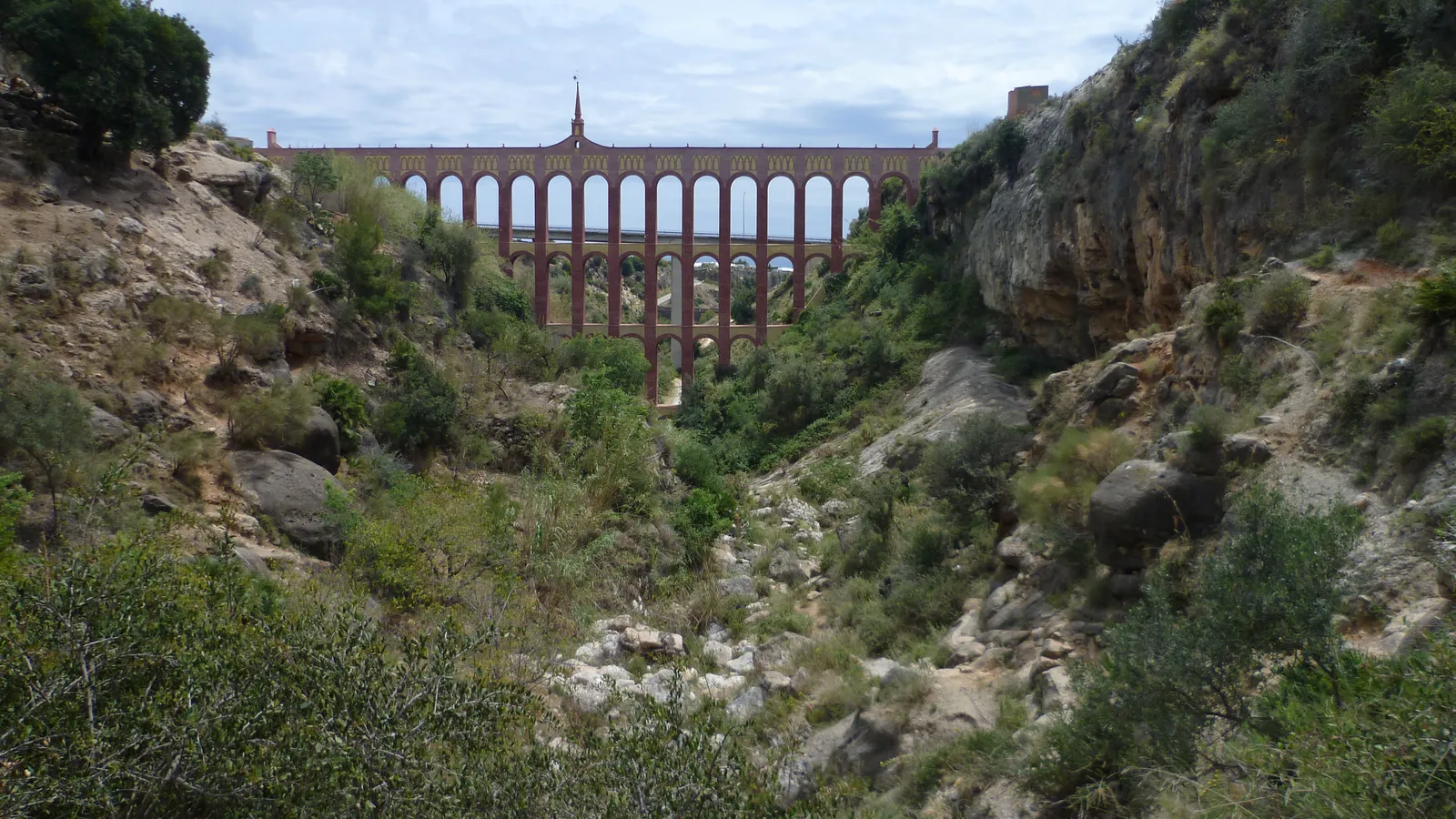

Sometimes history hides under layers of time; other times, it stands in the middle of a ravine as if waiting to be discovered. In the province of Málaga, amidst the rugged landscape that precedes the coast of Maro and the echoes of the industrial past of Axarquía, a construction emerges that shatters any expectations of the passerby: a monumental brick aqueduct that, more than a hydraulic infrastructure, seems like a scene frozen in time.
Access to this unique site is facilitated through a hiking route that starts from the old N-340 highway, in the direction of Maro and the area of the Cueva de Nerja. This journey winds through an environment where rural paths, remnants of old infrastructures, and transitional landscapes towards the cliffs of the Mediterranean coast coexist.
Along the route, the trail passes recognizable landmarks like the Ermita Ventorrillo Santo Cristo and the marked crossing towards the Cala del Barranco de Maro. The path initially descends via a paved track that gradually transforms into a dirt road, marking the transition to a more natural environment embedded in the relief.
One of the most characteristic moments of the journey occurs when crossing under the N-340 bridge. From that point, a left turn leads down to the bottom of the ravine, where the landscape narrows between sharp curves, natural reed tunnels, and small streams of water that accompany the descent towards the aqueduct.
The Eagle Aqueduct: a 19th-century engineering work
In the heart of the Coladilla ravine, near Maro, stands the Eagle Aqueduct, also known as Bridge of the Eagle. This structure was built between 1879 and 1880 with the purpose of supplying water to the San Joaquín sugar factory, located in the Las Mercedes area.
The work was designed by the local master Francisco Cantarero Martín, whose signature remains inscribed next to the central temple of the aqueduct, as testimony to his authorship and the technical context in which the construction was developed.
The aqueduct reaches a height of 52 meters and an approximate length of 100 meters. Its structure consists of four levels of elevated semicircular arches, adding up to a total of 36 visible arches made of brick. At its top stands a temple crowned by a weathervane shaped like a double-headed eagle, the element that names the architectural ensemble.
Architecture, decoration, and stylistic influences
The north face of the aqueduct, considered the most ornate, concentrates a series of decorative elements of great heritage value. Among them stand out the pointed horseshoe blind arches, as well as terracotta balls placed on brick pedestals.
A frieze composed of 18 groups of arches increases the visual impact of the ensemble, raising the total number of decorative arches to 70. This architectural language shows a clear Mudejar influence, where Islamic-rooted traditions are merged with Renaissance elements.
Although its original function was strictly practical—the transport of water from the Maro river to the sugar industry—the design of the aqueduct also incorporated an aesthetic intention, especially visible on its north face, oriented towards the old road connecting Nerja with Almuñécar.
An infrastructure still in use and its recent restoration
The Eagle Aqueduct remains active today, maintaining its function in irrigation tasks. This continued use makes it a living example of traditional hydraulic architecture in the province of Málaga, where historical heritage remains integrated into the daily functioning of the territory.
Between 2010 and 2012, a restoration process was carried out that allowed the recovery of part of its original polychromy and the conservation of epigraphic elements such as the inscription "Pura y limpia concepción", located on the central floor of the structure. This intervention contributed to the preservation of the ensemble without altering its historical physiognomy.
The legacy of the sugar industry in Axarquía
The existence of the Eagle Aqueduct is closely linked to the development of the sugar industry on the eastern coast of Málaga. Sugar cane, introduced during the Muslim era and intensively cultivated in this coastal strip, led to a network of mills and factories that shaped the economic landscape of the region.
The San Joaquín factory, which this aqueduct supplied, is part of that historical network that connects hydraulic engineering with the agricultural and industrial production of the area. This legacy is also reflected in other heritage spaces in Andalusia, such as the Preindustrial Sugar Museum in Torrox or the old Sugar Factory of Motril, in the neighboring province of Granada.
In this context, the Eagle Aqueduct remains one of the most representative testimonies of that historical stage, combining functionality, monumental architecture, and continuity in the use of water within the Malaga landscape.

Latest news





Upcoming events
12
Nov
El Desembarco, la traición de Viriato at La Caja Blanca
12
Nov
HOMER El Mero Mero at Sala Trinchera Málaga
13
Nov
Marbella Startup Lab – Innovate & Collaborate
13
Nov
Candlelight: Coldplay & Imagine Dragons at Sala Fundación Unicaja María Cristina
13
Nov
Candlelight: Tribute to Ludovico Einaudi at Anantara Villa Padierna
Similar News

Málaga Airport Makes History with More Than Three Million Passengers in One Month
Málaga

Port of Málaga looks beyond its docks to support future growth
Málaga

Guide to the Virgen del Carmen Processions in Málaga and the Province
Málaga
