


New paintings discovered in the Cave of Victory: the footprints of a baby and a child

31/05/2026 Updated at 23:11h.
It was a perfect cave to be inhabited. Thousands of years ago - just like today - the Cueva de la Victoria, in El Cantal, was accessed through two shafts, one at each end of the cave, making it a shelter protected from predators and with natural light for much of the day. Moreover, it was close to the sea, which guaranteed a warm climate and a diet based on fish and shellfish. This explains why it was inhabited from the time of the Neanderthals until just 6,000 years ago. A prolonged occupation over time that has been recorded on the walls and still yields surprises.
Related news
Experts have identified three new paintings in the cave's galleries, corresponding to two very different periods of prehistory. Although the latest campaigns in the cavity led by Pedro Cantalejo and María del Mar Espejo were focused on archaeology, it is inevitable to contemplate the rock art present. These paintings are now viewed in a new light due to the white light used today, which reveals red pigments that were previously unnoticed; the technology that allows processing and defining the images, and the information from other similar caves like the one in Ardales.
The cave can be visited in small groups to avoid altering a cavity that has hardly been modified.
In the first chamber, used during the Neolithic as a burial site where the bones of the dead were placed next to vessels, there is a mural filled with schematic art. This style of prehistoric art, the most modern and advanced, simplified human and animal figures, composing scenes and situations with a symbolic load. In Victoria, in a yellowish tone, there are ancoriform representations linked to individuals, a couple of archers, and other quadrangular signs that refer to seated people, according to researchers. But recently, they detected one that had not been recorded: a very small individual, with that anchor shape but much smaller than the rest. "It's a child character," concludes archaeologist Pedro Cantalejo.
Schematic Art
Anchor-shaped schematic figures painted in the gallery dedicated to burials during the Neolithic. It is the most modern and advanced rock art. Among them, a smaller figure has now been detected that could represent a child character. (Marilú Báez)Burials
In the recesses of the cave, they placed the bones of the dead next to vessels. As a witness, in the Cueva de la Victoria, this child's burial has been left (with a reproduction). (Marilú Báez)Rock Art
Panel in the chamber of the dead where the Neolithic schematic paintings are found. (Marilú Báez)The Interior
The Cueva de la Victoria, in the El Cantal area of Rincón de la Victoria, has barely been modified or intervened by humans, preserving its original appearance. It can be visited in small groups. (Marilú Báez)At another point on the panel, a series of motifs form a circle, like in a dance scene, but this year something else that was not identified has been detected: in the center, there is another figure. "The wall is usually dry and the paintings are less visible, but now it is very moist," Cantalejo says as he focuses on this new element.
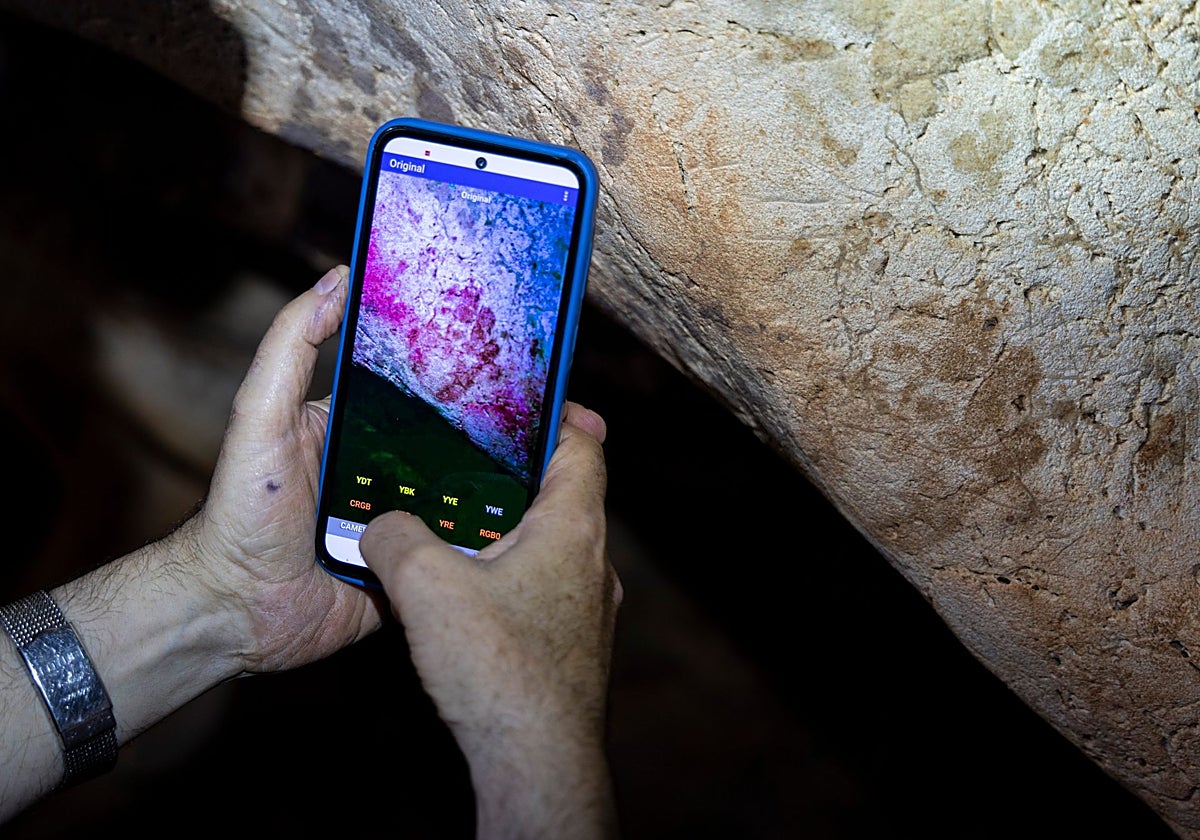
The most recent discovery is on the other side of the cave, in the chamber where archaeological excavations continue to trace the life of Neanderthals and sapiens. Here, on a rock outcrop, archaeologists have just detected a baby's hand imprinted in red pigment. It is visible to the naked eye, but when processed with the D-Stretch tool for ImageJ, the tiny fingers are revealed in detail. Based on what is known from other caves and datings performed here (with another hand dated to around 37,000 years), it corresponds to the oldest art.
The richness of this cave is impressive, yet it remains largely unknown to many people from Málaga, partly eclipsed by the fame of the nearby Cueva del Tesoro. It can be visited in two shifts a day (except Tuesdays and Wednesdays), in groups of no more than ten people to avoid altering a cavity that has hardly been modified by human intervention. Therefore, the activity is classified as Active Speleological Tourism, not suitable for people with mobility issues or claustrophobia, and always with trekking or mountain footwear (more information and reservations at the Turismo en Rincón website).
- More topics
- Archeology
- Tourism
- Caves
- Rincón de la Victoria

Latest news





Upcoming events
12
Nov
El Desembarco, la traición de Viriato at La Caja Blanca
12
Nov
HOMER El Mero Mero at Sala Trinchera Málaga
13
Nov
Marbella Startup Lab – Innovate & Collaborate
13
Nov
Candlelight: Coldplay & Imagine Dragons at Sala Fundación Unicaja María Cristina
13
Nov
Candlelight: Tribute to Ludovico Einaudi at Anantara Villa Padierna
Similar News

Málaga Airport Makes History with More Than Three Million Passengers in One Month
Málaga

Port of Málaga looks beyond its docks to support future growth
Málaga

Guide to the Virgen del Carmen Processions in Málaga and the Province
Málaga
