


A 'prehistoric landfill' in the Cueva de la Victoria reveals what they ate in Malaga thousands of years ago

31/05/2026 Updated at 00:15h.
Located on the side of the Shell Room, out of the way, it had never caught the attention of the researchers at the Cueva de la Victoria, in the El Cantal area (Rincón de la Victoria), where Paleolithic and Neolithic human groups lived, painted, and were buried at different times in history. It is known because their hands are on the walls, their tools have been found on the ground, and their bones were discovered in the rock crevices. But this accumulation of sediments tucked behind a stalagmite did not seem to offer anything new. Still, those who have dedicated their lives to archaeology are aware that in this science, nothing can be taken for granted. And they began to dig. What they found will now help to understand a fundamental part of the life of its occupants: their diet.
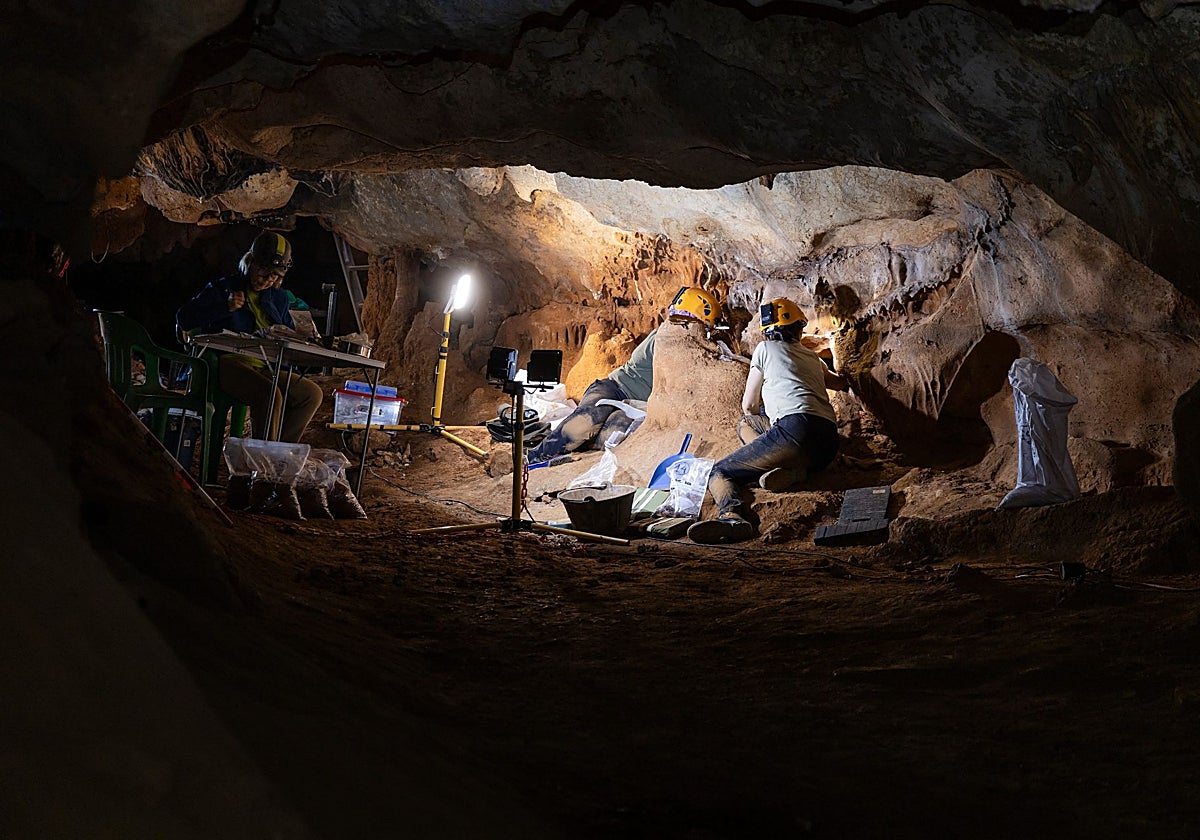
The team led by archaeologists Pedro Cantalejo and María del Mar Espejo has discovered a kind of 'prehistoric landfill', a corner where those inhabiting the cave discarded the leftovers of what they ate. It remains intact because, by hiding behind geological formations, it escaped the emptying of the cave that was carried out in the 19th and 20th centuries when people entered for bat guano and to loot archaeologically, and later when research began. And they say one man's trash is another man's treasure: from what the human groups threw away at least 14,000 years ago (the starting date), the Paleolithic menu of the Malaga coast can be composed. In a preliminary analysis 'in situ', pending processing in the laboratory of all the sediments and remains collected, it is estimated that 75% came from the sea and just 25% from the land.
The diet on the coast was completely different from that of the caves inland, where big game hunting predominated.
The shells protruding on the surface of that mound were precisely what made the experts focus on that area. Yolanda del Rosal, a biologist from the Nerja Cave Research Institute, and Cristina Liñán, a geologist from the same center, have already found hundreds of them which are classified in bags marked by the archaeologist María del Mar Espejo. They spend hours on the ground in an uncomfortable position, cleaning the earth and making an initial separation of what appears. The constant drip of bones, fishbones, vertebrae, and shells is ongoing. "There's charcoal!" one of them announces to Pedro Cantalejo as he approaches the excavation area, remains that will allow for Carbon-14 dating and confirm that what is here was 'cooked' in some way.
From the land
Rabbit bone fragments, the most consumed mammal by the prehistoric human groups that occupied this cave. (Marilú Báez)From the sea
White clam with carbonaceous sediments, indicating it was cooked. The presence of charcoal will allow dating it using the Carbon-14 technique. (Marilú Báez)Rareness
Among the waste, a shell has appeared with a hole at the end, which indicates that it could have been used as a pendant. (Marilú Báez)Methodology
The remains found on the ground are classified in bags to be later analyzed in the laboratory. There are hundreds of them from the last campaign in the Cueva de la Victoria. (Marilú Báez)The team
María del Mar Espejo and Pedro Cantalejo, on the left, classify the remains that Yolanda del Rosal and Cristina Liñán extract. (Marilú Báez)The human groups that occupied the Malaga coast had fishing skills. Among the 'trash', large fish vertebrae such as gilthead seabreams and white seabreams, which could be caught with a harpoon, and cetaceans such as dolphins and whales, which probably got stranded on the beach sand, have appeared. This along with various types of mollusks, limpets, and sea urchins made up a good part of their diet.
Land resources carried much less weight and, according to the preliminary information this campaign provides, rabbit was the main dish. A diet completely different from that detected in settlements inland of the province where almost everything they ate came from big game hunting, mainly deer and goats. The prehistoric man inhabited one place or another depending on the time of year: they moved inland during warm times and hunting season, and towards the coast when the cold tightened and the bay revealed itself as a paradise in climate and resources. This is what experts call 'restricted nomadism'. They estimate that in just ten hours they were able to walk the kilometers separating Ardales from Rincón de la Victoria, using the margins of the Guadalhorce River as a natural highway. Therefore, as Cantalejo highlights, one cave is a "mirror" of the other.
In Victoria, each discovery that deviates from the expected is celebrated like winning a lottery. They congratulate each other on the appearance of a closed shell, with the mollusk inside, which will provide a lot of additional information. Those bones with shapes they cannot identify by sight generate anticipation and are set aside for more thorough study. And their faces light up when rarities that require further investigation emerge: among the food remains, they find a shell with a hole made by human hand, indicating it could have been used as a pendant. The calm evaluation and laboratory analysis of the hundreds of bags with sediments and remains they have extracted will complete the puzzle. A task led by Cantalejo and Espejo and made possible by the combined efforts of the Rincón de la Victoria City Council, the Nerja Cave Research Institute, led by Luis-Efrén Fernández; and the University of Cádiz, with José Ramos at the helm of the project.
With the work in the 'prehistoric landfill', the Malaga team bids farewell to five years of campaigns inside the Cueva de la Victoria, a cave of just 150 meters linear in the El Cantal area but with a huge amount of information yet to be processed. Much is in museums, in the Malaga Museum and the Archaeological Museum of Madrid, where what was extracted from the first emptying of the rooms was taken. "The crème de la crème," says Cantalejo. He explains that technological advances mean that today, continuing to excavate 'in situ' is increasingly unnecessary to obtain data. On a human level, the tools they used, how they manufactured them, where they were buried, what they painted are already known... The next phase is to obtain paleoclimatic data: in which climatic stage they lived, what the temperature was, where the sea was, what plants existed at each moment... "And all that has remained prisoner in the archaeological context," points out Cantalejo. Now it remains to analyze it.
- More topics
- Research
- Caves
- Archaeology
- Rincón de la Victoria
- Málaga

Latest news





Upcoming events
12
Nov
El Desembarco, la traición de Viriato at La Caja Blanca
12
Nov
HOMER El Mero Mero at Sala Trinchera Málaga
13
Nov
Marbella Startup Lab – Innovate & Collaborate
13
Nov
Candlelight: Coldplay & Imagine Dragons at Sala Fundación Unicaja María Cristina
13
Nov
Candlelight: Tribute to Ludovico Einaudi at Anantara Villa Padierna
Similar News

Málaga Airport Makes History with More Than Three Million Passengers in One Month
Málaga

Port of Málaga looks beyond its docks to support future growth
Málaga

Guide to the Virgen del Carmen Processions in Málaga and the Province
Málaga
