


Andrea Romanos Nanclares: "With 7,000 steps a day, we already have health benefits"

29/05/2026 Updated 30/05/2026 - 16:23h.
Andrea Romanos Nanclares, a researcher and professor at the prestigious Harvard University School of Medicine who also conducts her scientific work at Brigham and Women's Hospital in Boston (USA), has featured this Friday in a new session of the 'Science and Health' series, organized by SUR in collaboration with the Unicaja Foundation. A graduate in Human Nutrition and Dietetics and a PhD in Preventive Medicine and Public Health from the University of Navarra, her research focuses on large-scale nutritional epidemiology and cancer prevention. Thus, she delivered the lecture titled 'Eating to live longer and better: the science behind longevity', and gave three essential tips to improve longevity, including the following: "Walk more than 30 minutes more than you do today, no excuses. 7,000 steps already have documented benefits, start with what you have."
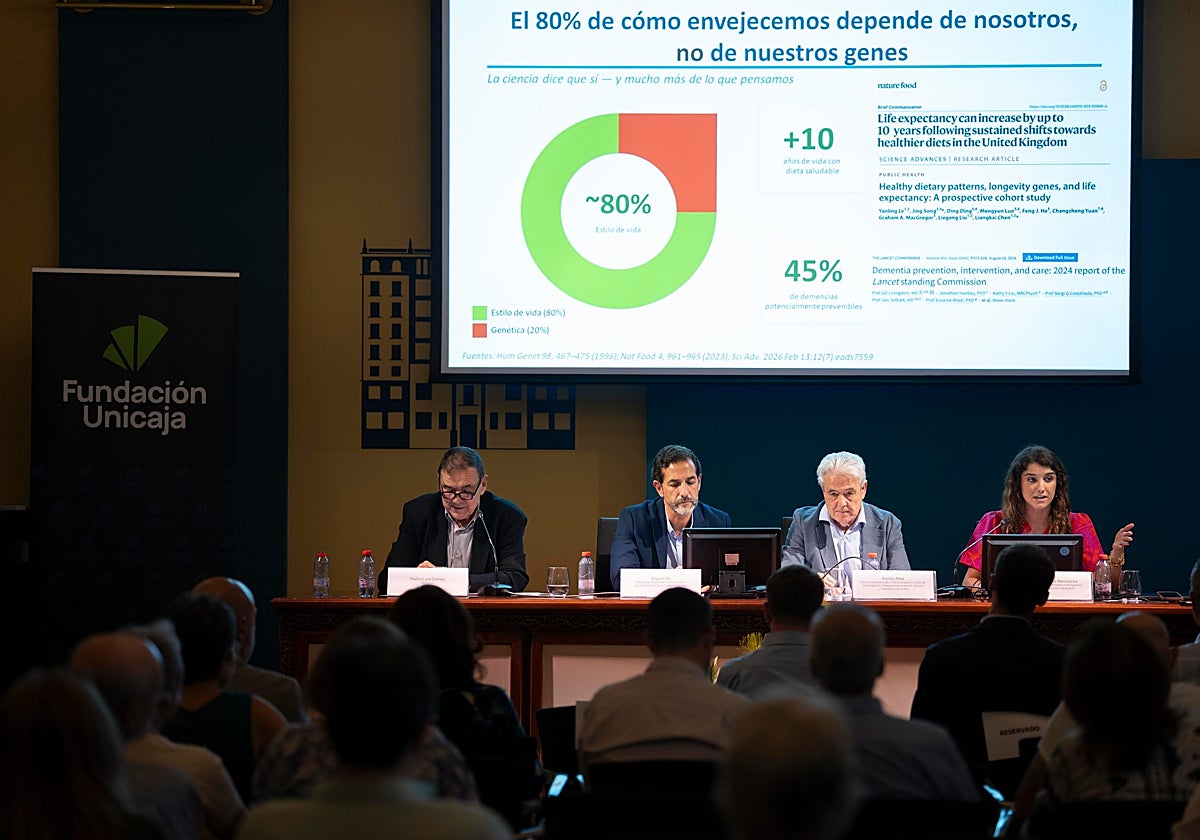
The event, held on Friday afternoon in the auditorium of the Unicaja Foundation, was presented by journalist Pedro Luis Gómez and was attended by the Director of Institutional Relations with Stakeholders of the Unicaja Foundation, Miguel Gil, and the Scientific Director of the CITAC Cancer Research and Advanced Therapies Center and Professor of Oncology at UMA, Emilio Alba.
Thus, Romanos clarified that the idea of 10,000 daily steps comes from a Japanese pedometer company, but a study published in The Lancet establishes that "with 7,000 steps we already have health benefits."
"Exercise is medicine"
In general, she explains, "exercise is medicine," such that a study showed a 30-35% reduction in total mortality in physically active people versus sedentary ones. "There is benefit from very little activity, you don't have to be an athlete, exercise acts on inflammaging (chronic inflammation that develops in the body over the years), epigenetic clocks, and cognitive function. Even walking has a great protective effect, a strong benefit. Climbing stairs, running, lifting weights, swimming, all have great benefits and less risk of premature death," she reflects.
"Genetics is 20% of longevity, the rest, 80%, depends on us"
"Why does what we eat matter? For decades we thought longevity was a matter of genes, genetics is important, there are many hereditary diseases, that's predisposition, not our destiny. Genetics accounts for 20% of longevity, the rest, 80%, depends on us: a person with a healthy diet can gain up to ten years of healthy life compared to someone with a poor diet," she indicates, highlighting that "40% of dementia cases are preventable from early childhood," so a person can modify certain risk factors.
Spain, Japan, and Italy, she explained, spend less on healthcare and live longer. "Why?" she asked. In theory, they have a plant-based diet, olive oil, "movement is embedded in their daily routine, they walk, shop, climb stairs, are part of communities and there is less consumption of ultra-processed foods."
In a study that analyzed the five blue zones of the planet, which are those where centenarians still live, places with "different languages, traditions, religions, analyzing them in detail reveals an ecosystem of common habits: plant-based diet, movement integrated into daily life, a vital purpose or ikigai, a reason for being, a motivation, this is seen to reduce chronic stress," she specifies.
Strong social bonds
This is complemented by "having strong social bonds, belonging to communities in which they feel integrated. In some areas, red wine is also consumed with meals, but the recent trend points to even reducing that and there are daily rest rituals: siesta, meditation, prayer, or family time."
Professor Romanos Nanclares has stated that ikigai means reason for being and is the intersection that gives meaning to life: passion, mission, profession, and vocation. "A clear sense of purpose reduces mortality by 15%," she says.
The Mediterranean diet is, on the other hand, essential in the pursuit of longevity. For example, in one study it was shown that this diet "reduced the risk of dementia by 21%". In another, it was determined that "higher consumption of olive oil was associated with a lower risk of death related to dementia". Specifically, the chances decrease between 28% and 34%. "Every increase of five grams per day of olive oil was associated with less risk of dementia," she indicates.
Regarding ultra-processed foods, a higher consumption of these was associated in another article "with a 32% less chance of having healthy aging."
"Call or meet with someone important to you this week, relationships are medicine, emotional connection is as important as diet"
Furthermore, the researcher, based on numerous top-level global studies, debunks some myths, such as the one about coffee. "With two or three cups a day, there's a lower risk of dementia, it falls by 18%," she says, in addition to improving cognitive function (small improvements in memory and thinking tests) and less subjective cognitive decline. The same occurs with tea (one or two cups), as it promotes healthier brain aging.
She continued debunking myths: "There is increasing evidence: there is no safe level of alcohol for brain health." For example, in another study it was determined that a glass of wine a day increased the risk of cancer by between 7% and 10%.
She advocates sleeping between 6.4 and 7.8 hours and, in addition to adding extra virgin olive oil and an extra serving of vegetables to each main meal and walking 30 minutes more than "you walk today," she concludes: "Call or meet with someone important to you this week, relationships are medicine, social connection is as important as diet." These were the two missing tips.
comments Report an error
Latest news





Upcoming events
12
Nov
El Desembarco, la traición de Viriato at La Caja Blanca
12
Nov
HOMER El Mero Mero at Sala Trinchera Málaga
13
Nov
Marbella Startup Lab – Innovate & Collaborate
13
Nov
Candlelight: Coldplay & Imagine Dragons at Sala Fundación Unicaja María Cristina
13
Nov
Candlelight: Tribute to Ludovico Einaudi at Anantara Villa Padierna
Similar News

Málaga Airport Makes History with More Than Three Million Passengers in One Month
Málaga

Port of Málaga looks beyond its docks to support future growth
Málaga

Guide to the Virgen del Carmen Processions in Málaga and the Province
Málaga
