


Why has the fire at the Ibis Hotel and the Grand Café reignited so many times?

28/05/2026 at 23:55h.
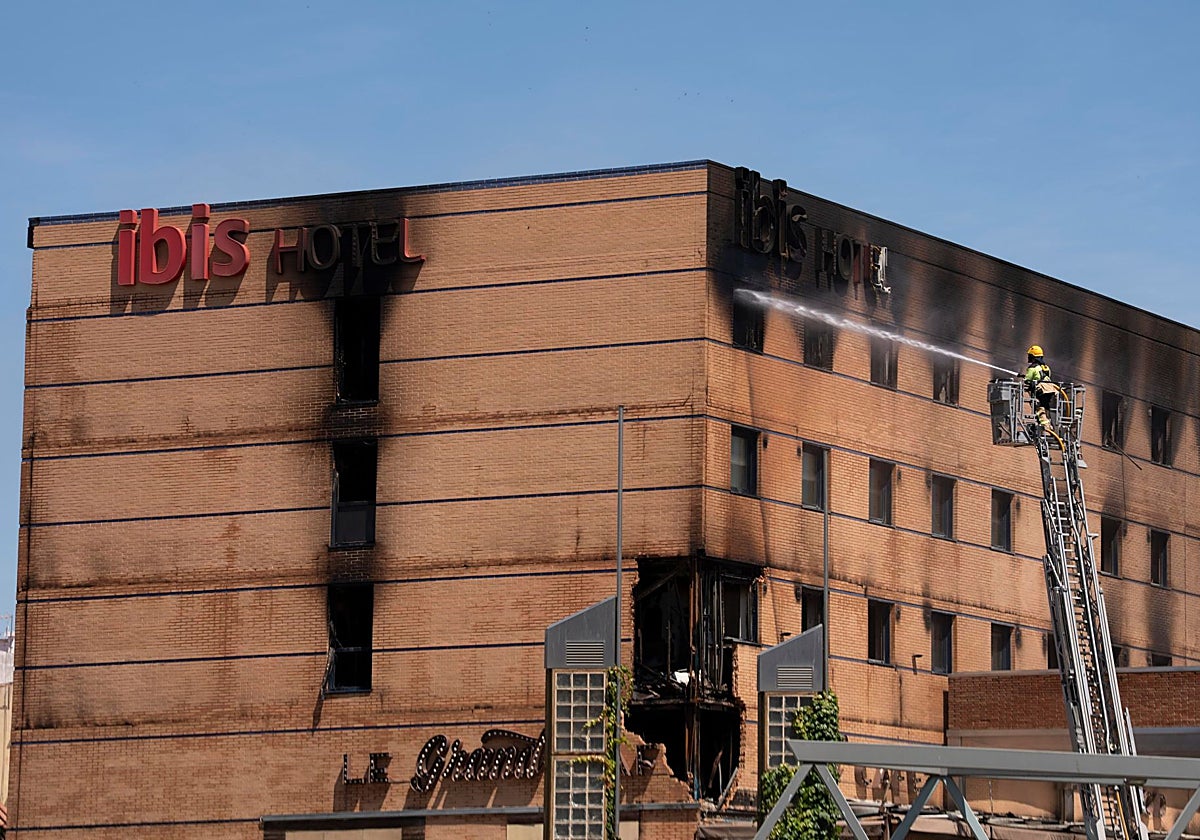
Wooden floors and false ceilings have prevented an internal attack in the devastating fire at the Ibis hotel and the Grand Café, which started in the early hours of Monday. Many wonder why the fire has reignited several times. A first clue is the structural instability after the collapse of the building's compartmentalization, which has forced firefighters to work almost exclusively from the outside, making it impossible to systematically use thermal imaging cameras and demolition hooks to extinguish latent hotspots.
SUR has raised the question of reactivations to Pedro Pacheco, spokesperson for the Andalusian Firefighters Union (SAB), who explains from his extensive experience the technical complexity of fires like this one. He avoids commenting on the future of the building, but it is clear that the damage is almost impossible to repair. Initially, the entire perimeter is fenced off to prevent further damage.
Thermal Transfer
The root of the problem lies in the initial thermal transfer and in the building's construction features, which combine highly combustible elements with confined spaces that are difficult to access. According to Pacheco: "The fire in the bar was brutal. The thermal load that has been transmitted to the rest of the hotel was brutal. This circumstance immediately caused the failure of the building's containment measures. All this has spread once the compartmentalization broke. All the calories and all the hot gases have been transferred to the entire surface."
Related news
Heat Confinement in False Ceilings
The main reason why the fire reignites recurrently is the presence of latent hotspots in the false ceilings distributed throughout the hotel, a common phenomenon in this type of building. Under normal conditions, the extinguishing teams conduct a visual and tactical inspection supported by specific technology. "We have this tool, the thermal camera, which very clearly marks, by changing the shades of colors, the hot zones," he points out. Upon detecting these transfer points, firefighters proceed to mechanically open the cladding: "We carry demolition hooks, sticks with spikes, we break the false ceiling and finish cooling down or extinguishing in that area."
The Particular Case
In this disaster, the vulnerability of the structure has complicated the application of this safety protocol inside. "We have not been able to access conventionally. We have not been able to opt for tearing down all the false ceilings or conducting an inspection with thermal cameras on all floors," argues Pacheco. "As we cannot scan or break the ceilings from inside, the confined heat remains there latent and may be self-feeding and reach a point where it restarts," he emphasizes.
The Risk of Collapse
The impossibility of progressing inside the establishment is determined by the certain risk of floor collapse. The building has an internal combustible structure of wooden floors.
The danger of the terrain was confirmed during the initial firefighting efforts on the upper floor, where a firefighter suffered an accident when the surface under his feet gave way. This incident determined a radical change in the strategy of action: attack from the outside.
Differences Between Wood and Metal
Unlike metal structures, which suffer rapid deformations and transmit tensions that cause the collapse in chain of anchoring points and welds, wood has a different physical behavior. "The wood starts to burn and loses section, there comes a time when the section can no longer hold and it breaks, but it does not suffer that deformation," the specialist clarifies, noting that although this can keep the building standing for a bit longer, the risk of sudden floor breakage makes it impossible for people to pass.
Selective Demolition on the Facade
With interior attack ruled out, efforts are limited to peripheral cooling and selective demolition of facade elements that have come loose, using demolition hooks from the outside to try to introduce water into critical areas. However, this maneuver also presents severe technical and safety restrictions for the personnel.
"We have not been able to opt for tearing down all the false ceilings or conducting an inspection with thermal cameras on all floors"
Pedro Pacheco
Spokesperson Andalusian Firefighters Union
The spokesperson warns about the risks of using the available machinery under these conditions: "The ladder truck is a catapult, any small movement given to it, colleagues can be thrown off." Also, the behavior of the external walls when struck is unpredictable, which requires high caution to prevent debris from reaching emergency vehicles or the operators themselves.
- More topics
- Firefighters

Latest news





Upcoming events
12
Nov
El Desembarco, la traición de Viriato at La Caja Blanca
12
Nov
HOMER El Mero Mero at Sala Trinchera Málaga
13
Nov
Marbella Startup Lab – Innovate & Collaborate
13
Nov
Candlelight: Coldplay & Imagine Dragons at Sala Fundación Unicaja María Cristina
13
Nov
Candlelight: Tribute to Ludovico Einaudi at Anantara Villa Padierna
Similar News

Málaga Airport Makes History with More Than Three Million Passengers in One Month
Málaga

Port of Málaga looks beyond its docks to support future growth
Málaga

Guide to the Virgen del Carmen Processions in Málaga and the Province
Málaga
