


Firefighters on alert due to difficulty in extinguishing fire at the IBIS hotel

Málaga
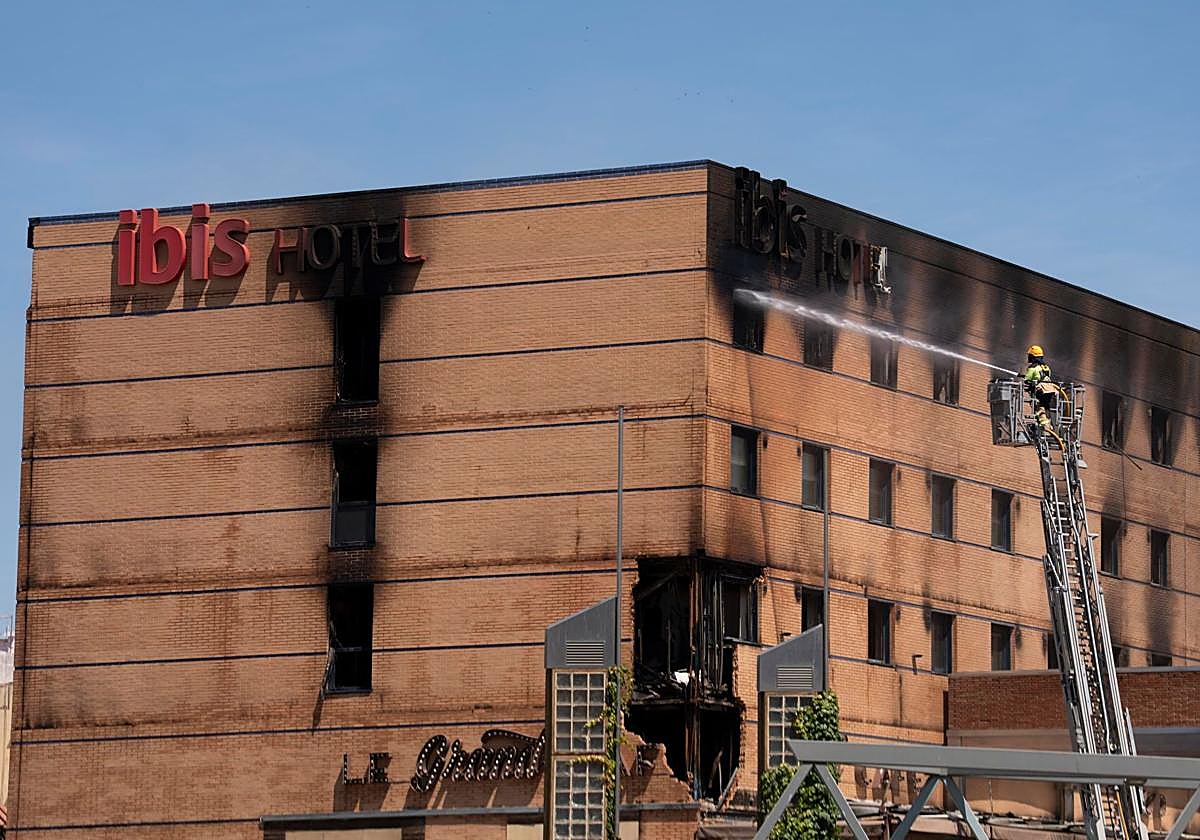
27/05/2026 Updated at 20:15.Flames were seen again this Wednesday at the Ibis Hotel in Málaga. The wind and the building materials keep firefighters on alert ... as at times the fire has reignited, producing columns of smoke again. During the morning, smoke was seen coming from the third floor of the burnt building. Therefore, the personnel of the Royal Fire Brigade of the capital are tirelessly working in the area affected by the devastating fire that, since early Monday morning, consumed the Ibis Hotel and the Le Grand Café hospitality establishment. After more than thirty hours of battling the fire, the Málaga City Council confirmed on Tuesday that the flames had finally been brought under control, although the extinguishing teams refrained from declaring it extinguished due to the persistence of small latent hotspots on the upper levels of the building.
Related news
Currently, two units consisting of two fire engines, three aerial ladders, and a tanker truck are deployed. The personnel are carrying out cooling and prevention work to avoid reactivation and complete the extinguishing.
These cooling efforts, which will continue over the next few days, may result in smoke appearing at certain times. Once safety inside is guaranteed, this morning the mandatory inspection visit was carried out by the Scientific Police of the National Police to investigate its causes, as well as by technicians from the Municipal Urban Planning Management to assess the state of the building.
A flow rate of up to 5,000 liters per minute
The severity of the incident required an unprecedented water deployment in recent local event history. According to emergency unit sources, the extinguishing teams managed to pump a flow rate ranging from 3,000 to 5,000 liters of water per minute at the peak of the thermal virulence. In just about twelve hours of intensive work, the firefighters projected more than two million liters of water onto the structure. To gauge the magnitude of this figure, the Municipal Water Company of Málaga (EMASA) detailed that this same volume is typically used to supply a whole population of 20,000 inhabitants for half a day. Sector technicians admitted that this estimate was conservative and that the final consumption far exceeded the initial records.
Related news
During the early hours of Tuesday, the fire was technically considered under control, after the fire front reignited on Monday afternoon and spread with unusual violence northward and to the upper floors of the hotel, areas that had initially been spared from the direct action of the flames. Although the main perimeter was stabilized by the night, the high temperatures kept several small secondary hotspots active on the fourth floor of the hotel infrastructure and also in the premises of Le Grand Café, the hospitality space where the disaster apparently originated.
This morning the mandatory inspection visit by the Scientific Police was carried out to investigate its causes
The councilor in charge of Security, Avelino Barrionuevo, appeared to certify that the fire was "practically extinguished" and detailed the start of the cooling tasks, for which three units remained fixed. This advancement in civil security also allowed the Local Police to decree the reopening to traffic of the Avenue of Fatima tunnel, restoring traffic flow to the right bank of the Guadalmedina River. Barrionuevo set the chronological origin of the tragedy at the early hours of last Monday, exactly at 1:24 a.m. The councilor recounted that the primary focus likely began inside the Le Grand Café cafeteria. The accumulation of gases and the extremely high heat load caused the extreme heating of the windows; the moment the glass broke, the massive influx of oxygen acted as a perfect oxidizer and propagated the fire uncontrollably towards the adjoining hotel.
When the flames reached the hotel building, the general alarms of the facilities went off. The complex immediately activated its self-protection plan and, thanks to the coordinated action of the employees, the private security personnel, and the local police patrols, the immediate evacuation of the building was executed. The guests initially moved to a safe area outside and, after verifying that no one was trapped in the rooms, social services managed their relocation. The affected initially stayed at the Málaga Centro Hotel, although they were later relocated to various establishments in the city by the hotel industry association.
The extinction posed an extraordinary challenge due to the architectural characteristics of the building. Barrionuevo acknowledged that the internal frameworks of the building included wooden elements, a factor that completely prevented the firefighters from tackling the fire from the inside during the first days. The risk of the ceilings collapsing from the heat forced the adoption of a purely defensive strategy, attacking the fire from the public road using aerial ladders and high-pressure pumps. During the most critical night, the operation added a constant reinforcement until simultaneously mobilizing three fire engines, two aerial ladders, three tanker trucks, and five light vehicles, maintaining extra crews to cover the rest of the municipality's incidents.
Firefighters
The extinction posed an extraordinary challenge due to the architectural characteristics of the building
Although the fire reignited on Monday afternoon and advanced forcefully to the upper floors, the firefighters managed to halt its perimeter progression. The initial surface analyses painted a desolate scenario: Le Grand Café was reduced to ashes, and the Ibis Hotel suffered severe damage to 75% or 80% of its usable surface. Only a few rooms located at the northern end of the fourth floor withstood the disaster by remaining completely closed, which prevented the entry of the thermal front. Although the initial reports from the firefighters suggested a technical situation of ruin and discouraged access by the Scientific Police due to the risk of collapse, subsequent evaluations nuanced this diagnosis.
The mayor of Málaga, Francisco de la Torre, intervened in the afternoon at a public event in District Zeta, where he described the fire as "complex" but categorically dismissed the hypothesis of an imminent collapse of the structure. The mayor linked the safety of the area to the opening of the adjoining avenues and demanded the urgent drafting of an expert report that clarifies the point of origin, the mechanical causes, and the development of the disaster. De la Torre refrained from speculating on whether the construction materials accelerated the combustion.
comments Report an error
Latest news





Upcoming events
12
Nov
El Desembarco, la traición de Viriato at La Caja Blanca
12
Nov
HOMER El Mero Mero at Sala Trinchera Málaga
13
Nov
Marbella Startup Lab – Innovate & Collaborate
13
Nov
Candlelight: Coldplay & Imagine Dragons at Sala Fundación Unicaja María Cristina
13
Nov
Candlelight: Tribute to Ludovico Einaudi at Anantara Villa Padierna
Similar News

Málaga Airport Makes History with More Than Three Million Passengers in One Month
Málaga

Port of Málaga looks beyond its docks to support future growth
Málaga

Guide to the Virgen del Carmen Processions in Málaga and the Province
Málaga
