


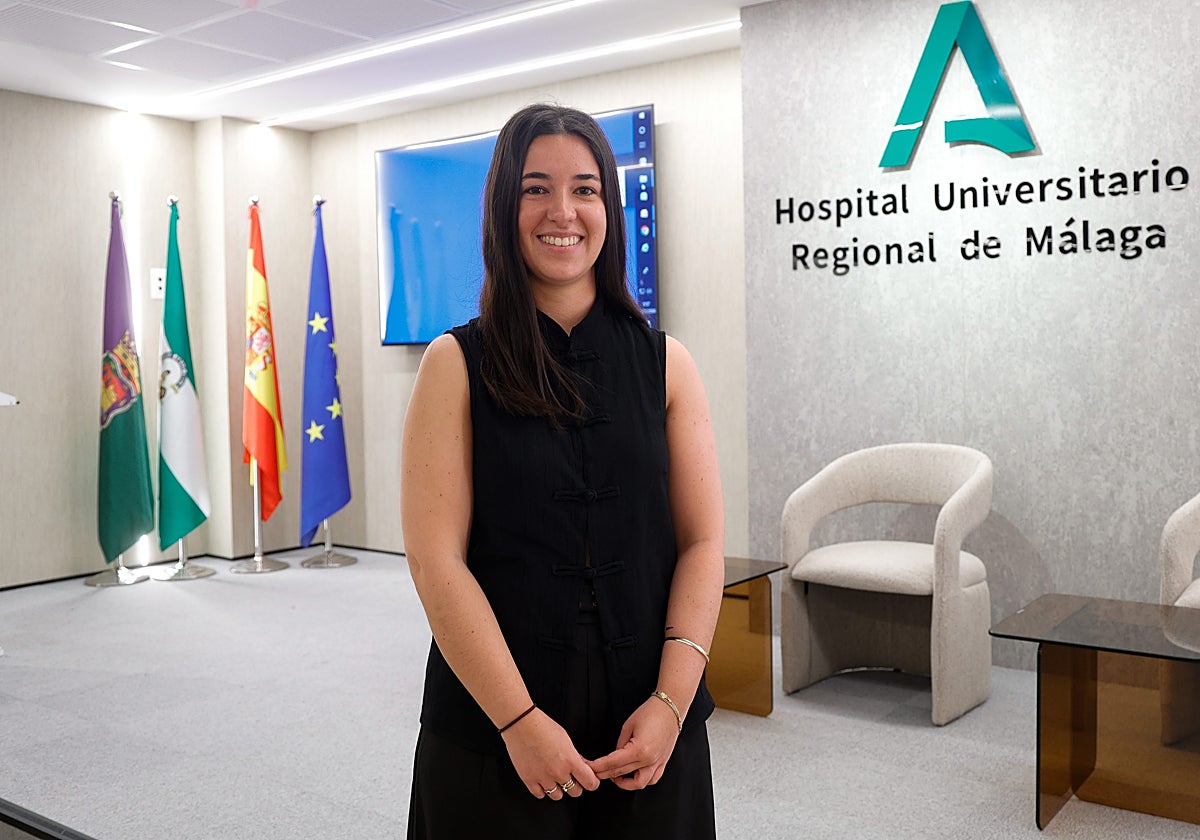
Loreto Fernández, first Emergency Resident at the Regional Hospital: "I like the adrenaline"

28/05/2026 at 00:28h.
Medical societies and numerous professionals have requested it for years, but their requests were always ignored. Until July 2024, when the central government approved the creation of Emergency Medicine as a new medical specialty, thus offering positions for new residents. In the 2026 MIR exams, the first two positions in this area were awarded in Málaga, both in the Clínico and the Regional Hospital. Consequently, SUR interviewed the first resident of the specialty at the former Carlos Haya, Loreto Fernández Domínguez, a 25-year-old from Algeciras whose training begins on June 5. "I like the adrenaline," she asserts.
The name of Loreto Fernández will be linked to the history of medicine in Málaga alongside the colleague who will debut in the specialty at the Clínico, which represents a responsibility and, above all, a lot of demand. The work will undoubtedly be arduous. In 2025 alone, the Emergency Department at the Regional Hospital handled 335,929 cases, 315,025 with admission and 20,904 without it. For example, at the Clínico, emergency doctors attend to more than a thousand cases each day.
Fernández explains to this newspaper that she chose the specialty for the following reason: "I really like the dynamics of emergency care, you have to know a bit of everything and be constantly on your toes. Often it's the patient's first diagnosis and, from what I'm seeing here with my colleagues, I believe there's great teamwork and I love that."
The Specialty
The specialty day was celebrated this Wednesday, an occasion that the Spanish Society of Emergency Medicine (SEMES) used to remind that the training will last four years. The program includes a system of rotations through reference and regional hospitals, rural settings, out-of-hospital care, and emergency management.
Loreto Fernández Domínguez, yesterday, with her Emergency Department colleagues. (MARILÚ BÁEZ)The specialty will be, according to SEMES, the most understaffed and aged in the country over the next ten years, hence the request to increase the number of positions.
The training program lasts four years and includes rotations through reference and regional hospitals, in rural settings, out-of-hospital care, and emergency management.
Loreto ranked number 6,151 in the MIR and was born in the town of Algeciras. She has always been drawn to doing her residency at the former Carlos Haya. "It has always caught my attention. Being from Cádiz, I have always heard a lot about Carlos Haya and when I had to do the ranking, honestly not to discredit Cádiz, I chose this one because it is a very good hospital," she declares.
Fearless
She is not at all frightened by the novelty of the specialty. Until now, most emergency doctors came from Family and Community Medicine, so the group of "emergency physicians," as they call themselves, is experiencing a moment of grace. "It's something new, we won't really know how it will go until we've been at it for a while, whether we need to add or remove something, it's the novelty of seeing how we will handle the specialty," she notes.
In her opinion, the opportunities are also many. "There are many outlets, you can work in a hospital, in ambulances, in health centers and in the end, you have to know everything and be on your toes, you are the frontline of the hospital," she says.
"There are many outlets, you can work in a hospital, in ambulances, in health centers and, in the end, you have to know everything and be on your toes, you are the frontline of the hospital"
Her first decision was not to dedicate herself to Emergency Medicine, she was interested in general surgery, "but since they were saying they wanted to establish it, it was already catching my attention and, when I ranked in that position in the MIR, I considered it much more: this year for sure."
Since she was very young, she claims, she has wanted to be a doctor. "My grandmother was very ill and my grandfather too, and I think experiencing that at such a young age made me value the profession a lot and want to be a doctor," she recounts, to immediately assure that one of her fundamental motivations lies in helping patients. "I hope to bring them peace of mind, that they come to the Emergency Room and see that their problem has a solution, maybe not everything has a cure, but we can alleviate the pain, calm them down, and treat them," she says.
In the future, she sees herself in Málaga. If she looks for a deeper reason for her decision, she doesn't find it, although the adrenaline explains part of it. "The truth is, I've never seen myself in other specialties that are more about consultations and being around the wards and such. In terms of patient interaction, I like seeing many cases at once and different things," she reflects.
Qualities
She also clarifies that among her qualities are "decision-making ability, working well under pressure. During my studies, I worked, and I believe, as I have been told, I convey calmness when I see the patient, and that is very important. Plus, I know how to work in a team, which is a very important role in Emergency Medicine."
Her family is happy and bursting with pride, and the colleagues she has just met (although she joins her MIR position at the beginning of June) "are very happy because the specialty has finally been established, I'm going to be the first and they are going to treat me very well, they will be able to teach me everything and more, so I'm very happy with them, honestly."
"My colleagues are very happy because the specialty has finally been established, I'm going to be the first and they are going to treat me very well"
There will undoubtedly be difficult decisions at key moments. "The most complicated thing is when a critical patient arrives, it's not known what decision to take first: maybe they have some respiratory, cardio, neuro issues or multiple traumas, those decisions I think are the most difficult," she says.
Is being an emergency doctor also a bit like being a detective? "Yes, yes, of course, when a patient first comes to the Emergency Room they say: 'Well, I have a bit of a cough, a fever,' and there you have a range of possible illnesses, so yes, you have to play a bit of a detective," she notes, also highlighting that she looks forward to meeting her colleague from the Clínico as well.
In the future, she insists, she wants to practice in Málaga. "I love the city, its people, the climate, I live nearby, I've come many times as well," she highlights.
- More topics
- Medicine
- Hospital Regional de Málaga

Latest news





Upcoming events
12
Nov
El Desembarco, la traición de Viriato at La Caja Blanca
12
Nov
HOMER El Mero Mero at Sala Trinchera Málaga
13
Nov
Marbella Startup Lab – Innovate & Collaborate
13
Nov
Candlelight: Coldplay & Imagine Dragons at Sala Fundación Unicaja María Cristina
13
Nov
Candlelight: Tribute to Ludovico Einaudi at Anantara Villa Padierna
Similar News

Málaga Airport Makes History with More Than Three Million Passengers in One Month
Málaga

Port of Málaga looks beyond its docks to support future growth
Málaga

Guide to the Virgen del Carmen Processions in Málaga and the Province
Málaga
