


Almodóvar, Alaska, and La Movida Settle into the Carmen Thyssen Museum in Malaga
The pictorial liberation of the crazy eighties stars in the new temporary exhibition featuring works by Barceló, Arroyo, and Pérez Villalta.

The exhibition opens and immediately catches the eye not just because of its generous mural-sized canvases but also because of the characters it portrays. Lying down and clad in 'animal print' tights is Alaska; standing and smoking a cigarette is Tesa Arranz, from the Zombies group; to their right, the artist from Malaga, Bola Barrionuevo appears, and dominating the scene is Herminio Molero from Radio Futura, observing everyone. Also present is the author himself, Guillermo Pérez Villalta, who includes a self-portrait in his emblematic work 'Scene, characters after a concert' (1979), loaned by the Reina Sofía, which authenticates the new exhibition at the Carmen Thyssen Museum, 'Liberated Painting. Young Spanish Figuration of the 80s', showcasing an era marked by democracy, a return to figurative art, color, music, and the spirit of the Movida Madrileña. A claim for freedom that is present not only in the selected authors but also in the lenders of this exhibition, including a collector who was also a major protagonist of that movement: Pedro Almodóvar.
From top to bottom, the canvas 'Scene. Characters after a concert', a work that portrays the era of the movida and serves as the entrance to the exhibition. In the second photo, the singer Alaska is portrayed during her time with the group Kaka de Luxe. In the last, the artist and musician Herminio Molero, founder of Radio Futura.
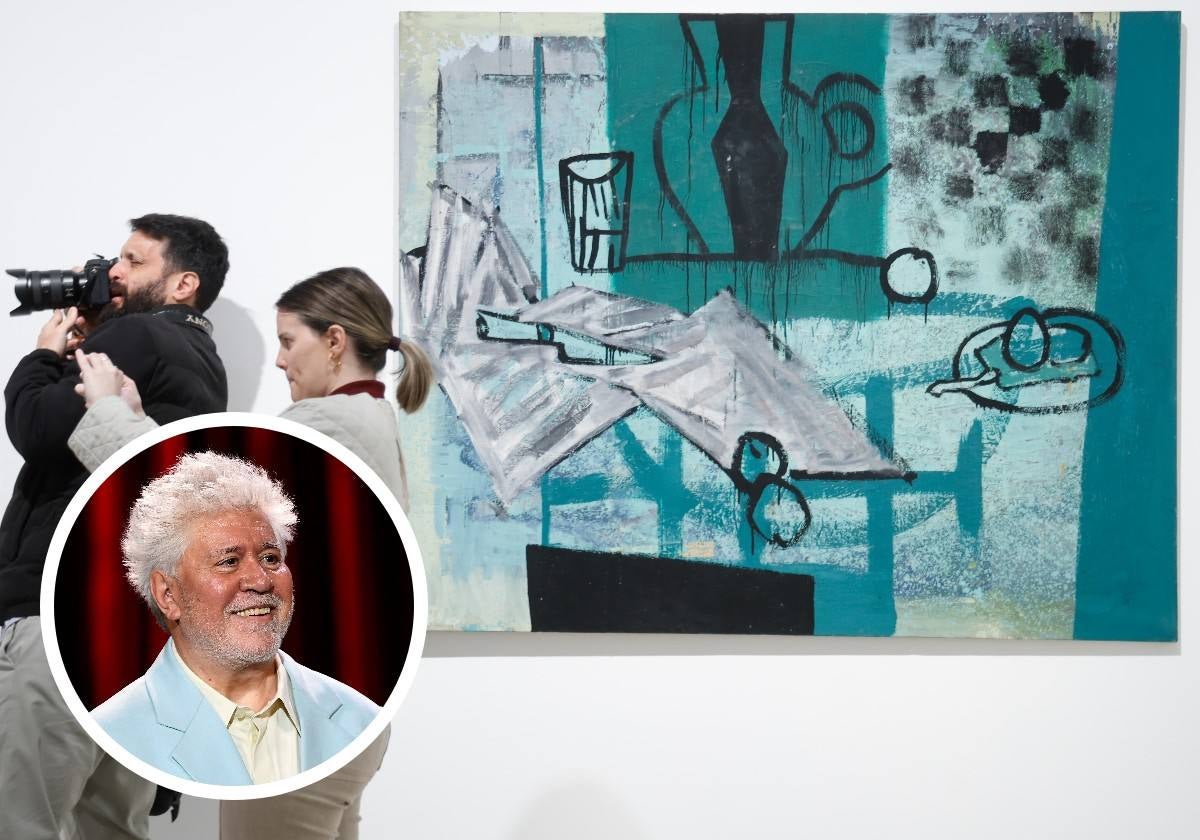
"Nothing is gratuitous, and the fact that the filmmaker is one of the collectors speaks volumes about the exhibition itself," said Lourdes Moreno, the artistic director of Carmen Thyssen, at the presentation of the show that will be open until next September. The director referred to the "generosity" of Almodóvar and the skills of the curators, Bárbara García and Alberto Gil, to "convince" the loan of a notable work by the informalist Miguel Ángel Campano, 'Untitled' (1986), which despite its name contains a decipherable green still life, a "tribute to Cézanne," the expert clarified. The loan of the work brings back to a museum in Malaga the director of 'All About My Mother' and 'The Room Next Door', who just last year exhibited in a collective at the Picasso a painting made by the filmmaker himself, along with artist Jorge Galindo.
Although the movida and democracy permeated the 24 artists gathered in this exhibition, it cannot be described as a unified or orchestrated movement, but rather as a coincidence marked by the pleasure of painting, the explosion of color, and the return to figurative art, though far from realism. "It is a liberated painting because it breaks free from the corsets of Francoism, which promoted a work with a political concept of struggle, but with the death of the dictatorship there is an explosion of art, the joy of painting for painting's sake, and a reconfiguration of the artistic scene," Lourdes Moreno said about an exhibition that, like a vinyl record of any group from the movida, shows a close relationship between music and art.
Thus, Pedro Almodóvar was very close to Pérez Villalta, who portrays the Zombies, Alaska, and Herminio Molero, who not only also performed with the filmmaker from La Mancha, was a founder of Radio Futura and wrote anthems of the era like 'Enamorado de la moda juvenil', but is present in the exhibition as a visual artist and author of 'Portrait of the Kandinskys' (1988). Interestingly, this last piece, in a further twist, transcends the boundaries of Carmen Thyssen and dialogues with the newly inaugurated exhibition at the Centre Pompidou Malaga dedicated precisely to the Russian painter and pioneer of abstract art, and his wife Nina.
"If there is an exhibition that has a soundtrack, it is this one because alongside this explosion of life in painting, there was also another very important explosion in Spain, which is that of pop, as shown in the first painting that welcomes the viewer to this exhibition," commented Lourdes Moreno referring to the work of Pérez Villalta, an author who, paradoxically, has repeatedly expressed his discomfort with being labeled as an 'artist of the Movida' and even rejects the noisy label.
Malaga Movida
Beyond visions and connections, the exhibition itself could also argue that its selection of canvases goes further and paints a broader portrait of the crazy 80s and what that newfound freedom in art meant, with the presence of Luis Gordillo, Carlos Alcolea, Manolo Quejido, Carlos Franco, Patricia Gadea, Ferrán García Sevilla, Menchu Lamas, Antón Patiño, Pepe Espaliú and the Malagans Chema Cobo, Alfonso Albacete, and Joaquín de Molina, of whom an exceptional work, 'Untitled 1' (1974), dated just a couple of years after the death of this author and cultural agitator who can be considered a representative of the Malaga movida, is shown.
The exhibition, presented by the Mayor of Malaga, Paco de la Torre, and sponsored by the Unicaja Foundation, also has the particularity of being the chronologically closest to the present and contemporary art that the Carmen Thyssen Museum has organized since its opening, in addition to an evident coincidence that catches the eye: the thirty works on display are medium and large format. Among them, some essential masterpieces of the era, such as 'Madrid-Paris-Madrid' (1984), which plays with the iconic image of Tío Pepe to portray the return from French exile of Eduardo Arroyo, or 'Map of Meat' (1982), which marked the international breakthrough of a then young Miquel Barceló. And although it is not heard in the room, it is recommended to view these works with headphones blaring Kaka de Luxe, Zombies, Radio Futura or 'The Painter and the Model' by Danza Invisible.

Latest news





Upcoming events
12
Nov
El Desembarco, la traición de Viriato at La Caja Blanca
12
Nov
HOMER El Mero Mero at Sala Trinchera Málaga
13
Nov
Marbella Startup Lab – Innovate & Collaborate
13
Nov
Candlelight: Coldplay & Imagine Dragons at Sala Fundación Unicaja María Cristina
13
Nov
Candlelight: Tribute to Ludovico Einaudi at Anantara Villa Padierna
Similar News

Málaga Airport Makes History with More Than Three Million Passengers in One Month
Málaga

Port of Málaga looks beyond its docks to support future growth
Málaga

Guide to the Virgen del Carmen Processions in Málaga and the Province
Málaga
