


The Thyssen Museum in Málaga rescues the "gifted" Baroque painter betrayed by death

Málaga
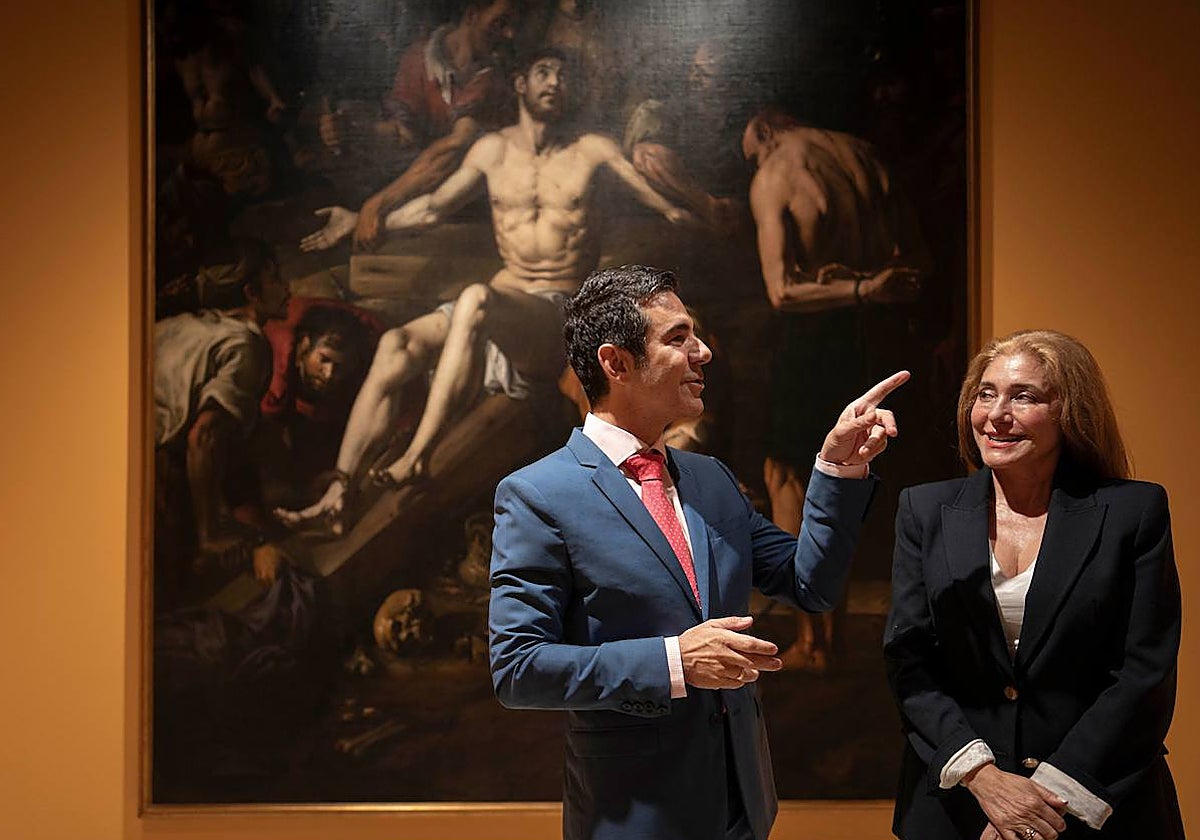
22/05/2026 at 18:16h.It is the smallest and most charming room of the Carmen Thyssen Museum. Thus, it is striking to see 'Preparations for the Crucifixion' (1615) right upon entering the ... Noble Hall. We are before a monumental canvas of three meters by two and a half painted by a young Juan Ribalta who, at just 18 years old, was already surpassing his father and teacher, Francisco, by repeating the same religious scene his progenitor had painted years earlier, now located at the Hermitage in St. Petersburg. Although it depicts the moment before Christ's passion, the painting is loaded with drama, featuring a skull at the feet of the protagonist, dice signifying that fate is sealed, and a darkness that heralds the arrival of tenebrism in painting. The work of this "gifted" painter presides over the exhibition 'The Ribaltas and Naturalist Baroque,' which from this Friday gathers in Málaga a dozen monumental works from this saga of Valencian Baroque masters whose parallel destinies were linked not only by painting but also in death. Although Juan was 30 years younger than Francisco, father and son died at the same time, in 1628.
"Both were carried away by the same epidemic," explained this Friday Pablo González Tornell, director of the Museum of Fine Arts of Valencia and curator of the exhibition, regarding the typhus plague that ended both painters' lives. With the master Francisco and with the disciple Juan already in his maturity. "Both were first-rate artists and were the germ of the first Valencian school, but the son would have been the great painter of Valencian Baroque had he not died," the expert considered, adding that this treacherous death left Levantine art orphaned, since the only one who managed to inherit the Ribalta's mastery was Jerónimo Jacinto de Espinosa, a contemporary of Juan.
Related news
Juan Ribalta was not only a child prodigy of painting capable of rivaling and surpassing his father while still a teenager, but also an "intellectual" who participated in the debates of his time and in "poetic jousts." "Juan claimed a role within the culture," revealed the curator and expert in 17th-century Baroque, who regrets that the son of the saga "did not have the expected impact in historiography because he dies in 1628 and his career was halted at the beginning of his artistic maturity." A mastery that visitors of the Carmen Thyssen can verify with a small, but representative selection of works by father and son -five in each case- that marked not only the Valencian school, but also connect with the great symbol of Malaga Baroque.
'Preparations for the Crucifixion' presides over the Noble Hall of the Carmen Thyssen Museum. (Ñito Salas)"Juan Ribalta would have been the great painter of Valencian Baroque had he not died" at 30 years old
Pablo González Tornell
Curator of the exhibition
"This exhibition allows us to approach a Baroque that is less known and evident, but that finds its reason for being when exhibited in the city that gave birth, in the generation following the Ribaltas, to one of the best sculptors of Spanish Baroque, like Pedro de Mena," explained Pablo González Tornell, who was accompanied by the artistic director of the Carmen Thyssen Museum, Lourdes Moreno; the councilor for culture of Estepona, María Salomé Hidalgo, and the mayor of Málaga, Francisco de la Torre, who has advanced the extension until the end of the year of the agreement with Carmen Thyssen to continue negotiating the continuity of the gallery in Málaga.
Call to Devotion
Although the work of father and son is present in major international museums, from the Prado to the Hermitage, the great collection of the Ribaltas is found in the Museum of Fine Arts of Valencia, from where this exhibition comes. Francisco became a reference figure of Levantine Baroque with the introduction of naturalism in religious painting. Institutions such as the Porta Coeli Charterhouse, the Santo Domingo Convent, and the San Miguel de los Reyes Hieronymite Monastery were the destinations for many of the canvases of these masters who sought to move the 17th-century viewer with religious scenes, loaded with emotion and pathos, and provoking the call to devotion and conversion of the faithful, in accordance with the precepts of the Catholic Counter-Reformation.
The works of Francisco and Juan Ribalta, father and son, have often been confused
The patriarch of the pictorial clan, Francisco Ribalta, of Catalan origin, arrived in Valencia at the end of the 16th century to end up marking Levantine Baroque painting. Among the masterpieces exhibited in Málaga with his signature is his iconic 'San Bruno' for the altarpiece of the Porta Coeli Charterhouse and 'Magdalene after Communion', which is a work of maturity at the end of his life.
'San Bruno', an iconic Baroque work signed by Francisco Ribalta. (Ñito Salas)During all that time, his son Juan grew up in the workshop and soon showed his skills. The son copied the father and their works, on many occasions, have been confused, although when he turned 18 years old he already began to show his own pictorial personality, as is the case with his emblematic version of 'Preparations for the Crucifixion'. The monumentality of the figures, the dramatic composition, a more Venetian-like color palette, and the singular treatment of light with Italian influence marked the career of the son who, paradoxically, died nine months after his progenitor and from the same disease. As if he were a character in his own work, marked by tragedy and the shadow of the father.
comments Report an error
Latest news





Upcoming events
12
Nov
El Desembarco, la traición de Viriato at La Caja Blanca
12
Nov
HOMER El Mero Mero at Sala Trinchera Málaga
13
Nov
Marbella Startup Lab – Innovate & Collaborate
13
Nov
Candlelight: Coldplay & Imagine Dragons at Sala Fundación Unicaja María Cristina
13
Nov
Candlelight: Tribute to Ludovico Einaudi at Anantara Villa Padierna
Similar News

Málaga Airport Makes History with More Than Three Million Passengers in One Month
Málaga

Port of Málaga looks beyond its docks to support future growth
Málaga

Guide to the Virgen del Carmen Processions in Málaga and the Province
Málaga
