


An Open Arms ship stops in Malaga before departing for Cuba on a humanitarian mission

19/05/2026 Updated at 18:50h.
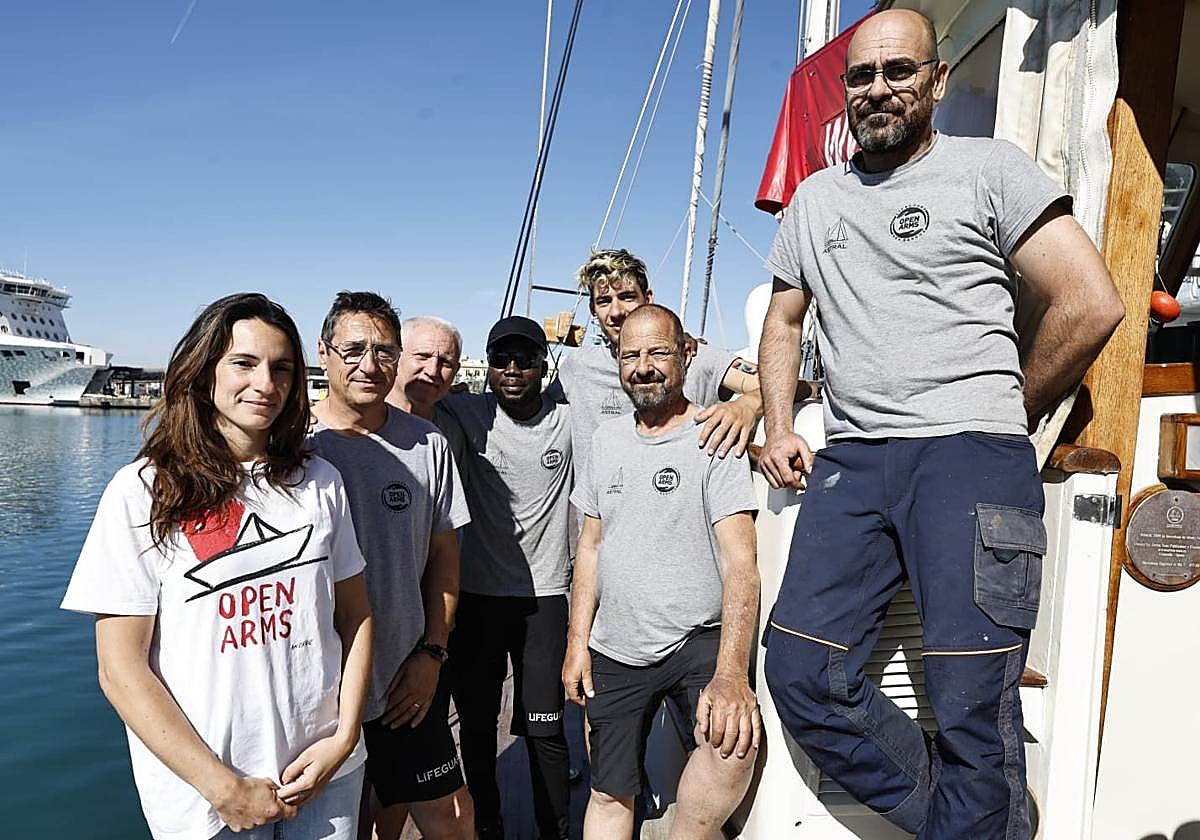
They arrived at four in the morning at the Port of Malaga and before ten in the morning, SUR joins the Astral, ... a ship from the Open Arms organization, where crew members and volunteers are already awake, enjoying the city sun and having a coffee, a small break before the whirlwind that crew and volunteers enter to clean the ship thoroughly and head to the press conference called to present their mission. They departed from Barcelona on May 9th, made a stop in Sagunto, because they were not given permission to dock at the port of Valencia - authorities claimed there was no space because it was under construction - and now they stop in the capital of the Costa del Sol, in a privileged location, at Pier 2, a step away from the center, where they can become more visible for the cause.
Esther Camps, who coordinates the mission, in statements to SUR, explains that their goal is to use their small megaphone to move solidarity with the situation of the Cuban people, who suffer continuous blackouts, the latest consequence of a decades-long blockade. Open Arms, the organization, is mainly dedicated to rescuing migrants at sea. In Cuba, Camps explains, they will also contribute to saving lives: they want to raise a total of 100,000 euros to buy solar panels so that a children's hospital in Havana, the Juan Manuel Márquez Pediatric Hospital, can be energy self-sufficient. They have already gathered about 80,000 euros, even though in Sagunto they could not spread the campaign because they had to stop at an industrial port difficult to access for residents. In Malaga, they will be today and tomorrow, and the ship will be open to the public this Tuesday afternoon, from five to seven, in addition to Wednesday morning. Also, this Wednesday, their crew will participate in the solidarity meeting 'Break the Blockade!', which will be held at seven in the evening in the Plaza de la Marina.
The journey of the Astral ship is part of the 'Heading to Cuba' campaign, which aims to denounce the economic, commercial, and financial blockade imposed against Cuba and carry out that specific humanitarian action: providing energy self-sufficiency to a hospital center.
"People are very supportive, the reception has been very good," values Esther Camps, who also remembers some other missions in which the organization, Open Arms, has participated, such as breaking the Gaza blockade with the shipment of 200 tons of food, in addition to support for the successive flotillas that have tried to reach the Palestinian beaches, support for Ukraine, humanitarian flights, as well as the important rescues in the middle of the sea, which are definitive of the NGO. "In the end, what we do is put the focus there where no one wants to look and we use our vessel now to get that material and that people, however little they can collaborate, do it and lend a hand to alleviate the drama that is being experienced in Cuba right now," adds Esther Camps, already at a press conference.
A luxury boat for humanitarian purposes
The boat itself, the Astral, has its history: it was a luxury sailboat donated by Livio Lo Monaco when he learned of the work being done at sea by the organization founded by Óscar Camps. Open Arms adapted it, and the vessel has mainly been dedicated to performing rescues at sea. Its role in this mission is fundamentally symbolic and awareness-raising because the solar panels do not fit here, and it will be much more operational to buy them near the Caribbean island, from which point they will charter a container. "As we all well know, it's not just light that's needed, but also medicines. We will try to carry medicines on board as much as possible. It remains a symbolic action, because what we can do is very tiny, it's a drop of water in the ocean. But we put the focus and we must try to get States and Governments, who are the ones who can really do something, to do it," she continues.
"It's not just light that's needed, but also medicines. We will try to carry medicines on board as much as possible."
On the boat right now there are eight people, including crew and volunteers, although it has room for eleven, so they make a call, in addition to financial, for volunteers to embark on the mission. "The most difficult thing is cohabitation. Because here each of us is from our own father and mother, we have to share a cabin, we have to organize the work, the watches... Now, making stops is more entertaining, because people visit us, but then the days get longer," continues Esther Camps. And after stopping in Cadiz and the Canary Islands, the journey to Cuba, which will begin at some point in the first half of June, depending on how long the maintenance work and weather last, lasts more than twenty days. "Here it seems to take up a lot, but in the middle of the ocean, the boat looks tiny," Camps also warns.
Thus, says Esther Camps, the captain, Savvas Kourepinis, Greek, is the most important, although almost with the permission of the cook, the Italian Lorenzo Torrini, who prepares wonderful salads, delicious pasta, and also meats, because apparently those on board are very carnivorous. A multicultural crew on a boat where Catalan, English, Italian, and Spanish are spoken.
Left-wing politicians supported the crew
The boat and the mission were supported this Tuesday by several politicians, in addition to the Hispanic Cuban Association of Malaga and the Andalusian Cultural Association La Avellaneda. Martina Velarde, a Podemos deputy in Congress, stated: "It is important to make visible and raise awareness among the population of the entire Spanish State about this mission and about the serious emergency situation that the Cuban people are going through due to this blockade which, from our point of view, is criminal, from the United States, and which is not new, having been ongoing for 60 years, but which has intensified brutally in recent times, directly affecting the lives of Cubans. In fact, tonight we have learned that more sanctions have been imposed." Velarde took the opportunity to "demand" that the Spanish Government and the EU "comply with the principles of international humanitarian law."
"If it becomes normalized that a State, however powerful, assigns itself the right to encircle another State, we are on a very bad path"
In turn, José Luis Centella, from the leadership of IU and the PCE, elaborated: "If it becomes normalized that a State, however powerful, assigns itself the right to encircle another State, another member of the United Nations, we are on a very bad path. Today Cuba is experiencing an energy emergency that is not the result of a natural disaster, it is the result of an illegal action denounced by the United Nations and by international courts, but which is not having a forceful response from the international community."
To conclude, Nico Sguiglia, co-spokesperson for Con Málaga, emphasized transmitting to the Cuban people that they are not alone and insisted to the Government of Spain to strengthen its diplomatic commitment "to contribute to dignifying the living conditions of the Cuban people."
- More topics
- NGO
- Cuba
- Port of Malaga
- Gaza
- Havana
- Malaga
- Costa del Sol
- Migrants

Latest news





Upcoming events
12
Nov
El Desembarco, la traición de Viriato at La Caja Blanca
12
Nov
HOMER El Mero Mero at Sala Trinchera Málaga
13
Nov
Marbella Startup Lab – Innovate & Collaborate
13
Nov
Candlelight: Coldplay & Imagine Dragons at Sala Fundación Unicaja María Cristina
13
Nov
Candlelight: Tribute to Ludovico Einaudi at Anantara Villa Padierna
Similar News

Málaga Airport Makes History with More Than Three Million Passengers in One Month
Málaga

Port of Málaga looks beyond its docks to support future growth
Málaga

Guide to the Virgen del Carmen Processions in Málaga and the Province
Málaga
