


The dog, best friend of mental health

18/05/2026 at 01:23h.
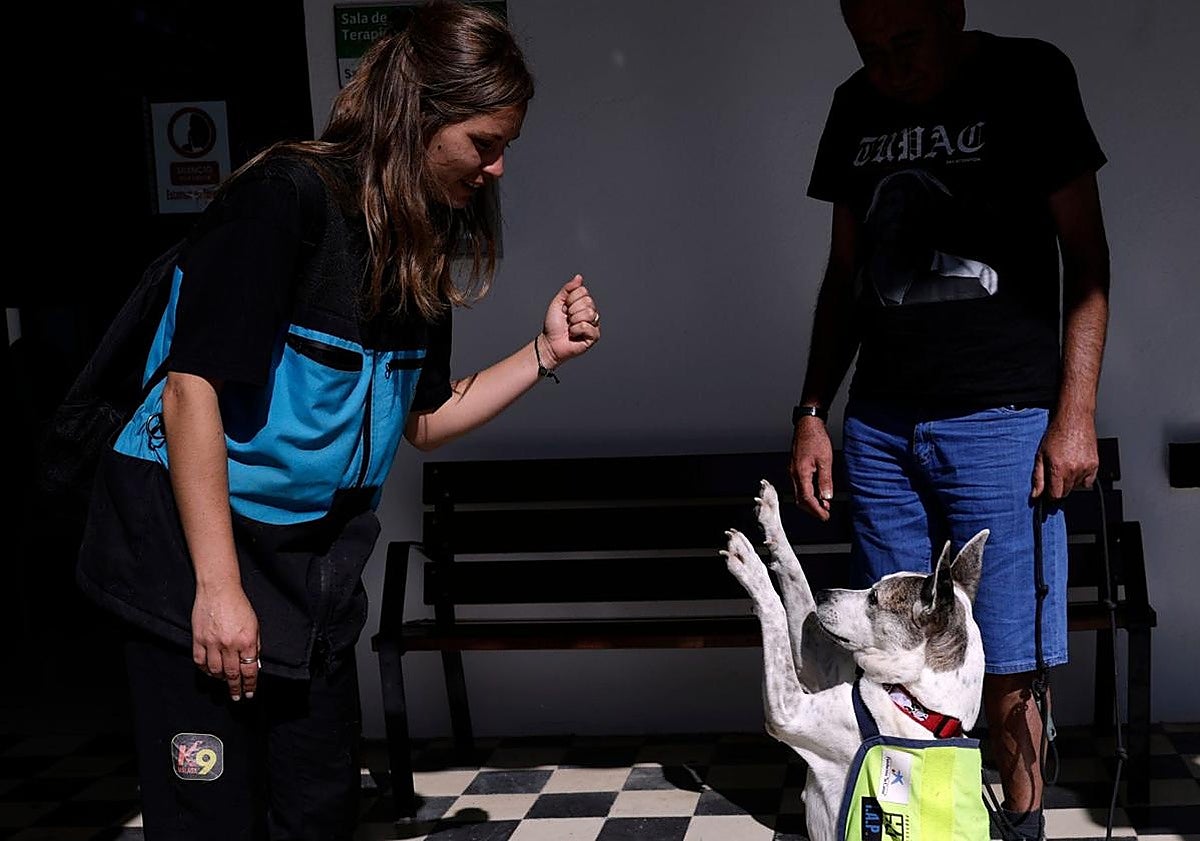
The corridors of the Mental Health Unit at the Marítimo Hospital in Torremolinos transform when they arrive: Sua, Mara, and Sulley. Suddenly, the ... downcast walks and lost gazes give way to whistles and caresses to the three dogs, who become the center of attention for more than an hour. For mental health patients, these visits have become the perfect antidote to calm, combat loneliness, improve confidence, and even think about a promising future career. This is a reality every fortnight at this hospital on the Costa del Sol thanks to the 'Dog-Assisted Interventions' project by K9 Málaga, which has been boosted by the 'la Caixa' Foundation through its call for Social Projects. The initiative also covers dozens of spaces in the province of Málaga, demonstrating that animals are also an invisible medicine endorsed by professionals.
Concepción López, director of the Clinical Management Unit of Mental Health, and Antonio Reyes, coordinator of care in the same unit, explain that this program, started at the beginning of the year in the hospital, represents a crucial qualitative leap: "This indeed has been a job developed in a programmed and planned way, also with biweekly sessions. It is allowing us to take a therapeutic-recreational approach," says Reyes, highlighting the "spectacular" reception of the project. Concepción López adds that the value of this contact with animals goes far beyond entertainment: "It facilitates the emotional environment for later intensive therapies that occur in our centers. Contact with nature and animals makes it easier to create a climate that is very conducive to therapy."
The benefit of this encounter expands in an integrative way. In this environment, where between 45 and 50 patients with severe mental disorders are in the process of stabilization and resocialization, clinical boundaries dissolve. The program welcomes both full hospitalization patients and partial or day hospitalization patients. It has strengthened the bond between healthcare staff and users, as Antonio Reyes highlights: "Mediated by this issue, it has improved a lot. They are much more confident. It's like we are all more relaxed and more willing to receive help and provide that help."
A "magnetic" effect
From the other end of the leash, Marta Sanz, instructor and trainer at K9 Málaga, observes the results with emotion and admiration. She notes that the users' motivation is "exponential": they attend theoretical explanations about dog handling and animal welfare guidelines, remembering everything perfectly from one session to the next. The effect is "so magnetic" that it transcends the boundaries of the unit itself: rheumatology users, orderlies, and staff from other departments spontaneously join in as they see them pass. "It's just that dogs always attract attention," explains Marta Sainz, director of the Social Area of K9 Málaga.
During the sessions, both theoretical parts and circuits with the dogs are developed. (Migue Fernández)"They do not judge, that's the key"
When looking for an explanation for this phenomenon, she is clear: "I always say that it's because they do not judge, that's the key. I might be having a bad day for some reason, but they don't; they don't care who you are, where you're from, what's wrong with you... They're going to love you and give you their all because they love people. There is no other being more unconditional to humans than the dog."
"The sessions have greatly improved the bond between healthcare staff and patients," the hospital professionals highlight
Behind each caress and each smile achieved throughout this project, there is an impeccable trajectory of more than three decades in the animal behavior sector by the K9 Málaga Canine School. Its team consists of accredited professionals whose official qualifications support every step. Marta Sanz emphasizes the importance of this rigor, fully adapted to the Animal Welfare Law: "'la Caixa' Foundation supported this when it is something very innovative, especially from a professional viewpoint. Before it was 'well, I have a very good dog and I bring it'; but these are intervention dogs, all in accordance with the new law and with our qualifications and professional certificates." K9 Málaga applies "strict action protocols to control working times, prevent the dog from becoming saturated, and perform an exhaustive 'positivization' work both before and after each session," they detail.
With scientific evidence unequivocally supporting that interaction with animals provides top-tier emotional benefits, the horizon of this project is ambitious and hopeful. More than 100 families in the province already benefit indirectly from extra "family respite" time, a vital pause that allows for better reconciliation for those who care unconditionally day by day.
Given the resounding success of the program, where just at the Marítimo Hospital in Torremolinos they have attended to 80 people, the hospital's medical and nursing team asks for continuity. As Pilar Bravo and her colleagues conclude, the goal now is to present new projects to expand these boundaries: "We would like to be able to share it with other units and other devices so that more patients could benefit. That would be a dream. There is scientific evidence that being with an animal provides a very important emotional benefit; we are trying to apply science in the best possible way."
comments Report an error
Latest news





Upcoming events
12
Nov
El Desembarco, la traición de Viriato at La Caja Blanca
12
Nov
HOMER El Mero Mero at Sala Trinchera Málaga
13
Nov
Marbella Startup Lab – Innovate & Collaborate
13
Nov
Candlelight: Coldplay & Imagine Dragons at Sala Fundación Unicaja María Cristina
13
Nov
Candlelight: Tribute to Ludovico Einaudi at Anantara Villa Padierna
Similar News

Málaga Airport Makes History with More Than Three Million Passengers in One Month
Málaga

Port of Málaga looks beyond its docks to support future growth
Málaga

Guide to the Virgen del Carmen Processions in Málaga and the Province
Málaga
