


The Secrets of the Bank of Spain in Malaga: a Bunker and a 'Big Brother' Monitored by 200 Cameras

16/05/2026 at 00:19h.
Historical chronicles tell us that Francisco de Goya became everything in painting thanks to the Bank of Spain. Fame, money, and recognition. And ... not because of a financial windfall, but because, once established in Madrid, he accepted that first commission from the then Bank of San Carlos, very interested in immortalizing its governors in a gallery of portraits. It was the year 1784, Goya had just arrived in the capital of the kingdom as a court painter and thought that going all out on this project would impress the family of Charles IV. And so it did. After the first came the second, then the third, and so on up to five governors. When he did the math, he was already the king's painter, the bank's painter... and also one of its main shareholders.
Since then, 242 years have passed, more than fifty governors, and just 170 years since the Bank of San Carlos formally became the Bank of Spain. Seen in this light, the history of this emblematic institution might well resemble a painting by Goya: adjusted to the society it has lived in, classical in its approaches, and sometimes, with areas of chiaroscuro.
The building is a 'bunker' guarded 24 hours a day. (Dani Maldonado)Above all, for the secrets it hides.
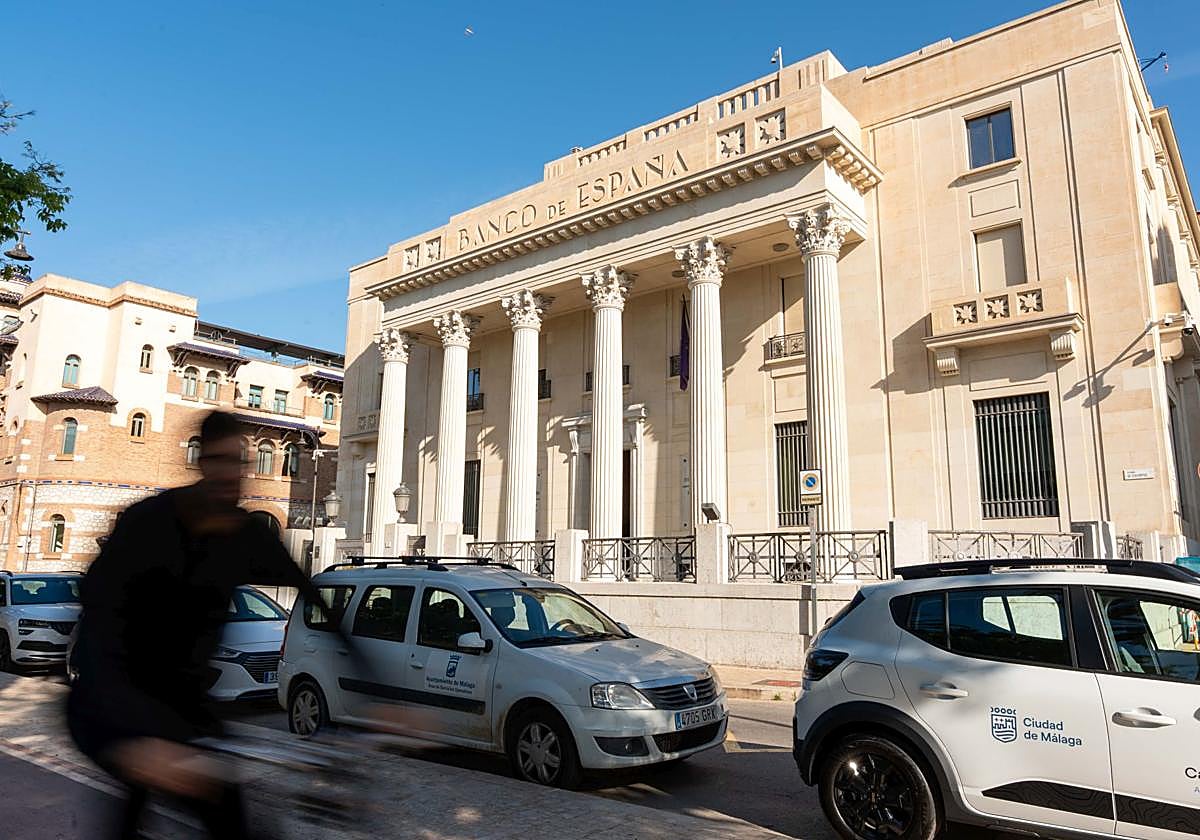
This is the case, at least, with the Bank of Spain's headquarters in Málaga, an imposing construction built 90 years ago in the Park known to Malagueños as the 'B' of the group of buildings popularly dubbed the 'ABC': City Hall, Bank of Spain, and Post Office (today, Rectorate). Of the three, the least known, without a doubt, is the Bank of Spain. At first glance, it stands immaculate white as a robust, balanced, and secure symbol. Just like a safe. Inside, it is a perfectly organized bunker that operates 24 hours a day under the supervision of 200 cameras. If a one-cent coin falls in the lobby, someone will see it.
"Many people come here and ask if they can enter, and of course, they can!" clarifies the civil guard at the door who controls entries and exits, bags and backpacks, appointments, and visits. "Today we have more than a hundred," he says reviewing the list of everything that remains for the morning.
In Germany, citizens are more careful with paper money; in Spain, not so much.
That the Bank of Spain is the financial lung of Málaga is an obvious statement, but perhaps it is better understood from the mouth of its director, Adolfo Gil, who has been in charge of this branch for 16 years and linked to the institution for more than 35: "We depend on the cash cycle, that financial entities operating in Málaga have their liquidity needs covered or can manage their surplus, and, above all, that the circulating bills are in good condition and reliable." That is, that they are not torn or fake.
Adolfo Gil, director of the Bank of Spain in Málaga. (Dani Maldonado)"It could be said that one of the main functions of the Bank of Spain branches is to act as a sort of purifier, a quality control of what circulates outside," adds Gil. And it is not a minor issue considering that, in the use and care of money, there are also classes, or rather, cultures: "In Germany, for example, citizens are very careful with paper money. We, not so much." This happens, especially with lower denomination bills: who doesn't remember having written a phone number on one or making a little figure with the paper. In these cases, when detected, they are destroyed and new ones are put into circulation. Today, for example, the blades in the huge room where money is counted and controlled are 'purifying' ten-euro bills: those in poor condition are cut into tiny pieces, compacted into small paper cylinders, and sent directly to recycling.
Another curiosity: 500-euro bills, popularly known as 'Bin Ladens' because everyone knows they exist but no one has seen them, are also immediately destroyed, regardless of their condition: this format stopped being issued a decade ago but remains a means of payment; however, links with criminal activities led the European Central Bank to gradually withdraw them from circulation. In these cases, the same process is followed: they are detected, destroyed, compacted, and recycled. And there ends the money cycle. Small and large.
15 branches in Spain
But there is another much more complex cycle, which is the one that really gives meaning to the branches that the Bank of Spain has spread throughout the territory: currently there are 15, but there was a time - before the 1980s - when each provincial capital had its own. In Málaga, there was even one in Antequera. "That capillarity came in very handy at key moments, such as the introduction of the euro," explains Gil, who however marks that line of the early 2000s as the moment when, gradually, branches began to close. Andalusia today only has the one in Málaga and another in Seville; and there are autonomous communities like Cantabria, Navarra, or Castilla la Mancha where the history of the Bank of Spain is only for the books.
Today, these branches fulfill another vital function in money management: being the bank of the banks. That is, to guarantee their liquidity needs or manage their surpluses. In these cases, it is the Bank of Spain that is in charge of the custody of these amounts, which arrive daily to the building's basements in huge security vans. "They are huge volumes that come organized in packages of about 10,000 bills. Once here, they are stored in the vault because they cannot be counted immediately; in fact, the oldest entries have weeks." In order, they go up to the huge room where money is counted and controlled and where machines work all day. They process up to 30 bills per second. And when finished, they are reorganized into packages of 10,000 bills ready to be put back into circulation. Today's are 50-euro bills. Half a million in each block. If a 50-euro bill falls there, someone will also see it.
A block of 10-euro bills in poor condition destroyed and sent to recycling. (Dani Maldonado)Beyond being the bank of the banks, the branches of the Bank of Spain are also the depositories of the accounts of large public organizations or institutions. The University, SEPE, or INSS are some of the clients of the Paseo del Parque branch. Individuals, no. "A physical person cannot come here to open an account at the Bank of Spain," adds its director, who nevertheless sets two exceptions: the branch's employees - about 30 in the case of Málaga - who do have the option; and individuals who have what are known as securities accounts or direct accounts. These are exclusively linked to Treasury Bills. "We have thousands of those, but they do not function like a conventional account," explains Gil about the contemporary formula for saving without having to resort to the underside of a mattress.
No more exchanging pesetas: "If your grandmother dies and you find a million under the mattress, you can only keep it as a keepsake"
Because anecdotes like these also exist, and by the dozens: when pesetas were still being exchanged for euros, it was relatively common for families to visit, once parents or grandparents had passed away, and discover considerable amounts of pesetas when dismantling the house. "I remember the case of someone who found 200,000 pesetas in 100-peseta bills issued in the year 40. At that time, that was a real fortune; however, we had to exchange it for the nominal value of the peseta with respect to the euro. 1,200 euros, nothing to do with what it would have been at that time," recalls Gil before remembering that since June 2021, pesetas are no longer exchanged for euros. "Since then, if your grandmother dies and you find a million pesetas under the mattress, you only have the option to keep it as a keepsake." And that's it.
Other times, other uses. Some, linked to the building from its origins and that have remained intact over time. For example, that the branch still has two private homes for two employees and their families. They are on the first floor and were originally essential in the branches of the Bank of Spain so that the director was permanently located. So nothing better than having him there. "With the improvement of communications, especially with the arrival of mobile phones, this need to be physically at the headquarters 24 hours a day was lost, but many of them are still being used."
This is the case of Málaga and its director, who admits the pros and cons, like in coins: "The truth is that it is very comfortable, I like living here; although many people see the disadvantage that you can't disconnect." The anecdotes of having the house upstairs and the work downstairs are told by the dozens. Like during the lockdown, with a team of four people as essential service that did not fail "not a single day" and the relief provided by the rooftop with views. There's no money that can buy that. Or going down in the afternoons "in sweatpants" to do paperwork in the office when it is already closed. You would also have to ask his children, today two independent adults who lived their adolescence in the Bank of Spain. Arriving "at all hours" by taxi or Uber and having the door opened by the Civil Guard. "That your father found out the time if you missed it," jokes Gil. Because if you did, just like when a coin or a bill falls to the floor, of course, someone saw it.
- More topics
- Guardia Civil
- Euro
- Málaga
- Antequera
- Spain
- Francisco de Goya
- Correos
- Bank of Spain

Latest news





Upcoming events
12
Nov
El Desembarco, la traición de Viriato at La Caja Blanca
12
Nov
HOMER El Mero Mero at Sala Trinchera Málaga
13
Nov
Marbella Startup Lab – Innovate & Collaborate
13
Nov
Candlelight: Coldplay & Imagine Dragons at Sala Fundación Unicaja María Cristina
13
Nov
Candlelight: Tribute to Ludovico Einaudi at Anantara Villa Padierna
Similar News

Málaga Airport Makes History with More Than Three Million Passengers in One Month
Málaga

Port of Málaga looks beyond its docks to support future growth
Málaga

Guide to the Virgen del Carmen Processions in Málaga and the Province
Málaga
