


Why do they throw wheat at San Isidro every May 15th in Periana? Discovering the origin of this custom

Málaga
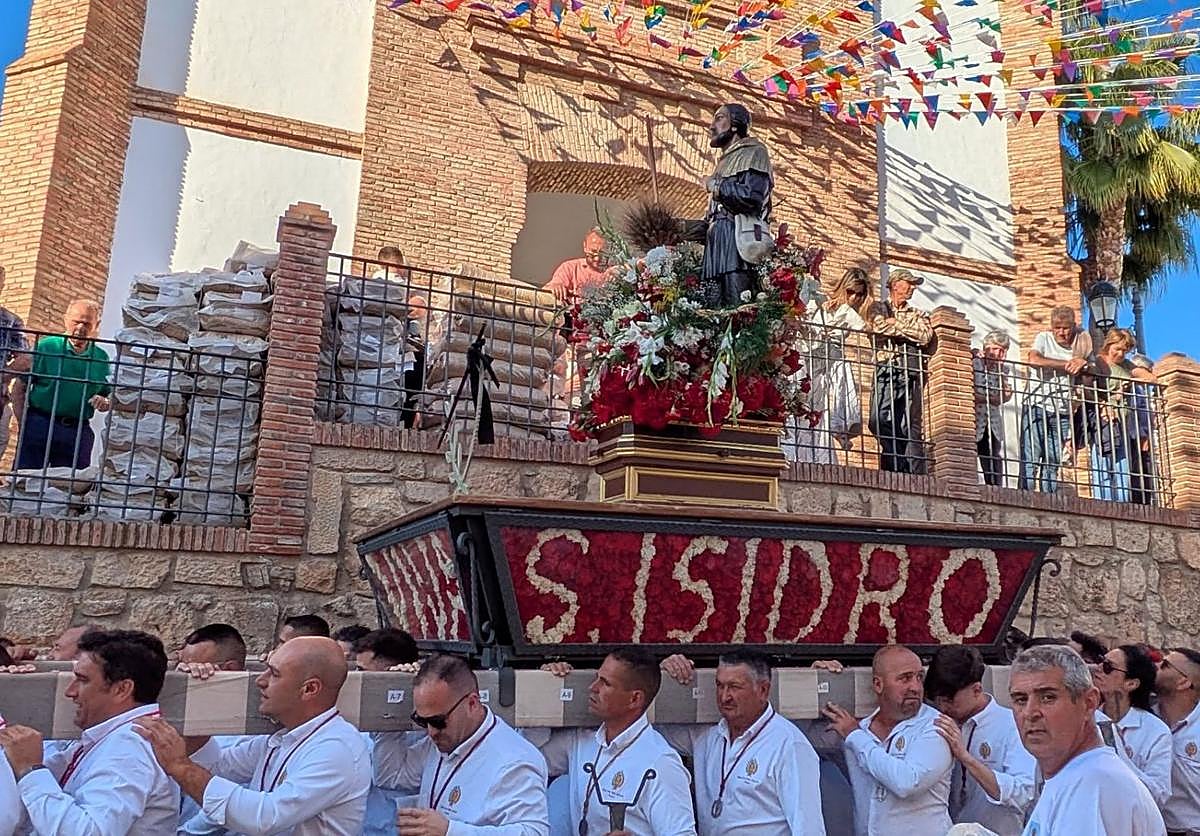
May 13, 2026 at 00:21h.Every May 15, Periana witnesses one of the most astonishing sights preserved in the province of Málaga. Saint Isidore the Laborer progresses... among sacks of wheat being emptied from balconies, handfuls thrown from rooftops, and an entire town watching the exceedingly slow journey of a unique procession. Because in this town of the Upper Axarquía, not only is their patron saint honored in a way not replicated anywhere else. A tradition is also kept alive, whose possible origin has just been reconstructed by a local researcher after decades of tracking a story transmitted almost solely by word of mouth.
This Friday, the town will once again experience one of the most unique celebrations in the province of Málaga. Thousands of kilos of wheat will fall over the throne of Saint Isidore in a tradition passed down from generation to generation and which, according to historian and researcher José Manuel Frías Raya, could have a much more specific origin than previously thought.
Frías Raya has been researching everything related to this festival in newspaper archives, archives, and oral testimonies since the seventies. The result is now part of a comprehensive dossier prepared to request that Saint Isidore of Periana be declared a Festival of Tourist Interest in Andalusia.
Every year about forty tons of wheat are thrown. (Francisco Lorenzo Tapia.)"Much has been speculated and nothing has been written about the existing ritual in Periana of throwing wheat at Saint Isidore," the researcher explains in that work. The key, according to his theory, would be in an episode transmitted by his maternal grandfather, Rafael Raya Zorrilla, popularly known as 'Ganguita'.
According to that story, in the past, farmers offered the saint fifteen freshly cut spikes of wheat when the procession passed in front of their homes. But one year of extreme drought completely changed that custom. It did not rain when it should have, and the crops failed to sprout. When May 15 arrived, there were no spikes to offer. Then, a farmer asked to bring the throne closer to his balcony and poured over Saint Isidore a quartillo of wheat, just over a kilo.
That gesture marked the beginning of a tradition that is still alive today. The following year the rains returned and the harvests came back, but the spikes never again took center stage in the offering. Farmers began to reserve part of the wheat they sowed to throw it over the patron during the procession.
Over time, that small offering transformed into a true rain of cereal. The promises were no longer linked only to the field but also began to relate to health, work, exams, or military service. Some residents even promised their own weight in wheat. The record, according to Frías Raya, reached 3,000 kilos offered at once in gratitude for passing an exam.
This procession could be the slowest in the world. There are various reasons why each neighbor throws wheat. Saint Isidore enjoys great devotion in this town of the Upper Axarquía. (SUR)The Slowest Procession
But Saint Isidore of Periana is not only notable for the wheat. Also for its pace. Or, more precisely, for its slowness. José Manuel Frías Raya himself decided to time the procession in 2017 and came to a conclusion as striking as it is hard to dispute: it is possibly one of the slowest processions in the world.
The saint left the church at 4:34 PM and did not return until 3:14 AM the next morning. Over ten and a half hours to cover just 1,190 meters. In other editions, even twelve hours have been exceeded. The reason is the constant stops made by the throne to receive wheat from balconies, terraces, windows, and stone walls. That year alone, 64 stops were counted during the route.
The figures are almost impossible to imagine: just over 91 meters traveled per hour. At that speed, the procession of Saint Isidore of Periana moves almost as fast as a starfish and much slower than a sloth. "The route is 1,190 meters and it takes more than 12 hours to complete," the researcher himself summarizes while finalizing the file that will be sent to the Junta de Andalucía.
Fundraising
During the procession, the wheat falls over a structure prepared as a sort of hopper. When a sufficient amount accumulates, the grain is bagged and later sold. Part of the money obtained is allocated to social works and another part is used to finance the following year's festivities.
The uniqueness of this tradition has attracted attention for more than a century from newspapers, photographers, and television channels. There are press references dating back to 1915, and in recent years images of Saint Isidore covered in wheat have appeared on national networks and programs specialized in popular festivals.
In Periana, moreover, Saint Isidore is not just a procession. It is almost a way of measuring time. There, nobody talks simply about the fair. It is common to hear phrases like "I'm going to Saint Isidore" or "how soon until Saint Isidore." Because during those days, the entire town revolves around a celebration where promises, family reunions, faith, memory, and an image that continues to astonish even those who have seen it their entire lives: a patron saint advancing slowly under an endless rain of wheat
- More topics
- Periana

Latest news





Upcoming events
12
Nov
El Desembarco, la traición de Viriato at La Caja Blanca
12
Nov
HOMER El Mero Mero at Sala Trinchera Málaga
13
Nov
Marbella Startup Lab – Innovate & Collaborate
13
Nov
Candlelight: Coldplay & Imagine Dragons at Sala Fundación Unicaja María Cristina
13
Nov
Candlelight: Tribute to Ludovico Einaudi at Anantara Villa Padierna
Similar News

Málaga Airport Makes History with More Than Three Million Passengers in One Month
Málaga

Port of Málaga looks beyond its docks to support future growth
Málaga

Guide to the Virgen del Carmen Processions in Málaga and the Province
Málaga
