


"Living on the street was a trauma that I want to transform into something positive, into helping others."

May 13, 2026 at 23:58h.
"I lived for more than a year and a half without a home, during Covid. With mental health issues. With traumas that overwhelmed me. There were days when I cried lying on the ground, unable to get up, not knowing how to get out of there." This is how the speech he has prepared to deliver at the next plenary session of the Malaga City Council, scheduled for May 28, begins. He wants to speak in front of the mayor and councilors and is fighting for any of the available options to do so: having a political group present a motion with his claims, being supported by a humanitarian organization to accompany him to La Casona del Parque that day, or, if these attempts are unsuccessful, he is willing to appear alone so that politicians will listen to him, even if informally. He goes to everyone with a meticulous folder with the proposal and documentation he has worked on.
His name is Alejandro Doña García, he is 32 years old, and the cause that moves him is that of homeless people with severe mental illness, "which is the lowest among the low," he says: "If being on the street is already low, imagine with a severe mental illness." These are people, he illustrates, who perhaps scare because they walk half naked, or because they shout in the middle of the street. "They are not aware of their illness and are not going to come to reason no matter how much you want to take them to a center. That is not the solution. So, the system needs to be adapted, because right now it is a bit obsolete," he asserts.
Along with the intervention he has prepared to recite at the plenary, he has developed a document with his proposals to improve the care of homeless people with severe mental disorders. There, he identifies the deficits of the current action scheme: the difficulty of real access to the resources that exist for this group, the insufficient intensity of street intervention, the scarcity of places in specific programs with support housing, as well as the high rate of abandonment or the rejection that the insertion itineraries provoke among those affected. And he proposes measures: reinforcing street intervention with direct care teams with profiles specialized in mental health, creating "engagement" teams to generate a human bond between professionals and the most reluctant street dwellers, increasing the number of homes intended for people with severe mental disorders, intensive and continued accompaniment, coordination between municipal social services and the public mental health system, and adapting care models to the reality of these people by reducing bureaucratic demands, for example.
In what he has prepared to read at the plenary, he summarizes it like this: "I ask for three very specific things: more specialized mental health intervention on the street and constant over time; more supported housing, because no one recovers on the street; and more real coordination between social and health services." And he adds, also, to address the approach to the group he is committed to defending: "When someone cannot comply with the rules, it is often not due to a lack of will. It is illness. And a fair city does not leave behind those who cannot keep up."
"When someone cannot comply with the rules, it is often not due to a lack of will. It is illness. And a fair city does not leave behind those who cannot keep up."
In his conversation with SUR, he emphasizes the importance of apartments, in the 'Housing First', a social intervention policy with increasing support that consists of, before anything and without conditions, providing a safe home to homeless people: "On the street, people do not recover from alcohol problems or mental illnesses. It has to be in a house and with professional monitoring and support. A shelter is not the place: they are saturated and there is still drug dealing, fights... It is not a conducive environment."
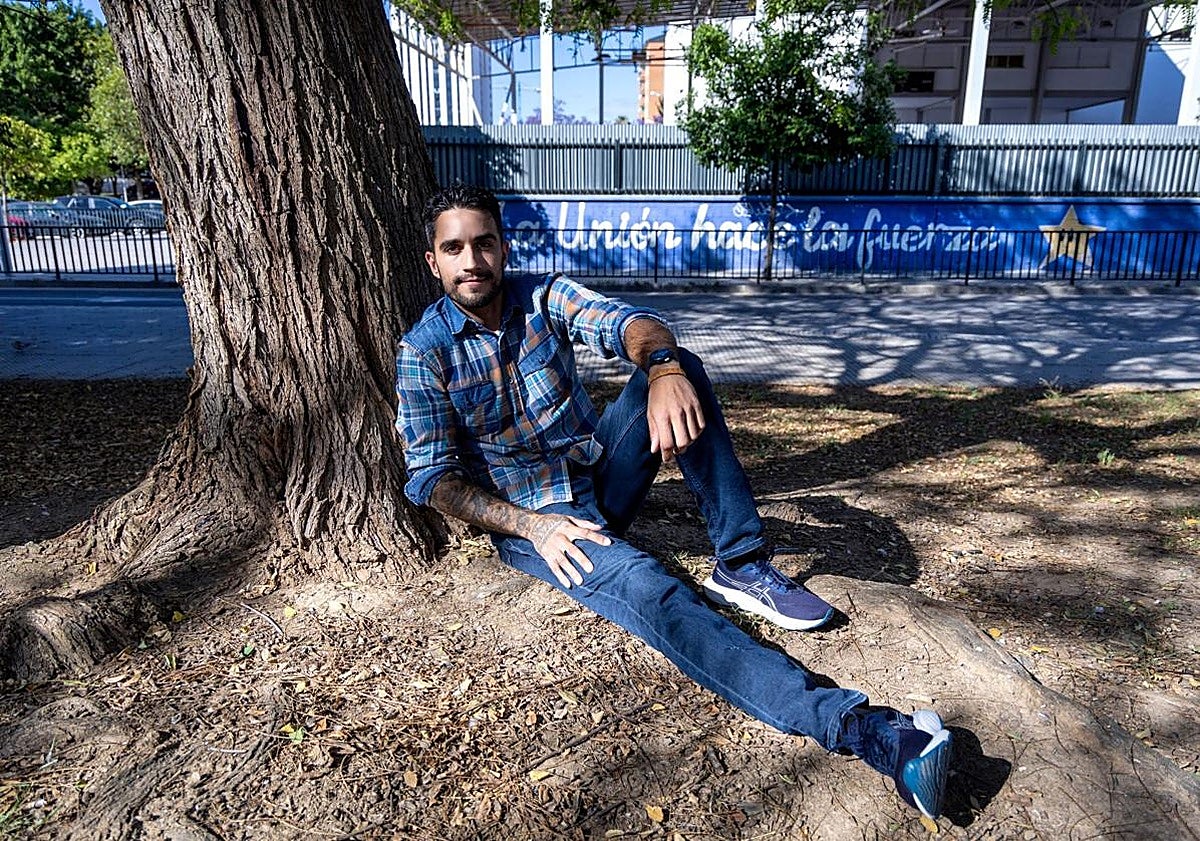
Alejandro Doña speaks from his own experience and, precisely, cites this newspaper in Juan Pablo II park, next to the Hans Christian Andersen school, where when he himself was homeless he went to think, to meditate, and to seek inspiration in that inscription "Unity is strength" planted on the wall surrounding the school. "This proposal comes from the experiences I had to live on the street, because I was almost two years living on the street. All this comes from what I was observing and also suffering in my own flesh, from being many times also collapsed on the ground crying. I want to transform all that into something good, with a purpose, to help others," he explains.
The boy ended up living on the street because he went to Germany to work and when he returned he found that the traffic fines he had previously left unpaid had wiped out his savings. He went to the Casa de la Buena Vida, in La Palmilla, where he stayed for a month and a half, until he was kicked out, and then he literally ended up on the street in March 2020, just as the pandemic was beginning.
He confesses that the trauma of being outdoors was added to the feeling of abandonment that has accompanied him since the complicated childhood he suffered: "That wound from the past was activated again. In fact, it is activated many times when I socialize and all the insecurities assail me, but now I know what it is, I know what happens to me."
"I created the fantasy that this was going to be my life, that I was going to live in that half hippie, half bohemian, half homeless way."
But above all, he is proud that he has been able to transform his pain and bad experiences into something positive, into his vocation to help others. Even when he was in a street situation, he says he acted as a Single Door, directing his homeless peers to the existing resources. And he does not hide that being outdoors leads to "losing dignity": "You feel in a hole and it is very difficult to get out." That's why he resorted to self-deception: "During those almost two years I was in my world. I created the fantasy that this was going to be my life, that I was going to live in that half hippie, half bohemian, half homeless way. I had to believe that story I was telling myself to set aside the reality that I was lying on the street and survive."
He slept in El Corte Inglés, ate in various soup kitchens... occasionally saw his father who gave him some money... Until ASAEC (Asociación Solidaridad Asistencial En Compañía) offered him help and he accepted it. They paid for a hostel in El Palo. "The decisive factor was not the roof, it was the accompaniment, and participating in volunteering gave me a purpose." But soon another job came up in Germany and he went back. In fact, in recent times he has been coming and going from that country, but already with a "normalized" life, off the street. The last season he was in Germany he worked at Amazon and returned to Malaga with money and the determination to rebuild his life, get his high school diploma, enter the University for people over 25, and study Social Work and Social Education, because from his life comes the vocation: "With what I have lived I have realized that I have that empathy or that closeness with the most vulnerable people."
Meanwhile, he works on weekends at a beach bar, has signed up for athletics, and continues collaborating with ASAEC or Fundación Harena, among other organizations. As he intends to say at the City Council on May 28, today Alejandro Doña works, studies, plays sports, and helps as a volunteer. "Getting off the street should not depend on luck. It should depend on a system that really works," he insists, because, more than about himself, what he talks about is his purpose, he does not deviate from his mission. He knows that when one is on the street because a mental illness has led someone to have no emotional, economic stability, or any kind at all, or when it has been a work slump that leads to a deep depression and this combined to losing the house, it is difficult to follow rules: "You cannot keep appointments, you cannot adapt to a system that demands stability when you are completely broken. That's why there are people who are still on the street today. Not because there are no resources. But because those resources are not designed for those who need them most." It is the wake-up call that Alejandro Doña wants to bring to the Council in a few days, illuminated by the light of his own experience.
- More topics
- Poverty
- Malaga
- Germany
- Covid-19
- Mental Health
- Malaga City Council

Latest news





Upcoming events
12
Nov
El Desembarco, la traición de Viriato at La Caja Blanca
12
Nov
HOMER El Mero Mero at Sala Trinchera Málaga
13
Nov
Marbella Startup Lab – Innovate & Collaborate
13
Nov
Candlelight: Coldplay & Imagine Dragons at Sala Fundación Unicaja María Cristina
13
Nov
Candlelight: Tribute to Ludovico Einaudi at Anantara Villa Padierna
Similar News

Málaga Airport Makes History with More Than Three Million Passengers in One Month
Málaga

Port of Málaga looks beyond its docks to support future growth
Málaga

Guide to the Virgen del Carmen Processions in Málaga and the Province
Málaga
