


A Baroque spectacle that was hidden: discovery on the facade of a building in downtown Malaga
The Provincial Council rescues valuable 18th-century paintings on the exterior of a palace on Carretería Street during its rehabilitation.
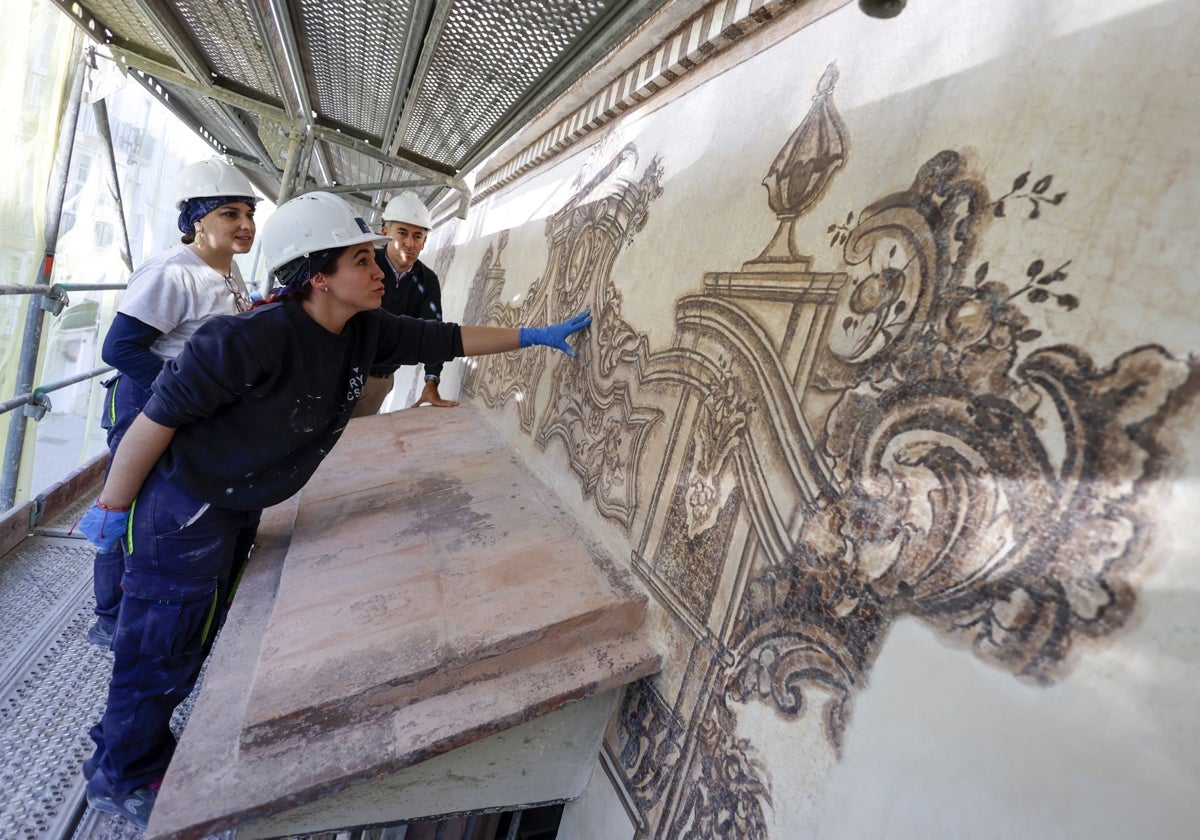

One of the greatest treasures of Baroque mural paintings in the center of Málaga has been brought to light. After nearly a year of work, the results of the restoration carried out by the Provincial Council on the exterior of the building at 60 Carretería Street, known as the Palacio de Valdeflores, can now be seen. Thanks to surveys conducted years ago, it was known that this 18th-century building could have decorations on its facade. What was unknown was the ornamental richness hidden beneath five layers of paint.
SUR has had access to the results of the recovery of this mural decoration performed by the technicians of Trycsa company. Up close, the richness of volumes and the motifs presented by these drawings, made solely in brown tones and in a time when technical means for working on a facade of considerable height were precarious, is astonishing. Exuberant friezes with an abundance of rocailles, plant elements, and the fruit of the pomegranate, repeated numerous times, frame the balconies and windows of the palace.
"We believe these paintings were done freehand because, although they have the same base, there is nothing symmetrical," explains Marina Albaladejo, one of the Trycsa restorers who, along with Claudia Molero, has been patiently uncovering the paintings over the last few months. "We discovered some incisions in the wall that would serve as a guide, but most of the drawings do not adhere to these marks. We think several authors could have intervened," adds this restorer while pointing out one of the motifs where, along with the rocailles and plant elements, a kind of castle and a hermitage appear. In other parts of the facade, clusters of pomegranates hang from ribbons.
The restorers have tried to add as little as possible to the paintings found, so they have only completed the areas where there was enough information about what the drawings were like. In the rest, only what has been rescued under the layers of paint has been reconstructed.
However, this is not the only 'treasure' discovered in this work, with a budget of 1,592,781 euros and under the direction of the architect Rafael Salas Pulido. Inside, remains of the original flooring of the palace's stable and part of the barbican of the medieval city wall, which runs right along the axis of Carretería and of which its largest section was rescued in the pedestrian area set up by the City Council right next to this building, have been found. In one of the rooms on the first floor, a section of this Muslim enclosure will be showcased behind ventilated glass, where a curious vertical ceramic channeling can be seen.
"It is possible that it was used as a chimney," points out the architect Rafael Salas, who leads to another of the palace's jewels. This is the ceiling of an adjacent room where, framed by diamond-shaped borders, two paintings made in 1908 by José Fernández Alvarado, an artist born in Málaga in 1865 who was a disciple of Antonio Muñoz Degrain and José Moreno Carbonero, and who ended his life in Huelva, where he was the director of the Museum of Fine Arts, have been preserved. In one of these paintings, almond branches with butterflies appear, and in another, vines with birds. However, it is also noteworthy that, in the decoration that frames them, four ceramic plates are embedded, perfectly preserved. Also, in the windows of the central courtyard of the building, the 'guillotine' type mechanism that operates the leaves with internal lead weights has been recovered.
The Palacio de Valdeflores was built in the mid-18th century and owes its name to Luis José Velázquez de Angulo y Cruzado (Málaga, 1722-1772), who besides being the second Marquis of Valdeflores, was a prolific archaeologist, historian, and writer. This character was a member of the Royal Academy of History; he participated in the excavations of the Cártama site; he wrote about the origins of Castilian poetry, the annals of the Spanish nation until the arrival of the Romans or about pre-Roman alphabets; and, commissioned by the Marquis of la Ensenada, he traveled the country for three years to compile the monumental history of the Peninsula. He left a legacy with his works, but in Málaga, he also did so with this building attached to the ancient city wall.
In Baroque style, the palace was exploited by the marquisate as an inn with stables. Later it had another owner, but there are no records. There are records to corroborate its use as a residence when in 1895 it was purchased by the Countess of Albarede, who made several significant renovations. Almost a century later (1985) and after passing through various hands, it was acquired and restored by the Provincial Council, which opened here the Provincial Women's Service, now located at the main headquarters of the supra-municipal entity, next to the Poniente seafront promenade.
For the moment, the use that the provincial institution will give to this building is under study, whose works could be finished before the summer. However, the president of the Provincial Council, Francisco Salado, is proud of the work undertaken to recover the heritage values of this property. "It is a very important milestone in the recovery of the city's unique buildings, to give them better use. We have discovered a richness of paintings on the facade that makes it even more unique. It will be something unique, an additional tourist attraction, we are very happy with the discovery," highlighted Salado.

Latest news





Upcoming events
12
Nov
El Desembarco, la traición de Viriato at La Caja Blanca
12
Nov
HOMER El Mero Mero at Sala Trinchera Málaga
13
Nov
Marbella Startup Lab – Innovate & Collaborate
13
Nov
Candlelight: Coldplay & Imagine Dragons at Sala Fundación Unicaja María Cristina
13
Nov
Candlelight: Tribute to Ludovico Einaudi at Anantara Villa Padierna
Similar News

Málaga Airport Makes History with More Than Three Million Passengers in One Month
Málaga

Port of Málaga looks beyond its docks to support future growth
Málaga

Guide to the Virgen del Carmen Processions in Málaga and the Province
Málaga
