


Eleven reasons to get lost in the Book Fair
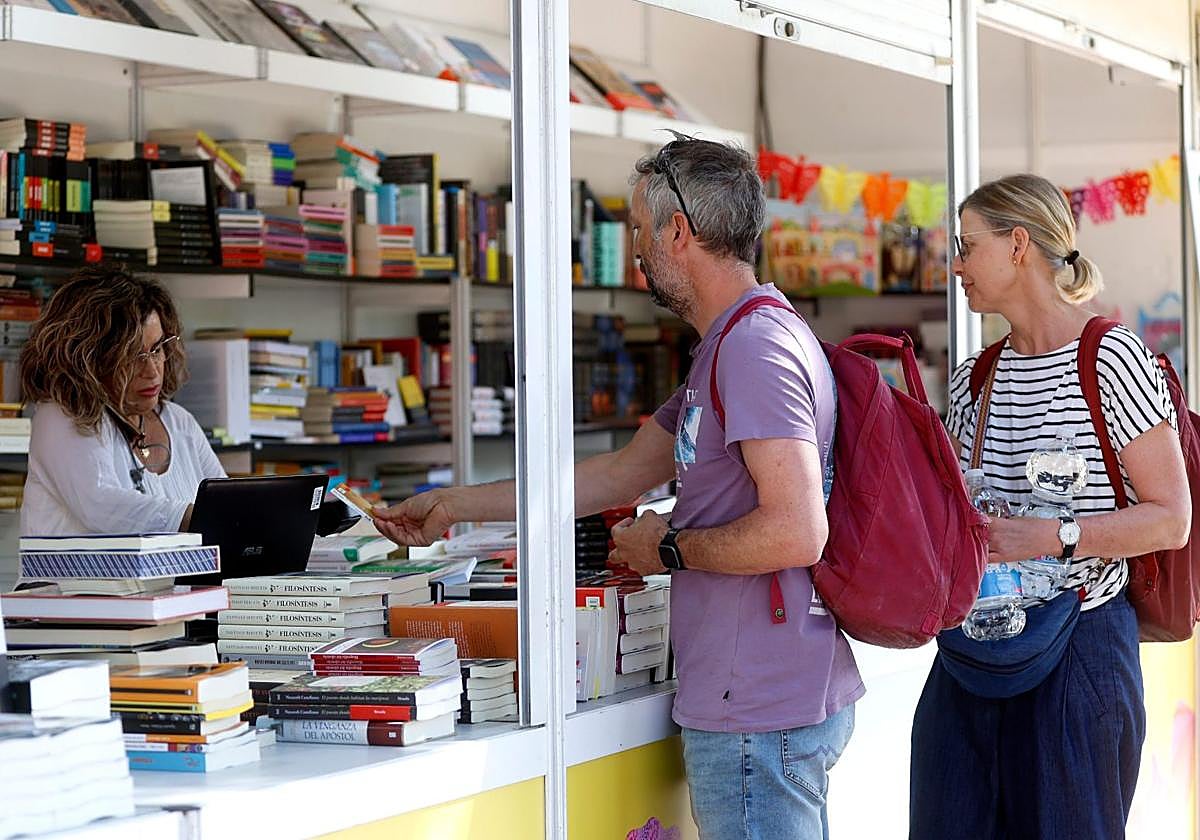

1 May 2026 Updated at 3.16 pm. The Málaga Book Fair has already raised its shutters. And quite literally so. The edition that opened yesterday will run until 10 May on the Paseo del Parque, where it returns for the third consecutive year with an expanded programme that has an international focus. The event has grown to include 71 stalls run by booksellers and publishers and has expanded its venues with the addition of the Eduardo Ocón Auditorium as a new venue for public events.
Málaga-based writer Esther García Llovet was tasked with opening the event with a speech in which she championed imagination as an essential element of reading in the face of today’s information overload. During her speech, the author argued that ‘information is not knowledge’ and warned that the capacity to imagine — necessary for both writing and reading — ‘is being lost’ in a context dominated by the immediate. Moving away from a conventional speech, García Llovet chose to tell a story — the tale of Tono and his father — as a way of championing the power of fiction and oral storytelling. The story, which culminates in the revelation that the father could not read, serves as a metaphor for the value of stories beyond formats and as a defence of literature.
The Mayor of Málaga, Francisco de la Torre, alongside the Councillor for Culture and Historical Heritage, Mariana Pineda; the Director of the Activities, Communication and Image Division at the Unicaja Foundation, Cristina Rico; the Rector of the University of Málaga, Teodomiro López Navarrete; the Director of the UNIA Secretariat, María Altamirano; and the President, Director and Content Director of the Málaga Book Fair, Noelia Clavero, Manuel García Iborra and Txema Martín, respectively, attended the fair’s opening tour.
From Vicente Vallés to Ángel Idígoras and from Elsa Punset to Chantal Maillard, including María Dueñas, Bernardo Atxaga, Irvine Welsh (author of the iconic ‘Trainspotting’), Alan Hollinghurst (winner of the Booker Prize) and Martín Caparrós, over five hundred writers will be signing and presenting books over the coming days.
Here are some of the gems recommended by SUR:
“Confín”, by Paco Cumpián
It is always worth championing Paco Cumpián, the poet and printer from Málaga, on the first anniversary of his death. He alluded to that end in “Confín”: ‘Beloved death / time / that which separates us // It is not that I feel impatience / Do you perhaps offer me a respite? / A mystery behind?’. He always remained on the fringes of the establishment, far from headlines and institutions, yet he achieved something rare in a sector as cut-throat as literature: the respect of everyone. His commitment to poetry, radical and honest, led him to open a specialist bookshop, Árbol de Poe.
Letraversal, the publishing house founded by the poet Ángelo Néstore —with whom he launched one of the most compelling cultural initiatives in the province in recent years, the Irreconciliables festival— has its own stand at the fair (23rd and 24th) featuring a gem: a carefully crafted edition of ‘Confín’ which includes, at the end, the poem ‘Hogaza de mi pan, agua que corres, jinete cabalgando, cebra sola’, comprising over three hundred verses.
‘Historias de un año siesomanío’, by Idígoras and Pachi
A lighter offering, though no less incisive: pandemic stories illustrated by the brothers Idígoras and Pachi, graphic comedians and contributors to this newspaper. “Historias de un año siesomanío”, tastefully published by Maldragón and available at Comic Stores (35–37), includes the series “La vida en los balcones”, “Perita beach” and “Plaza Noniná”. The book is not only a humorous comic, but also a guide to the speech and customs of Málaga, an essential purchase for anyone who wants to get to know (and understand) this region better.
Complete Poetry, by Idea Vilariño
They say that no more than ten people attended Idea Vilariño’s funeral. She died alone. It was the price of an incorruptible freedom, but also of a rugged character and an honesty she took to the limit, to the point of her own pain. She laid herself bare in every poem. That is why she needed no artifice, no landscapes, no images to embellish the intent of her writing. She soon renounced distortions, and modesty too. No rhetoric: her books hold only the open wound, stripped-back poetry. She seemed taciturn, and she was, but she always maintained ‘a desire / a vulgar desire / to carry on’.
She loved many men but wrote of only one: Onetti. He accused her of creating a relationship ‘for the sake of literary history’. She never relented: ‘We were two monsters’. The stall at the Sideral bookshop (32) has her complete poetry collection on sale, published by Lumen. A book containing ‘Poemas de amor’ (Love Poems), her magnum opus, which in turn includes ‘Ya no’ (No Longer), paradoxically considered one of the finest poems of heartbreak written in Spanish: “You will never know who I was / why others loved me. / I shall never know / why or how / nor if it was true / what you said I was / nor who you were / nor what I was to you / nor what it would have been like / to live together / to love each other / to wait for each other / to be.”
“El oro de los tigres”, by María Victoria Atencia
María Victoria Atencia was born at number one Calle del Ángel and soon wanted to fly, living up to her destiny. She succeeded, first by becoming the first woman to obtain a pilot’s licence (“Where shall we settle if there are five cardinal directions / and I passionately choose that of flight?”) and then through her poems, a constant striving for formal excellence without neglecting the emotion that a few months ago earned her the Spanish Literature Prize, adding her name to those of figures such as Caro Baroja, Vázquez Montalbán, Juan Goytisolo, Emilio Lledó and Paca Aguirre.
“El oro de los tigres”, published by Ediciones de Aquí (stand 26), brings together lectures, articles and presentations in which Atencia, author of titles such as “Marta & María” and “El mundo de M. V.”, reflects on the poetic act and the foundations of her own writing, with echoes of her readings of Rainer Maria Rilke, Gustavo Adolfo Bécquer, Jorge Luis Borges and Juan Ramón Jiménez. A delightful rarity, it is rounded off with several interviews and the recovery of scattered or unpublished texts that offer keys to understanding a body of work now firmly established among the most significant of the second half of the 20th century.
“España oculta”, by Cristina García Rodero
She was the first Spanish photographer to join Magnum, the iconic photojournalism agency founded by Robert Capa and Henri Cartier-Bresson, among others. She won the National Photography Prize in 1996, the Gold Medal for Merit in Fine Arts in 2005 and the Gold Medal for Merit in Work in 2014. Pedro Almodóvar has chosen one of her images as the central set piece in his latest film, and the King and Queen entrusted her with creating a family album. A documentary about her life has been released (‘La mirada oculta’, produced by Wanda and available on Movistar). Yet Cristina García Rodero remains surprised when people regard her as a leading figure, a living legend of photography in Spain.
Hers is the series ‘España oculta’, the colossal work on popular festivals and traditions that catapulted her to legendary status. A book that had been out of print for years and reached exorbitant prices on second-hand platforms. That speculation was the last straw. She decided to republish the book, a gem now available at the DaRWIN stall (53), a charming bookshop in Canillas de Aceituno.
“La casa”, by Paco Roca
The three siblings at the heart of this story return to the family home where they grew up a year after their father’s death. Their intention is to sell it, but with every old item they throw away, they are confronted with memories. They fear they are discarding the past, the memory of their father, but also their own. Paco Roca delivers one of his most intimate and universal works with “La Casa”, winner of the 2020 Eisner Award for Best Foreign Work. It has received other accolades such as the 2015 Zona Cómic Award, the 2016 Estrella Award for the year’s most outstanding comic awarded by Le Parisien, and the Grand Prize and the Award for Best European Comic at the Romics fair in 2017. Translated into 16 languages, it has sold over 70,000 copies in Spain. It is now available at the Comic Stores (35–37) and Luces (59–61) stands.
“Punto de araña”, by Nerea Pallares
It is surprising that “Punto de araña” is Nerea Pallares’ debut; a first novel that bursts onto the scene with a powerful voice blending social realism, collective memory and a mythical undercurrent to tell the story of a group of women’s rebellion on the Costa da Morte. Set in Camariñas, the story follows Ari, a newcomer to a village rife with secrets and tensions, where the lace-makers (palilleiras, rederas, mariscadoras) decide to break with the imposed order by invoking ancestral forces. With sensory and choral writing, the author constructs a narrative that is both a denunciation and a celebration, a hymn to the invisible networks that sustain life and to female solidarity in the face of injustice. It can be purchased at the FNAC (67-68) and Luces (59-61) stands.
“La hora del amor”, by Carmen de Burgos
“La hora del amor”, by Carmen de Burgos, is a lucid example of how the author turned the novella into a vehicle for social criticism at the very beginning of the 20th century. Through Margarita, a widow caught between debt and the fear of losing her lover, Burgos clearly addresses class prejudice, economic dependence and the tensions surrounding women’s freedom. With a direct and uncompromising style, the work not only portrays an era but also raises conflicts that continue to resonate today. A gem published by Aliar after more than 80 years and available at their stall (57).
“El libro blanco”, by Vicente Luis Mora
The silence of the traitor. That of the harassed. That of Bernarda Alba and that of Mallarmé. That of excitement. That of the empty room of the son who has just moved out. In “El libro blanco. Alfabeto de silencios”, Vicente Luis Mora returns to poetry with an unclassifiable book that transforms silence into literary material and a tool for cultural exploration. Halfway between an essay, a poem and a list, the author explores, with his usual erudition and a good dose of imagination, the many faces of silence—from the intimate to the political, from the everyday to the tragic—in a work that engages with diverse traditions and challenges genre boundaries. Demanding yet evocative, it is a book for readers willing to be swept away by a strange and stimulating proposition. In Proteo (47-48).
“Operation Beluga”, by Ángela Castro and Zuzanna Celej
A children’s book recommendation based on a true story: “Operation Beluga”, by Ángela Castro Díaz and illustrated by Zuzanna Celej, tells how Akkú, a boy from the Chukchi people, discovers hundreds of beluga whales trapped in the ice and mobilises his community to rescue them. Not even an icebreaker can get them to move, until an unexpected idea emerges: music. A simple and beautiful tale of solidarity and respect for nature. In A Fin de Cuentos (10).
“Para una educación senti-mental”, by Chantal Maillard
Chantal Maillard is the most unique poet in Spanish literature, a profound and enigmatic author, admired and dazzling. She walks the line between poetry and philosophy to annihilate the ego and preconceived notions in a radical work that sets her apart from her contemporaries: ‘I am trying to tell you something / that cannot quite be put into words’. Her latest book draws on an idea attributed to Solon—the need to govern oneself before governing others—and offers a critical reflection on the present and the fragility of democratic systems. Through short texts, she proposes a journey through five spheres (ethical, political, spiritual, artistic and educational) to explore who we are and how we organise ourselves. The work, with an essayistic and combative tone, is available at the Rayuela stall (54-55).comments Report an error

Latest news





Upcoming events
12
Nov
El Desembarco, la traición de Viriato at La Caja Blanca
12
Nov
HOMER El Mero Mero at Sala Trinchera Málaga
13
Nov
Marbella Startup Lab – Innovate & Collaborate
13
Nov
Candlelight: Coldplay & Imagine Dragons at Sala Fundación Unicaja María Cristina
13
Nov
Candlelight: Tribute to Ludovico Einaudi at Anantara Villa Padierna
Similar News

Málaga Airport Makes History with More Than Three Million Passengers in One Month
Málaga

Port of Málaga looks beyond its docks to support future growth
Málaga

Guide to the Virgen del Carmen Processions in Málaga and the Province
Málaga
