


A "stone museum" in Malaga: a hiking route among rocks shaped like an eagle, camel, or lady
The route starts in Júzcar, the famous blue village, and delves into a stone labyrinth.Málaga is much more than just beaches: eight hiking trails to make the most of the good weather.
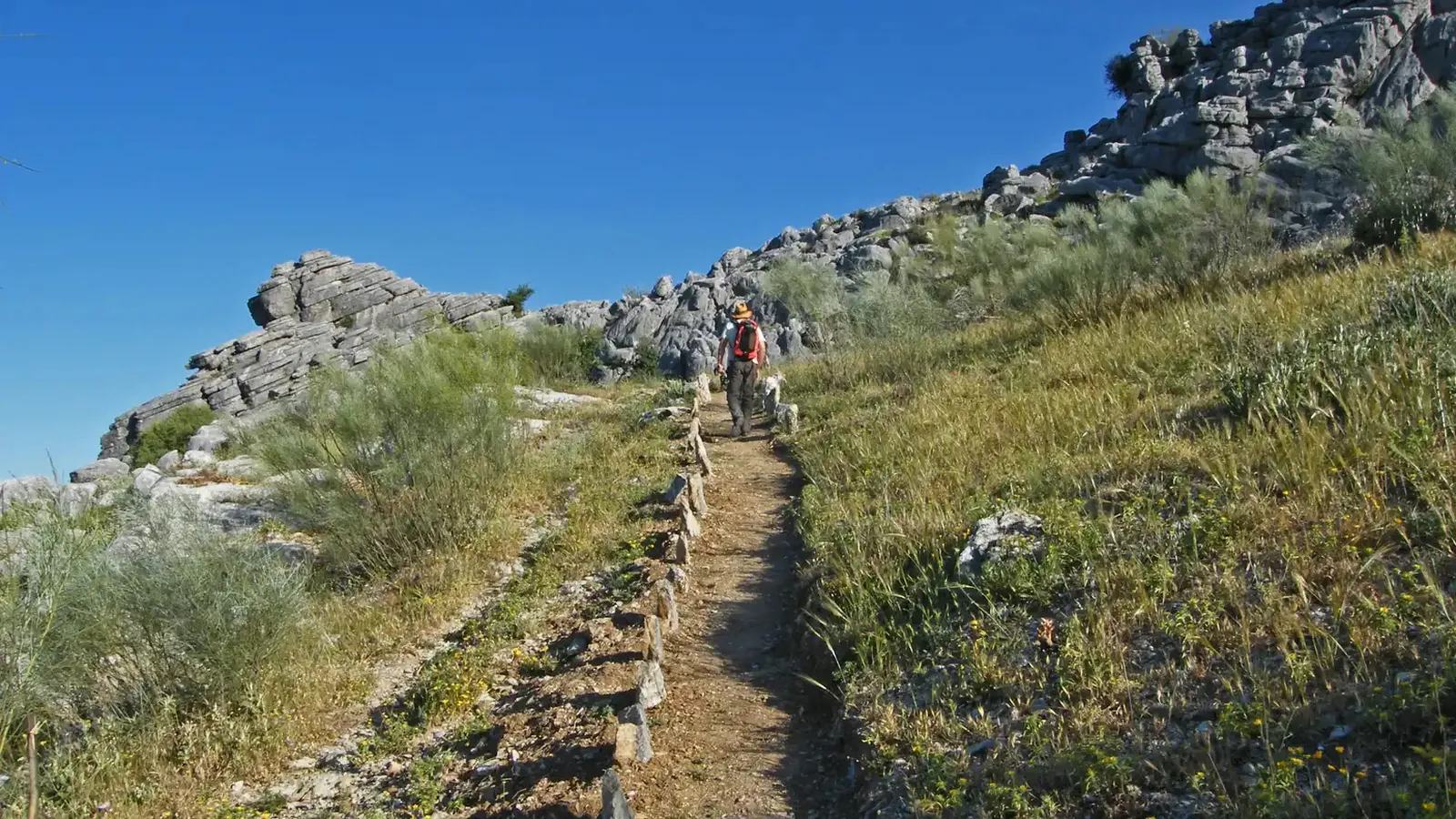

There are landscapes that are beheld and others that seem to silently observe the visitor. In the heart of the Serranía de Ronda, among profiles of eroded limestone and trails winding through chestnut trees and olive groves, emerges a place where stone takes unexpected shapes. In this corner of inland Málaga, each natural figure seems to tell a different story, as if the passage of time had sculpted a catalog of recognizable silhouettes in the middle of the mountain.
Los Riscos rise as one of the most unique areas in the interior of the province of Málaga. Located between the municipal boundaries of Júzcar and Cartajima, this enclave is part of the Sierra del Oreganal, at about 1,400 meters altitude. Its location places it at a strategic point, surrounded by some of the most representative landscapes of the area: to the north, the Ronda Plateau; to the east, the Sierra de las Nieves; to the south, Sierra Bermeja; and to the west, the Guadiaro valley.
This site is defined as a young torcal, the result of a prolonged erosion process on limestone with high calcium carbonate content. The action of rainwater has been shaping the terrain for hundreds of thousands of years, resulting in an abrupt and ruiniform landscape. The outcome is a geological scenario of great visual richness, where the rock formations take whimsical shapes that evoke easily recognizable figures.
A hiking route among recognizable shapes
The route that allows entry into this "stone museum" starts from Júzcar, known for its unique blue color. From this point begins a circular itinerary that is organized around three main alleys, connected in turn with ravines, cracks, and chasms that define the terrain's complexity.
Among all the formations, one particularly striking one stands out: the Eagle. This large rock presents a silhouette reminiscent of a watchful bird of prey, becoming one of the symbols of the route. It is not the only figure that sparks the imagination. Along the trail, others appear such as the Camel, the Lady, the Child, or the Window, names given by the locals to describe these curious natural structures.
Structures of Los Riscos. / malaga.esEach section of the path offers new perspectives, with constant changes in the relief that invite detailed observation of the surroundings. The combination of narrow rock corridors and more open spaces creates a visual experience marked by contrasts.
A path between rural history and landscape
The itinerary is not only notable for its geological value. Throughout the route, traces of human activity that historically has been part of this territory are also preserved. Ancient threshing floors and dry stone constructions are integrated into the landscape, recalling the agricultural past of the area.
The ascent begins on a concrete track that crosses farming areas, with the presence of olive and almond trees. During this first stretch, the path passes by sites such as the Fuente de la Castilla and an abandoned quarry from which broad views of the surroundings are obtained.
The Eagle. / malaga.esAfter a steep climb, the Puerto de las Eras is reached, a key point within the route. From here, access to the main core of the site is gained, where the terrain becomes more demanding. This section leads to the formation of the Eagle, after which the path gradually smoothens in the Macoría area, where a traditional threshing floor still preserved allows for broad panoramas of the landscape.
An environment of natural wealth
The uniqueness of Los Riscos is not limited to its geology. This space also harbors a notable diversity of fauna, especially in terms of birds. During the route, the presence of species such as goldfinches, starlings, hoopoes, black wheatears, or rock thrushes is common.
Powered by WikilocIn the higher areas, it is not uncommon to observe birds of prey, including the Bonelli's eagle. Specimens of griffon vulture have also been recorded, soaring over the area taking advantage of the thermal currents generated in this mountainous environment.

Latest news





Upcoming events
12
Nov
El Desembarco, la traición de Viriato at La Caja Blanca
12
Nov
HOMER El Mero Mero at Sala Trinchera Málaga
13
Nov
Marbella Startup Lab – Innovate & Collaborate
13
Nov
Candlelight: Coldplay & Imagine Dragons at Sala Fundación Unicaja María Cristina
13
Nov
Candlelight: Tribute to Ludovico Einaudi at Anantara Villa Padierna
Similar News

Málaga Airport Makes History with More Than Three Million Passengers in One Month
Málaga

Port of Málaga looks beyond its docks to support future growth
Málaga

Guide to the Virgen del Carmen Processions in Málaga and the Province
Málaga
