


A Bornean orangutan, a critically endangered species, is born at Bioparc Fuengirola
Mukah, an experienced female facing her third motherhood, starred in a birth that proceeded normally in the middle of the park under the gaze of visitors.
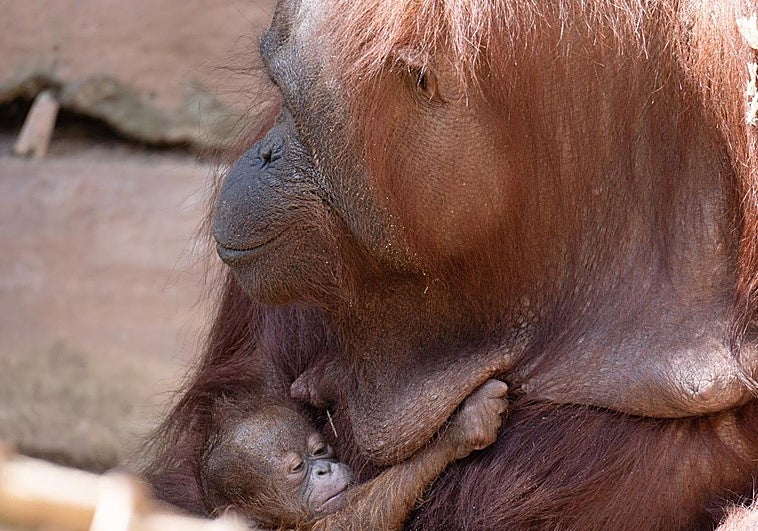

This week, Bioparc Fuengirola has been the scene of a very special milestone. Last Monday, the 20th, in the outdoor area of the habitat, a Borneo orangutan baby was born to the surprised gaze of visitors walking through the park. A new life that brings hope to one of the most endangered species on the planet.
The mother, Mukah, an experienced female facing her third motherhood, had a normal delivery. From the first moments, the baby showed excellent health. "In orangutans, as in other large arboreal primates, survival depends on a gesture as simple as it is decisive: the grip. From the moment of birth, the baby must cling to its mother's body, as it will spend its first months and even years in constant contact with her, moving among the trees. This innate reflex is not only a sign of bonding but an essential condition for survival. The strength of that first embrace is, in fact, the first victory against an environment where every detail counts," explain the staff at Bioparc.
Licking or ingesting the placenta
After the birth, another natural behavior catches attention: the mother's interaction with the placenta. In many mammal species, including primates, the mother licks or even ingests the placenta. "This act serves a relevant biological function, as it provides essential nutrients and helps in recovery after the effort of childbirth, in addition to reinforcing the bond between mother and baby in those critical first moments," add the park staff.
The birth of this baby is particularly significant in the context of the conservation of the Borneo orangutan (Pongo pygmaeus), listed as "critically endangered" by the International Union for Conservation of Nature (IUCN). It is estimated that around 100,000 individuals survive in the wild, although their populations continue to decline mainly due to deforestation, the expansion of palm oil plantations, and illegal hunting.
In this scenario, the role of international conservation programs is crucial. BIOPARC Fuengirola actively participates in the European Endangered Species Program (EEP) coordinated by the European Association of Zoos and Aquaria, a network that responsibly manages populations under human care to ensure their genetic viability and contribute to the global conservation of the species.

Latest news





Upcoming events
12
Nov
El Desembarco, la traición de Viriato at La Caja Blanca
12
Nov
HOMER El Mero Mero at Sala Trinchera Málaga
13
Nov
Marbella Startup Lab – Innovate & Collaborate
13
Nov
Candlelight: Coldplay & Imagine Dragons at Sala Fundación Unicaja María Cristina
13
Nov
Candlelight: Tribute to Ludovico Einaudi at Anantara Villa Padierna
Similar News

Málaga Airport Makes History with More Than Three Million Passengers in One Month
Málaga

Port of Málaga looks beyond its docks to support future growth
Málaga

Guide to the Virgen del Carmen Processions in Málaga and the Province
Málaga
