


Airlines increase to 22.4 million the seats available for flights from Malaga this summer season
Companies increase their air capacity by 8.2% and rule out kerosene supply problems due to the impact of the war in Iran.
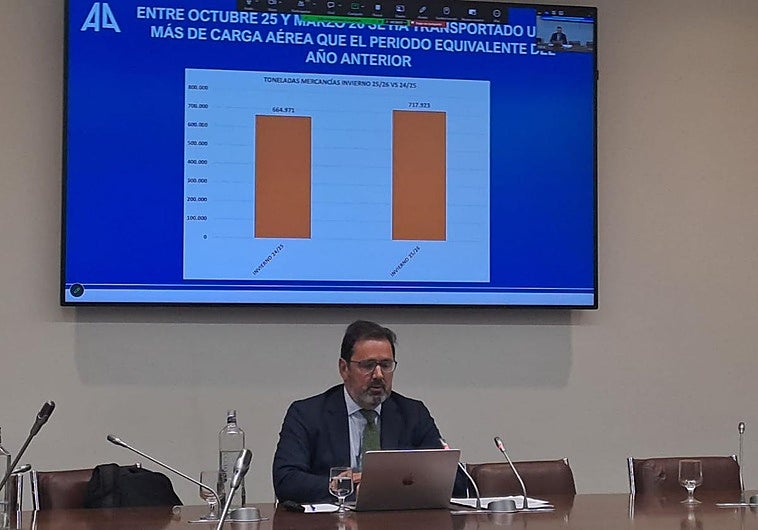

The Costa del Sol is once again a winning bet. Airlines have reinforced their operations at Malaga airport for this summer season, which began at the end of March and will last until the end of October. Specifically, they have increased the number of seats for flights from Malaga by 8.6%, which means that the air capacity has been raised to 22.4 million seats. This historic figure highlights the strength of this destination. This was reported by Javier Gándara, president of the Airline Association (ALA), an organization that encompasses 85% of air traffic in Spain, who highlighted a greater dynamism of activity on the Costa del Sol by noting that the average growth at Spanish airports will be 5.7% above the seats scheduled for the same date for the summer of 2025. "In this context, airlines combine positive forecasts with cautious management, adapting their strategies to maintain profitability while keeping an eye on potential challenges from the economic environment caused by the conflict in the Middle East," stated ALA representatives.
Malaga airport is the fourth in Spain in terms of air capacity offered, only preceded by Madrid, where companies have put 51.5 million seats on sale, an increase of 8%; Barcelona, with 45.8 million, an increase of 7.6%; and Palma de Mallorca, with 33.3 million and an increase of 2% compared to last high season, according to data provided by ALA.
Precisely, Gándara has sent a message of reassurance to those who have plans to fly and have booked air reservations given the uncertainties about the impact of the Iran war. The president of ALA has ruled out flight cancellations due to fuel supply problems and has stated that "there are no foreseeable problems with the supply of aviation kerosene in Spain, being in a relatively better situation than neighboring countries." He justifies this statement by noting that "only 11% of crude oil imports to Spain come from the Middle East, and, moreover, more than 80% of the aviation kerosene consumed in Spain is produced in refineries located within the country." However, he did clarify that "even so, this situation does not immunize Spain from possible effects on flights from other places to our country, in case other countries have problems if the conflict extends over time."
5.7%
is the average increase in seats for flying this summer from Spanish airports.
Regarding the outlook for this high season, Gándara stated that "we face the summer with optimism, with an offer 5.7% higher than last summer, and traffic that has already grown 3.2% so far this year, although these good figures should be approached with some caution due to the increase in kerosene prices, and the uncertainty generated by the geopolitical situation." In this regard, he highlighted the growth expected at the airports in Andalusia, noting that a combined increase of 10% in air capacity is expected in this region. He also recalled that air traffic has shown an upward trend with 65.63 million passengers accumulated, which represents a 3.2% increase compared to the same period of the previous year.
The president of ALA has advised for this summer that "it is advisable for travelers who have not yet purchased their tickets to consider doing so as soon as possible to benefit from the best conditions." In fact, he explained that, although the offer of seats and air traffic forecasts show a positive evolution for this high season, it is important not to lose sight of the impact that the conflict in the Middle East is having on the price of kerosene, which has doubled compared to the levels before the conflict began. "This context poses one of the main challenges for the sector, causing very high volatility in fuel prices, which account for about 30% of the operating costs of airlines. This situation has a very significant impact on these costs, an impact that some companies are managing to mitigate in the short and medium term thanks to hedging contracts," he specified.

Latest news





Upcoming events
12
Nov
El Desembarco, la traición de Viriato at La Caja Blanca
12
Nov
HOMER El Mero Mero at Sala Trinchera Málaga
13
Nov
Marbella Startup Lab – Innovate & Collaborate
13
Nov
Candlelight: Coldplay & Imagine Dragons at Sala Fundación Unicaja María Cristina
13
Nov
Candlelight: Tribute to Ludovico Einaudi at Anantara Villa Padierna
Similar News

Málaga Airport Makes History with More Than Three Million Passengers in One Month
Málaga

Port of Málaga looks beyond its docks to support future growth
Málaga

Guide to the Virgen del Carmen Processions in Málaga and the Province
Málaga
