


The war in the Gulf leads to a new record in container traffic at the port of Malaga
The import and export of products at the docks of the capital skyrocket in the first quarter of the year, with increases of up to 300%
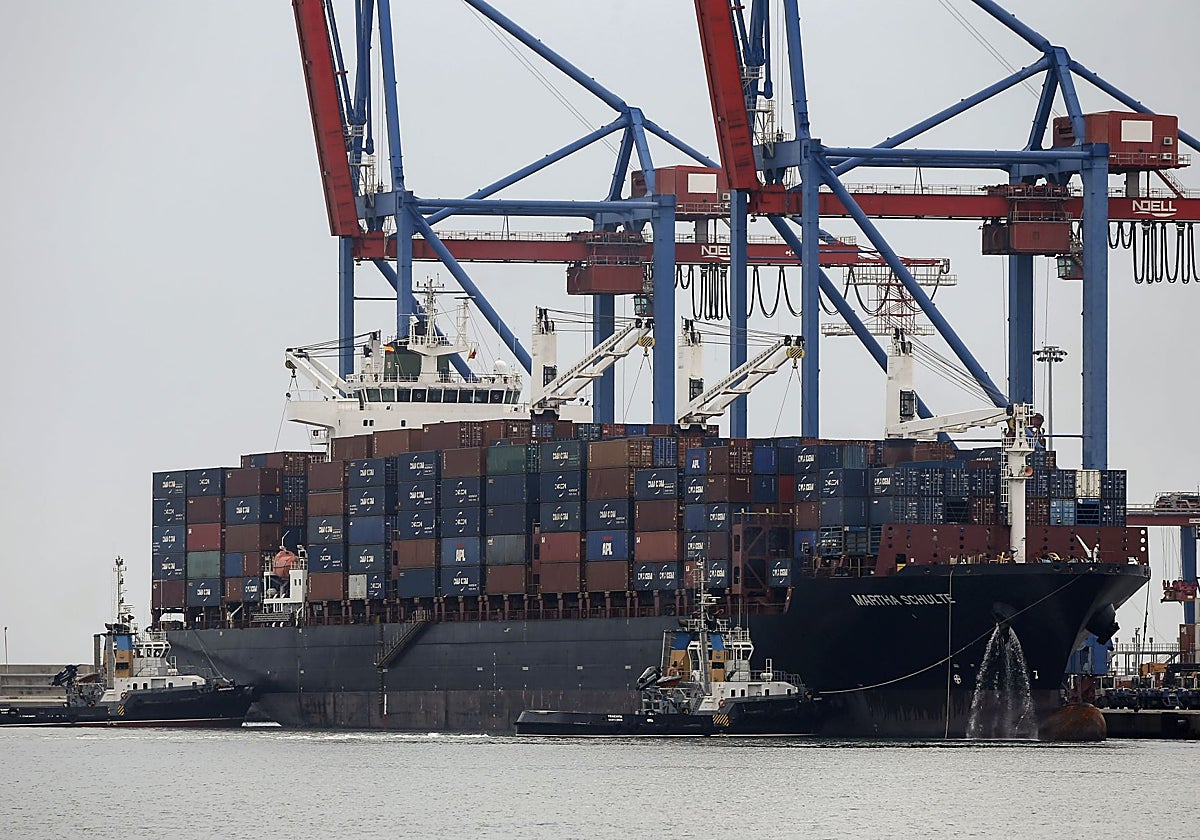

The war in the Persian Gulf area is leading to historic levels of merchandise traffic at the port of Málaga, which is experiencing a particularly sweet moment, thanks to its strategic position on the Strait of Gibraltar; but also in an increasingly thriving 'Hinterland' (land influence area).
From January to March of this year, container traffic has quadrupled in some categories compared to the first quarter of the previous year, according to data provided to SUR by the Port Authority of Málaga. This is the case in the section of exporting full Teus, which grows by more than 300% both in the number of units and in the tons that have been sold to other countries. At this point, it is worth remembering that there is a usual transit mode in the bays which is that of empty containers.
The second chapter where this expansion is clearly seen is in the importation of full 'containers'. In this case, the increase is between 58 and 75%, depending on whether it is based on their number or the tons that have been managed. The maritime transit mode (full) also increases, by up to 40%. In conclusion, nearly 94,000 containers have been moved in three months, with a combined weight of 1.2 million tons.
"The underlying movement is the consolidation of the port of Málaga, which has accumulated three consecutive years of growth; although the war in Iran and the blockade of Ormuz is providing a plus, which is causing us to occasionally have an excess of demand," explains Carlos Rubio, president of the Port Authority.
The Port will start occupying space at the Adif terminal in Los Prados in the coming days to solve its space issues
So much so that the next board of directors of this entity will urgently address the rental contract to Adif for part of the Los Prados logistics platform, to begin its occupation imminently. "We have a need to relocate containers, because there is no more space within the docks. That's why we are looking for space outside for the less priority ones, which will be the ones that can go to Los Prados."
What moves through Málaga?
At this point, Rubio also highlights the change in model, since Málaga used to specialize in empty containers in transit, and now they mainly move full ones. "Now we have greater interaction with the 'Hinterland', especially for export but also for import."
The Malaga products that are sold abroad through containers are mainly meat and its derivatives; packaged oil; table olives; industrial and textile products. In the opposite direction, what arrives through this route is mainly fresh fruit from South America.
As a final reflection, the president of the Port is optimistic about the future: "Traffic will continue to grow; the war in the Persian Gulf only adds additional pressure, but without this factor we would still be at record numbers."
Other goods
The total goods traffic, which also includes solid and liquid bulk; provisioning, ro-ro (on trucks) and the importation of new vehicles, also shows a very positive result. In the first quarter of this year, almost 1.7 million tons (specifically, 1,666,934) were managed; representing an increase of 29% compared to the same period of the previous year (1,289,420 tons).
Through the port, meat, oil, olives, industrial products, and textiles are exported; and fresh fruit from South America is imported
At this point, there are substantial differences depending on the products. For example, solid bulk cargo is down almost 12% compared to the same period last year (262,635 tons); although there is a slight rise in cement and clinker. The activity of liquid bulk also decreases. During the first quarter, 28,746 tons were moved, 16% less. However, this variation is explained by the fact that olive oil has grown (15% more, with 28,746 tons). This product justifies 100% of the liquid movement this quarter, as there was no diesel activity.
In the provisioning part, the fuel service to ships is very notable, which has increased by 261% (24,994 tons). Regarding ro-ro traffic (cargo on trucks), there is also a growth of 7.5% (116,915 tons). Lastly, the importation of new vehicles is down 16%, and 22,262 units were moved between January and March of 2026.
Regarding passenger transit, both on the regular Málaga-Melilla line and in the arrival of cruise passengers, there is a growth of 52%, up to 139,236 passengers. At the start of the year, 325 ships have moored at the port of the capital, compared to 263 the previous year (a 23.5% increase).
Malaga companies export more
Malaga companies are increasingly exporting, despite attempts to restrict tariffs by Trump in the United States. In February, the companies of the province sold abroad for a value of 578 million, which represents an 8% increase. Much of these product exits were carried out through the port of the capital. Thus, the trade surplus in the province reaches 25 million, according to data from the Ministry of Economy released by the Junta. At the Andalusian level, the increase in long-range exports is striking, with a very prominent position in the case of Indonesia, which enters the top ten countries that buy the most Andalusian products. This group also includes the United States, Morocco, and China.

Latest news





Upcoming events
12
Nov
El Desembarco, la traición de Viriato at La Caja Blanca
12
Nov
HOMER El Mero Mero at Sala Trinchera Málaga
13
Nov
Marbella Startup Lab – Innovate & Collaborate
13
Nov
Candlelight: Coldplay & Imagine Dragons at Sala Fundación Unicaja María Cristina
13
Nov
Candlelight: Tribute to Ludovico Einaudi at Anantara Villa Padierna
Similar News

Málaga Airport Makes History with More Than Three Million Passengers in One Month
Málaga

Port of Málaga looks beyond its docks to support future growth
Málaga

Guide to the Virgen del Carmen Processions in Málaga and the Province
Málaga
