


AI, a New Tool to Revolutionize Tourism
Experts in the sector debate the importance of this new technology for the development of destinations and improving competitiveness.
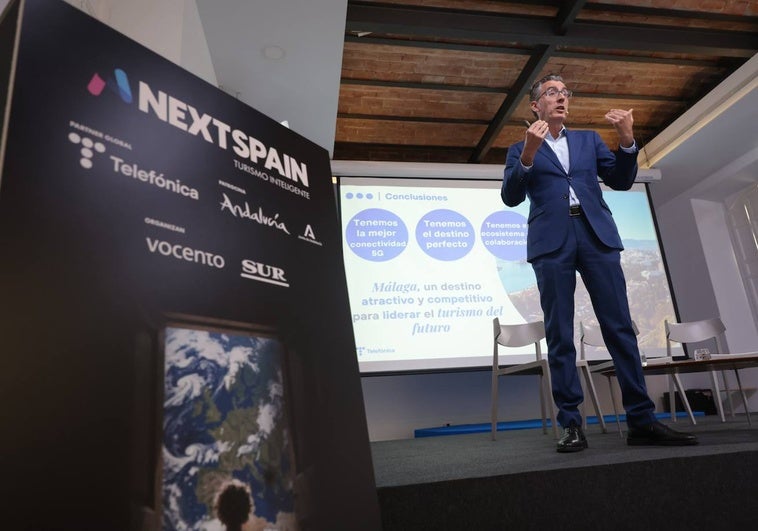

The tourism sector aims to leverage Artificial Intelligence to revolutionize the market and gain more global influence. In an increasingly globalized and competitive world, utilizing all the tools offered by new technology, and especially being the first to do so, can make a difference. That's why smart tourism has become the central theme of the Next Spain meeting held this Friday in Malaga.
The technology forum, organized by Vocento and SUR, and featuring Telefónica as a global partner and sponsored by the Junta de Andalucía, saw the participation of numerous experts who discussed the strengths of the destination, the opportunities that are now opening up, and the challenges that require close attention. "We are inventing the tourism of the future," they summarized.
Following the welcome address by the director of SUR, Manolo Castillo, the podium was taken by Arturo Bernal, the Tourism Minister of the Junta de Andalucía. The Andalusian leader considered "technology as a fundamental element to achieve quality" and referred to sustainability and technological innovation as the two cornerstones they have adopted after the pandemic. Citing specific cases, he mentioned Nexus, a platform they have launched that allows the development of digital services and connects entrepreneurs with professionals.
Next, Joaquín Segovia, director of Telefónica in the Southern Territory, took the floor after the welcome words from the Tourism Minister of the Junta de Andalucía, Arturo Bernal. Continuing on the same note, he added that "Spain, Andalusia, and Malaga have a huge opportunity to be leaders in digital tourism and we cannot miss it." In his opinion, "we have the best broadband infrastructure in Europe, the best companies, the best destination, and we just need to develop the tools to achieve it."
Segovia spoke about '5G Infrastructure and its impact on tourism' and assured that 5G "opens an infinite path to better understand visitors and offer them new services." The tourist—he detailed—is permanently connected, and therefore it is essential to rethink cities so that they can interact with visitors, whether through panels, lighting, or even music. As a specific example, he talked about an augmented reality project launched in Malaga in 2019, allowing visitors to see what Holy Week looks like. "Seeing a throne pass through Larios Street will surely generate a need in the visitor to come at another time to see it."
The fundamental role that Artificial Intelligence will play in the development of destinations and the sector was also valued by Adrián Gómez, Director of Innovation of Tourism of Andalusia. During a panel titled 'Augmented and virtual reality in the tourist experience,' he noted that we are facing "the third major revolution in the production process as was the industrial revolution and the launch of the internet."
Also from the public sphere, Jonathan Gómez, Director of Tourism of Malaga, detailed that the city is undertaking a range of projects that allow approaching the metaverse. Among them, he highlighted that this year they are going to change all the tourist signage so that it can communicate with visitors' phones. But not only that: What if we could book a hotel room from the current streaming platform while watching a scene filmed in the city? That is the way forward.
The private sector was represented at this table by Germán García Mancebo, CEO of VR Studio 360, a company specialized in developing immersive technology for the tourism sector. From his perspective, he has asked the administrations to accelerate processes so that "today's ideas can be implemented soon."
The possibilities that open up for the sector thanks to the use of Artificial Intelligence are infinite. This was highlighted by José Ruiz Pardo, CEO of Goli Neuromarketing during his lecture titled 'Big Data and Artificial Intelligence in Tourism Personalization'. "You will be able to tell the tourist when to come and what they need to see," he advanced.
The professional explained that there are different types of AI and that by combining them all, very valuable data about visitors can be obtained. Through cameras installed in cities, hotels, or beaches, it is possible to know the gender and age of the visitors, where they move, and even specific data such as where they are looking or the emotions they express through non-verbal language. "Having data on how people behave in places allows us to adapt."
During the last part of the day, there was talk about modernization and sustainability. Javier Ortiz, CEO of Sextaplanta, was in charge of breaking the ice in the roundtable titled 'IoT and sustainability in hotel and urban management' explaining the importance of making all these processes energy-efficient. "There is still a long way to go, but it is essential to seek safe environments and improve management."
This table also featured Mari Francis Peñarroya, member of the executive committee of the Aehcos employer's association and advisor and partner of the Peñarroya group. "We take pride in sustainability and it can be profitable," she summarized. Among other examples implemented recently, she referred to the cleaning of towels, which used to be done daily, the sale of old furniture through specialized platforms, or the donation of leftover food to social dining facilities.
Completing this conversation, Gema del Corral, General Director of Tourism Promotion of the Junta de Andalucía, introduced the importance of business intelligence to launch tools that have allowed promoting and repositioning the brand of Andalusia. "We are working on a pilot project in the German market because we have data on when a family is ready to hit the button to buy a vacation," she advanced.

Latest news





Upcoming events
12
Nov
El Desembarco, la traición de Viriato at La Caja Blanca
12
Nov
HOMER El Mero Mero at Sala Trinchera Málaga
13
Nov
Marbella Startup Lab – Innovate & Collaborate
13
Nov
Candlelight: Coldplay & Imagine Dragons at Sala Fundación Unicaja María Cristina
13
Nov
Candlelight: Tribute to Ludovico Einaudi at Anantara Villa Padierna
Similar News

Málaga Airport Makes History with More Than Three Million Passengers in One Month
Málaga

Port of Málaga looks beyond its docks to support future growth
Málaga

Guide to the Virgen del Carmen Processions in Málaga and the Province
Málaga
