


From Tokyo to El Perchel: welcome to the most 'kawaii' Málaga
From Hello Kitty to Hatsune Miku, the cutest characters from Japanese culture are finding an increasingly larger audience in Malaga.

Who doesn't know HelloKitty? With her round head, huge eyes, and the look of never having broken a plate, the character created by Yuko Shimizu in 1974 embodies the quintessence of kawaii culture. Cute. Pretty. Tender. Adorable. Innocent. Positive. Cute. All these adjectives fit into this Japanese word that is loved by millions of people around the world and has also taken root in Malaga.
'Okaerinasaimase' is the first thing you hear when you enter Panda Kawaii. We are on Mármoles Street, between the neighborhoods of El Perchel and La Trinidad, looking for a classic Malaga breakfast. But if it weren't for the ham and cheese sandwich brought to the table, you would think we were in Akihabara, the famous Tokyo district that is the epicenter of kawaii culture. Plushies, drawings, a stage for dancing, hearts, lots of colors, and above all, the 'maids'. "The maid café is in the DNA of the Japanese," explains Daniel Domínguez, "the idea is that the master arrives at his home, his castle, and then the service attends him in a special way, because he is the owner of that place." Last June, Domínguez, together with his partner Ariane Elías, opened the first maid café in Malaga, "in Japan it is normal to be there during the week, with the 'maids', and with the experience that it is." But, what differentiates a 'maid' from a waitress? "The attention, in the sense that they want to make you feel at home," Domínguez assures, "they are not only serving you a meal or a drink, but they really care about how you are, how you have been during the time you have been away from home."
Today, wearing a custom-made 'meido' (maid) outfit is Lucía, although she prefers to be called Lusii. "We have a huge amount of resumes from girls and boys who want to be 'maids' at our place," Domínguez assures. Lusii indicates that if we want her to come to the table, we should say "meow, meow," in line with the cat ears she wears on her headband. When she brings the sandwich, she forms a heart with her hands and casts a magic spell "to make it tastier," and informs us that each 'maid' has her special drink, hers is called 'luciilove' and contains cherry tea, ice, milk, and whipped cream, "it tastes like a lollipop, and then I always make a little drawing with syrup on top." She is 21 years old and clearly loves her job. "It doesn't tire me, when I see the sparkle in the children who come in and think you are a princess..." Lusii says with a smile, "it happens to adults too. Many older ladies find it very amusing."
Science confirms it. In 2012, scientists Hiroshi Nittono, Michiko Fukushima, Akihiro Yano, and Hiroki Moriya, from Hiroshima University, published in the journal 'PLOS ONE' the results of three experiments in which participants were exposed to cute images of baby or adult animals before performing certain tasks. They called their work 'The Power of Kawaii', because they concluded that it promotes more careful behavior in tasks that require a lot of concentration. Or in other words: "Kawaii things not only make us happier, but they also influence our behavior."
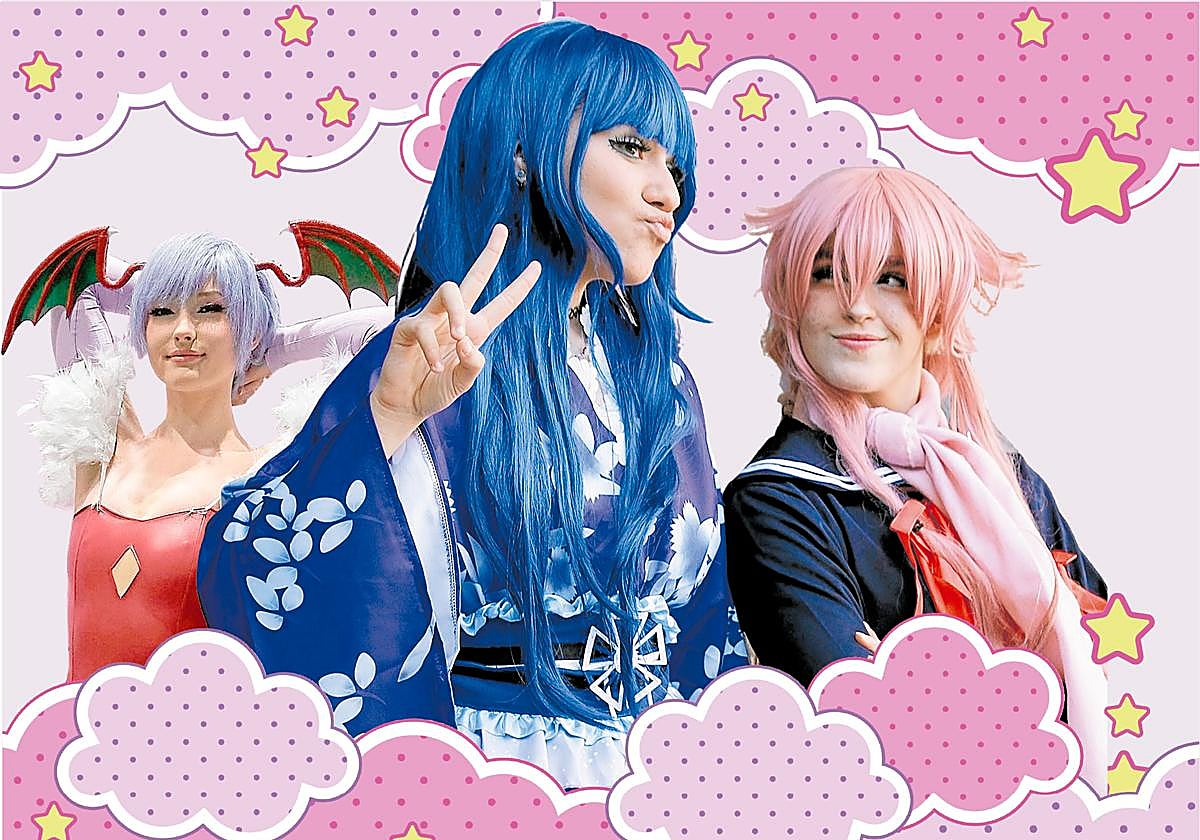
The next stop is Comic Stores Málaga Soho, located on Trinidad Grund Street. There, Alberto González has been working since 2020, although as a dedicated otaku (a term used to refer to a manga and anime fan), he was previously a regular customer. "I have been immersed in this universe since I was very young, since elementary school," says González, who at 29 years old has seen how consumers of Japanese culture no longer fit the stereotype of the 'nerdy' introvert. "Nowadays, I would say it is equally popular among men and women, from the shy to the most extroverted." And he gives a very illustrative example: "I have worked simultaneously at Comic Stores and at an armory. And I had customers who were from both stores." What products can we find? "There are many things, from mugs, merchandising of many types, also kawaii culture is very linked to everything that is 'cosplay'," explains González about the fashion of dressing up as characters, "crafts are also very associated, we sell something called 'hamasbeads' that are used to make art, like pixel art." Asked about Hello Kitty, he highlights that "it has now moved down to the second division". Only within the world of Hello Kitty does he highlight Kuromi, MyMelody, or Cinnamonroll, "these characters surpass it by a lot." And outside of that world? "One that is always present, for example, is Hatsune Miku. She doesn't come from any series, nor any anime, nor any manga. She is a voice synthesizer that has been used since the mid-2000s to make songs in Japanese. She has achieved tremendous popularity, to the point that she organizes world tours every year where obviously a hologram sings." If the name of this virtual singer doesn't ring a bell, know that this green-haired, huge-eyed, adorable-faced teenager has over four million subscribers on her official YouTube channel and three and a half million monthly listeners on Spotify. González confirms: "We sell a lot of figures, mugs, fans, of this character every month."
González reveals the meeting places for kawaii and otaku fans in Malaga: the Marina Park, the skate areas, and the Palace of Fairs and Congresses. "Kawaii is very linked with the whole K-pop theme, even though it's Korean. And they usually meet there because of the large glass windows they have. They work as mirrors to practice choreography." The definitive combination between kawaii aesthetics and K-pop music occurred in 2025 with the Netflix movie 'K-pop Warriors', which is now the most-watched animated film on the platform and has received two nominations for the upcoming Oscars: for best animated film and best original song.
And there are also Manga Conventions, where there are activities, guests, and cosplay contests. The company Eventos Go! specializes in organizing them. They started twelve years ago in Alhaurín de la Torre and now, just in the province of Malaga, they have expanded to Estepona, Rincón de la Victoria, Antequera, Ronda, San Pedro Alcántara, Marbella, Alhaurín el Grande, Coín, Vélez-Málaga, and Torrox. Each one lasts a weekend, and its director, Daniel Ferrer, assures that they can gather up to 3,000 people. At the time of the conversation, Ferrer is finishing the preparations for the tenth edition of 'EsteponGo!', where the entrance fee is four euros. "Some are free because the city council covers all expenses and others, like in Estepona, we charge an entrance fee." Regarding the representation of the kawaii world, Ferrer highlights the pull that Sin-Chan still has, "it's an old character but very kawaii because it's very 'cute'" but "what is very popular is K-pop, to Estepona come 50 groups, we give about 500 euros in prizes."

Latest news





Upcoming events
12
Nov
El Desembarco, la traición de Viriato at La Caja Blanca
12
Nov
HOMER El Mero Mero at Sala Trinchera Málaga
13
Nov
Marbella Startup Lab – Innovate & Collaborate
13
Nov
Candlelight: Coldplay & Imagine Dragons at Sala Fundación Unicaja María Cristina
13
Nov
Candlelight: Tribute to Ludovico Einaudi at Anantara Villa Padierna
Similar News

Málaga Airport Makes History with More Than Three Million Passengers in One Month
Málaga

Port of Málaga looks beyond its docks to support future growth
Málaga

Guide to the Virgen del Carmen Processions in Málaga and the Province
Málaga
